
Table of Contents
- What Is OTA Testing?
- Why Anechoic Chambers Are Used
- How OTA Testing Works
- Applications of OTA Testing
As wireless devices become more compact and complex, validating real-world antenna and radio performance is
more important than ever. That is where OTA testing in anechoic
chambers comes in. Over-the-air (OTA) testing measures how a device transmits and
receives wireless signals without relying only on direct cable connections.
An anechoic chamber creates a controlled RF environment by absorbing reflections and blocking outside
interference. This allows engineers to evaluate the actual performance of smartphones, IoT devices,
wearables, automotive modules, routers, and other connected products with high accuracy.
What Is OTA Testing?
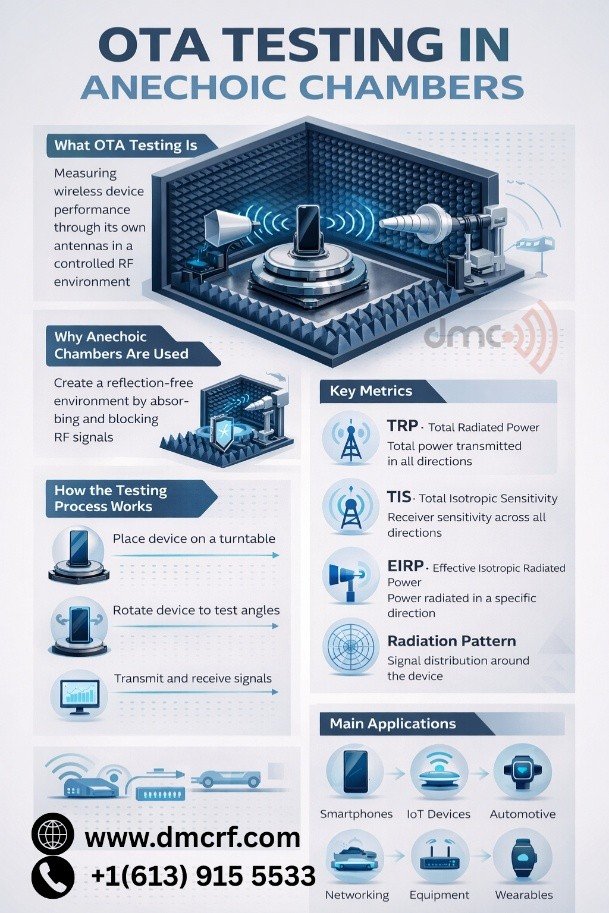
OTA testing is the process of measuring the wireless performance of a device as it operates through its
own antennas. Instead of testing only the radio chipset through a cable, OTA testing captures the
combined effect of the antenna, enclosure, materials, and device design.
This is critical because a product may perform well at the component level but still show weak
real-world signal performance if the antenna placement or housing affects radiation efficiency.
Why Anechoic Chambers Are Used
Anechoic chambers are designed to simulate free-space conditions. Their RF-absorbing walls reduce signal
reflections that could distort measurement results. In addition, the shielded structure prevents
external RF noise from influencing the test.
This setup helps engineers:
- measure true antenna patterns
- evaluate radiated power and sensitivity
- compare device orientations consistently
- support certification and compliance testing
Key OTA Metrics
The most common OTA measurements focus on how effectively a device sends and receives signals.
| Metric | Full Form | What It Measures | Why It Matters |
|---|---|---|---|
| TRP | Total Radiated Power | Total transmitted power in all directions | Indicates transmit performance |
| TIS | Total Isotropic Sensitivity | Receiver sensitivity across all directions | Shows receive quality |
| EIRP | Effective Isotropic Radiated Power | Power radiated in a specific direction | Useful for directional analysis |
| Radiation Pattern | — | Signal distribution around the device | Reveals antenna strengths and nulls |
These metrics give a clearer picture of actual wireless behavior than conducted testing alone.
How OTA Testing Works
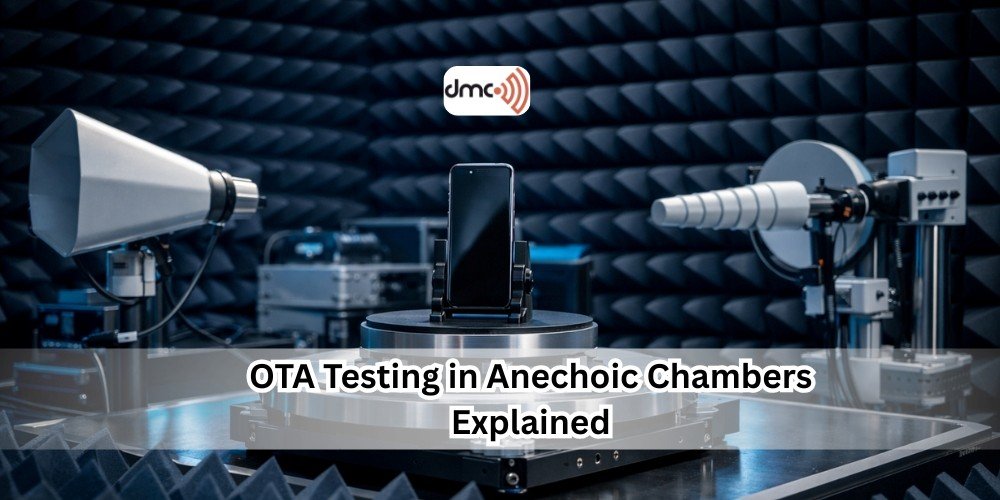
The device under test is placed on a positioner inside the anechoic chamber. A measurement antenna
communicates with the device while the system rotates the product across multiple axes. Test software
captures signal behavior from many angles and frequencies.
A typical OTA test process includes:
- placing the device in the chamber
- connecting control and power interfaces
- calibrating the measurement setup
- rotating the device through test positions
- recording transmit and receive results
- analyzing TRP, TIS, and radiation patterns
Because orientation affects antenna performance, this multi-angle approach is essential.
Applications of OTA Testing
OTA chamber testing is widely used across industries:
- Consumer electronics: smartphones, tablets, smartwatches, earbuds
- IoT devices: sensors, trackers, gateways, industrial monitors
- Automotive: telematics units, V2X modules, connected infotainment
- Networking equipment: routers, access points, CPE devices
- Medical and wearables: connected health devices requiring stable wireless links
It is especially important for products using 4G, 5G, Wi-Fi, Bluetooth, GNSS, and NB-IoT technologies.
Benefits of OTA Testing in Anechoic Chambers
One major advantage of OTA testing is that it reflects how the full device performs, not just isolated
RF components. This helps teams detect hidden issues earlier in development.
Key benefits include:
- improved antenna design validation
- better correlation with real-world performance
- reduced risk of certification failure
- more reliable product benchmarking
- faster root-cause analysis during design optimization
Challenges to Consider
While OTA testing is highly effective, it can also be complex. Chamber size, frequency range,
positioning accuracy, and test methodology all influence the quality of results. For advanced products
such as 5G beamforming devices, the test setup becomes even more demanding.
Manufacturers must also account for factors like user-hand effects, multiple antennas, and integration
with compact industrial designs.
Pro Tip
Perform OTA testing early in the product development cycle, not just before certification. Early chamber
validation can uncover antenna detuning, enclosure-related losses, and placement issues before they
become costly redesigns.
OTA testing in anechoic chambers is a critical step in modern wireless product development. It provides
a realistic view of radiated device performance in a controlled environment, helping manufacturers
improve connectivity, meet certification requirements, and deliver a better user experience.
As wireless technologies continue to evolve, OTA testing will remain essential for ensuring that
connected devices perform reliably in the real world.
Frequently Asked Questions
1. What is OTA testing in anechoic chambers?
OTA testing measures the wireless performance of a device through its own antennas inside a controlled
chamber that absorbs RF reflections and blocks external interference.
2. Why is OTA testing important?
It shows how the complete device performs in real conditions, including the effects of antenna design,
housing materials, and device orientation.
3. What do TRP and TIS mean?
TRP stands for Total Radiated Power and measures transmit performance. TIS stands for Total Isotropic
Sensitivity and measures receive performance.
4. Which products need OTA testing?
Smartphones, IoT devices, routers, wearables, automotive modules, and any wireless product with embedded
antennas can benefit from OTA testing.
5. How is OTA testing different from conducted RF testing?
Conducted testing measures radio performance through direct cable connections, while OTA testing
evaluates the full radiated performance of the complete device.