
Table of Contents
- What Are RF Chambers?
- Why RF Chambers Matter for Modern Wireless Devices
- Key Applications of RF Chambers
- Design Features That Enhance RF Chamber Performance
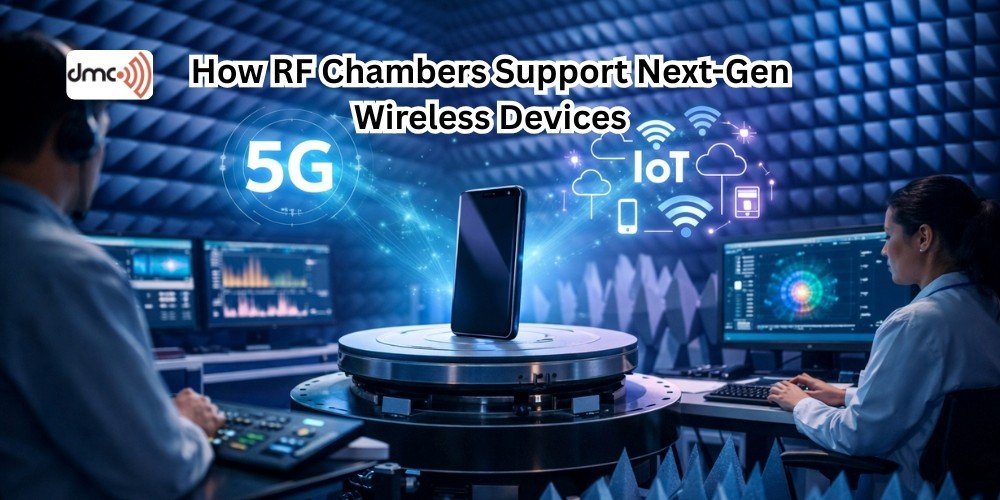
RF chambers (radio frequency shielded anechoic chambers) support next-gen wireless devices by providing a highly controlled, interference-free environment essential for testing complex technologies like 5G, 6G, and IoT. They enable engineers to accurately measure device performance by eliminating external noise and preventing signal reflections, simulating “free-space” conditions.
RF (radio frequency) chambers provide controlled environments where engineers can test wireless devices without interference from external signals. As the wireless ecosystem grows more complex, these chambers have become indispensable in the development, validation, and certification of next-generation devices.
What Are RF Chambers?
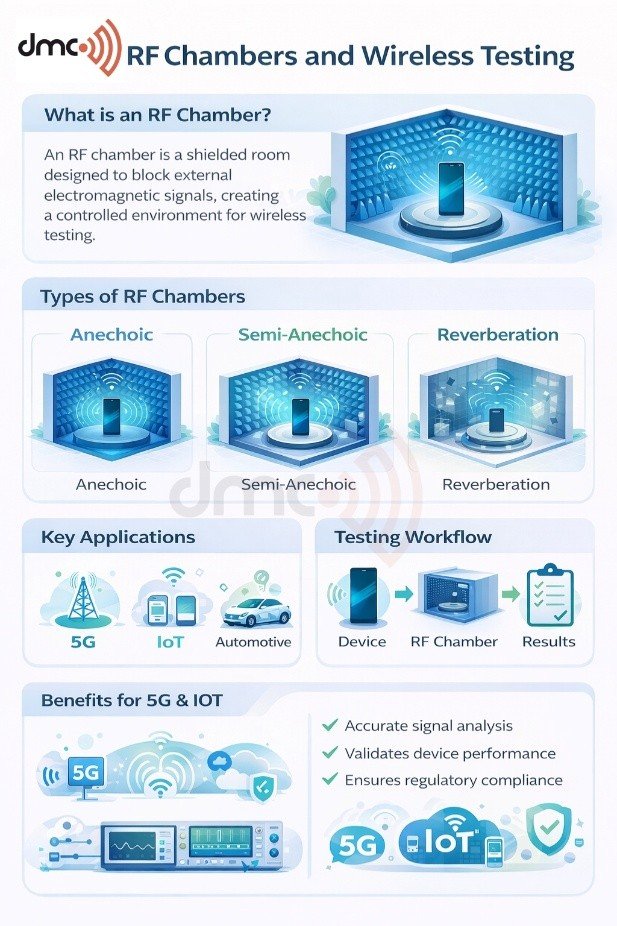
RF chambers are specialized enclosures designed to block external electromagnetic signals and absorb internal reflections. They simulate a “free-space” environment, allowing accurate measurement of wireless device performance.
There are several types of RF chambers, including:
- Anechoic chambers – eliminate reflections using absorbing materials
- Semi-anechoic chambers – partially reflective, used for EMC testing
- Reverberation chambers – create multipath environments
- Shielded enclosures – block external interference
Each type serves a specific purpose depending on the testing requirements.
Why RF Chambers Matter for Modern Wireless Devices
Next-generation wireless devices operate across multiple frequencies, protocols, and environments. Testing them in uncontrolled conditions can lead to inaccurate results.
RF chambers address key challenges:
1. Eliminating Interference
External RF signals—from cell towers, Wi-Fi routers, and other devices—can distort test results. RF chambers isolate devices completely, ensuring precise measurements.
2. Ensuring Regulatory Compliance
Wireless devices must meet strict global standards (FCC, CE, etc.). RF chambers enable compliance testing for electromagnetic compatibility (EMC) and emissions.
3. Supporting Complex Technologies
Technologies like 5G use advanced features such as beamforming and millimeter-wave frequencies. RF chambers provide the controlled environment needed to evaluate these behaviors.
4. Improving Product Reliability
By simulating real-world conditions, engineers can identify performance issues early, reducing costly redesigns later.
Key Applications of RF Chambers
RF chambers are used across a wide range of industries and applications:
| Application | Purpose | Example Devices |
|---|---|---|
| OTA Testing | Measures over-the-air performance | Smartphones, wearables |
| EMC Testing | Ensures devices don’t interfere with others | Consumer electronics |
| 5G & mmWave Testing | Validates high-frequency performance | 5G routers, base stations |
| IoT Device Testing | Verifies connectivity and reliability | Smart home devices, sensors |
| Automotive Testing | Tests radar and V2X communication | Autonomous vehicles |
RF Chambers and 5G Innovation
5G technology introduces new challenges due to:
- Higher frequency bands (mmWave)
- Beamforming and MIMO (Multiple Input Multiple Output)
- Dense device ecosystems
RF chambers enable engineers to test these features with precision. For example, beamforming requires directional testing, which is only possible in a controlled RF environment.
Without RF chambers, validating 5G performance would be nearly impossible due to environmental noise and signal complexity.
RF Chambers and IoT
From industrial sensors to smart thermostats, the Internet of Things (IoT) links billions of objects.
RF chambers help by:
- Testing coexistence with other wireless technologies
- Ensuring consistent connectivity
- Evaluating battery efficiency under RF load
As IoT ecosystems grow, RF testing becomes even more critical to prevent network congestion and device failures.
Design Features That Enhance RF Chamber Performance
Modern RF chambers incorporate advanced features to meet evolving testing needs:
- High-performance absorbers – minimize signal reflections
- Precision positioning systems – enable accurate antenna measurements
- Wide frequency coverage – from MHz to GHz and beyond
- Automation capabilities – improve testing efficiency
These innovations allow engineers to test increasingly complex devices with greater accuracy.
Challenges in RF Testing
Despite their advantages, RF chambers come with certain challenges:
1. Cost and Infrastructure
High-quality RF chambers require significant investment and space.
2. Calibration and Maintenance
Regular calibration is essential to maintain accuracy.
3. Evolving Standards
As wireless technologies evolve, testing requirements change, requiring continuous upgrades.
However, these challenges are outweighed by the benefits of accurate, reliable testing.
Future of RF Chambers
The future of RF chambers is closely tied to advancements in wireless technology. Key trends include:
- 6G development – requiring even higher frequency testing
- AI-driven testing automation – improving efficiency and accuracy
- Compact chambers – enabling testing in smaller labs
- Digital twin simulations – combining physical and virtual testing
As wireless innovation accelerates, RF chambers will continue to play a central role in ensuring performance and compliance.
Pro Tip
Invest in Scalable RF Chamber Solutions
As wireless standards evolve rapidly (5G → 6G → beyond), choosing a modular and upgradeable RF chamber can save significant costs and future-proof your testing infrastructure.
RF chamber relocation servicesare available to help you move your testing infrastructure with minimal disruption.
From enabling 5G breakthroughs to ensuring IoT reliability, RF chambers support every stage of innovation. As we move toward a hyper-connected world, their importance will only continue to grow.
Frequently Asked Questions