
Table of Contents
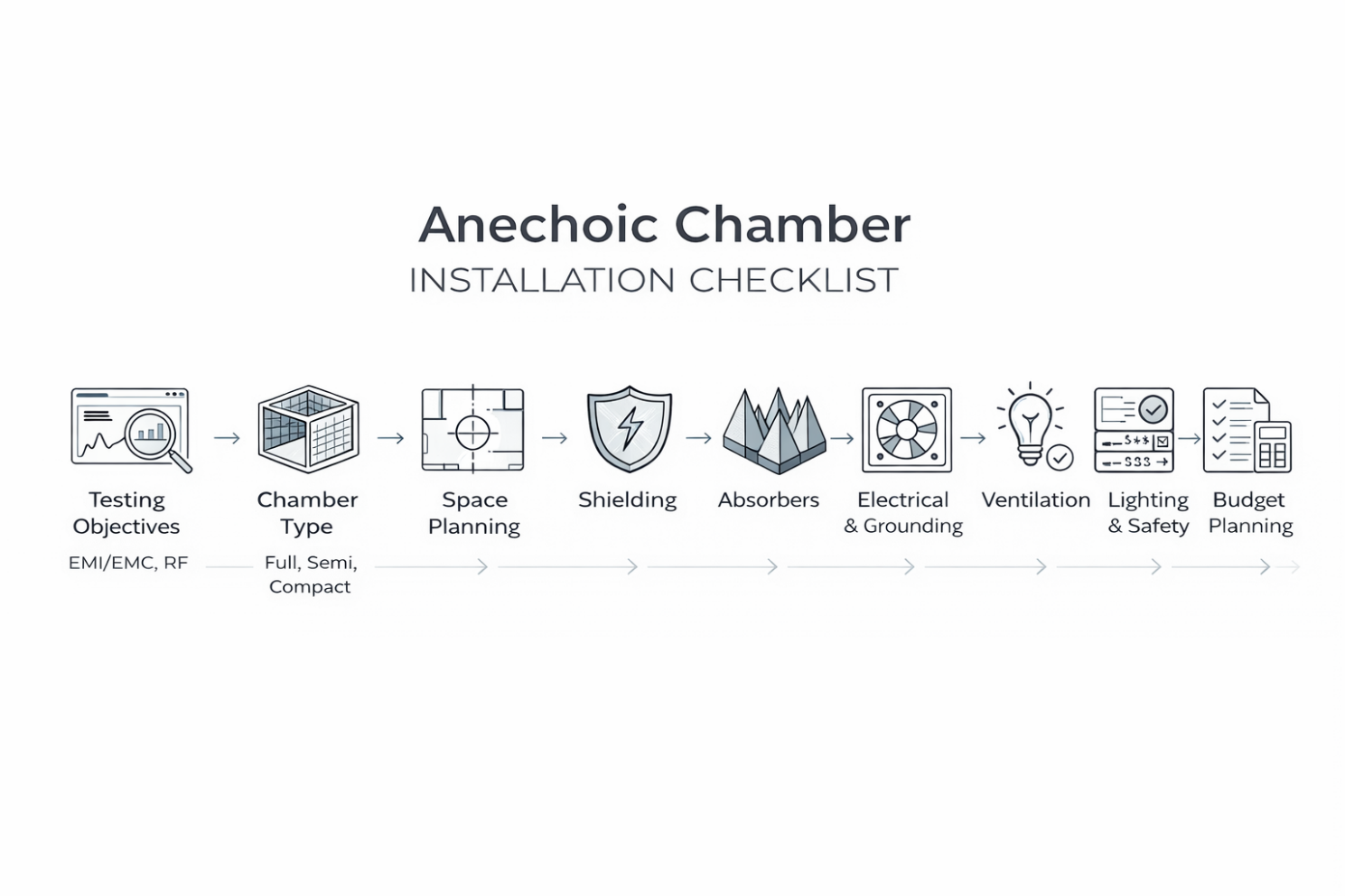
- 1. Define Testing Objectives Clearly
- 2. Select the Appropriate Chamber Type
- 3. Space and Layout Planning
- 4. Shielding Effectiveness
- 5. Absorber Selection
- 6. Electrical and Grounding System
- 7. Ventilation and Temperature Control
- 8. Lighting and Safety Features
- 9. Compliance with Industry Standards
- 10. Equipment Planning and Layout
- 11. Vendor Selection and Installation Support
- 12. Budget Planning
Installing an anechoic chamber is a significant investment for organizations involved in EMI/EMC testing, RF measurements, antenna validation,and product compliance. Whether you are setting up a new testing lab or upgrading an existing one, careful planning is essential to ensure accuracy, efficiency, and long-term performance.
A poorly designed or improperly installed chamber can result in unreliable test results, compliance failures,
and costly modifications. That’s why having a structured checklist before installation is crucial.
In this guide, we provide a complete checklist covering all technical, environmental, and operational aspects
you must consider before installing an anechoic chamber.
1. Define Testing Objectives Clearly
The first step is to clearly identify the purpose of your anechoic chamber.
Ask these key questions:
- Will the chamber be used for EMI/EMC testing, RF testing, or both?
- What frequency range will your testing cover?
- Which industry standards must you comply with?
Your answers will directly influence:
- Chamber design
- Absorber type
- Size and layout
For example, EMC testing for automotive applications requires larger chambers compared to compact RF
testing setups used in electronics labs.
2. Select the Appropriate Chamber Type
Choosing the right anechoic chamber type is one of the most critical decisions in your installation
process. The chamber you select directly impacts test accuracy, compliance capability, space
utilization, and overall project cost. A mismatch between your testing needs and chamber type can lead
to inaccurate results or unnecessary investment.
Common Types:
- Full Anechoic Chamber – Ideal for antenna and RF measurements
- Semi Anechoic Chamber – Commonly used for EMC testing
- Compact Anechoic Chamber – Suitable for limited space and specific RF tests
Each type varies in:
- Cost
- Space requirements
- Performance capabilities
Selecting the wrong type can lead to inaccurate results or unnecessary expenses.
3. Space and Layout Planning
Anechoic chambers require dedicated space with proper planning.
Consider:
- Room dimensions (including absorber thickness)
- Ceiling height
- Equipment placement
- Operator movement space
Best Practice:
Always allocate 20–30% extra space for:
- Future expansion
- Cable routing
- Maintenance access
Ignoring space planning can limit scalability and operational efficiency.
4. Shielding Effectiveness
Shielding is one of the most critical components of an anechoic chamber.
Key Requirements:
- High RF attenuation (typically 80–120 dB)
- Leak-proof construction
- Proper sealing at joints and doors
Important Elements:
- RF shielded doors with proper gaskets
- Honeycomb ventilation panels
- Filtered cable entry points
Without proper shielding, external interference can compromise test accuracy.
5. Absorber Selection
Absorbers are the core component of any anechoic chamber. Their primary function is to eliminate electromagnetic reflections and create a controlled environment that closely simulates free-space conditions. Without proper absorber selection, even a well-designed chamber can produce inaccurate and unreliable test results.
Choosing the right absorber is not just a technical decision—it directly affects measurement
accuracy,
compliance performance, and long-term durability of your testing facility.
Types of Absorbers:
- Pyramidal absorbers – High-frequency performance
- Ferrite tiles – Effective for low frequencies
- Hybrid absorbers – Broadband performance
Selection Factors:
- Frequency range
- Fire resistance
- Durability
- Maintenance requirements
Choosing the wrong absorber can significantly impact test results.
6. Electrical and Grounding System
A proper electrical setup ensures safety and measurement accuracy.
Grounding Checklist:
- Dedicated grounding system
- Low resistance earth connection
- Isolation from building grounding (if required)
Electrical Setup:
- Stable power supply
- Filtered AC lines
- Backup systems (UPS or generator)
Improper grounding can introduce noise and affect test reliability.
7. Ventilation and Temperature Control
Anechoic chambers are enclosed environments, making ventilation essential.
Ensure:
- RF-shielded ventilation systems
- Proper airflow design
- Temperature control systems
Why It Matters:
- Prevents equipment overheating
- Maintains measurement accuracy
- Extends absorber lifespan
Poor ventilation can lead to performance issues and equipment damage.
8. Lighting and Safety Features
Lighting inside the chamber must be carefully designed to avoid interference.
Lighting Requirements:
- Non-reflective fixtures
- RF-shielded lighting
- Uniform illumination
Safety Measures:
- Emergency exits
- Fire suppression systems
- Alarm systems
Safety should always be a priority in enclosed testing environments.
9. Compliance with Industry Standards
Your anechoic chamber must meet industry standards for accurate and reliable testing.
Common Standards:
- CISPR 16
- ISO 11452
- MIL-STD-461
- IEC standards
Ensure:
- Pre-compliance verification
- Certification from authorized bodies
Compliance ensures your test results are globally accepted.
10. Equipment Planning and Layout
Efficient layout design improves workflow and testing accuracy.
Include:
- Turntables
- Antenna masts
- Measurement instruments
Layout Tips:
- Maintain proper test distances
- Organize cables efficiently
- Ensure repeatability of measurements
A well-planned layout enhances productivity and minimizes errors.
11. Vendor Selection and Installation Support
Choosing the right vendor is crucial for a successful installation.
Evaluate Vendors Based On:
- Industry experience
- Previous projects
- Technical expertise
- After-sales support
Ask:
- Do they offer turnkey solutions?
- Do they provide calibration and validation services?
A reliable vendor ensures smooth installation and long-term support.
12. Budget Planning
Anechoic chamber installation involves multiple cost components.
Cost Breakdown:
- Chamber construction
- Absorbers
- Shielding materials
- Installation services
- Testing equipment
Additional Costs:
- Maintenance
- Upgrades
- Calibration
Planning your budget properly helps avoid unexpected expenses.
| Category | Key Considerations | Status |
|---|---|---|
| Testing Objectives | EMI/EMC or RF, frequency range | ☐ |
| Chamber Type | Full / Semi / Compact | ☐ |
| Space Planning | Room size, expansion | ☐ |
| Shielding | RF attenuation, sealing | ☐ |
| Absorbers | Type, performance | ☐ |
| Grounding | Dedicated system | ☐ |
| Electrical Setup | Filtered power, backup | ☐ |
| Ventilation | RF-shielded airflow | ☐ |
| Lighting & Safety | Emergency systems | ☐ |
| Compliance | CISPR, ISO, MIL standards | ☐ |
| Equipment Layout | Turntables, antennas | ☐ |
| Vendor Selection | Experience, support | ☐ |
| Budget | Total cost + maintenance | ☐ |
Pro Tip
Always conduct a pre-installation site survey and RF simulation.
This helps you:
- Predict chamber performance
- Optimize absorber placement
- Identify potential interference issues
- Reduce costly redesigns
A proper simulation can save both time and money while ensuring optimal results.
Common Mistakes to Avoid
- Ignoring future expansion needs
- Selecting incorrect absorber types
- Poor grounding setup
- Inadequate ventilation planning
- Skipping compliance checks
Avoiding these mistakes ensures long-term reliability and performance.
Installing an anechoic chamber is not just about building a controlled environment—it’s about ensuring
precision, compliance, and efficiency in testing.
By following this complete checklist, you can:
- Improve measurement accuracy
- Ensure compliance with global standards
- Optimize operational efficiency
- Reduce long-term costs
Careful planning today ensures reliable and accurate testing for years to come.
Frequently Asked Questions
1. What is an anechoic chamber used for?
It is used for EMI/EMC testing, RF measurements, and antenna performance evaluation.
2. How much does an anechoic chamber cost?
Costs vary widely depending on size, type, and features, ranging from thousands to millions of dollars.
3. Which chamber type is best for EMC testing?
A semi-anechoic chamber is typically used for EMC compliance testing..
4. Why is shielding important in an anechoic chamber?
Shielding prevents external electromagnetic interference, ensuring accurate test results.
5. How long does installation take?
Installation can take several weeks to months depending on complexity and customization.