
Table of Contents
- What is an Anechoic Chamber?
- Why Choosing the Right Chamber Matters
- Types of Anechoic Chambers
- Key Factors to Consider
In today’s fast-evolving technology landscape, ensuring electromagnetic compatibility (EMC), radio frequency (RF) performance, and antenna accuracy is critical. Whether you’re working in automotive, aerospace, telecommunications, or IoT, selecting the right anechoic chamber is a crucial investment for your lab.
However, choosing the ideal chamber isn’t just about budget—it involves understanding your testing
requirements, compliance standards, and long-term scalability.
This guide will help you make an informed decision.
What is an Anechoic Chamber?
An anechoic chamber is a specially designed room that absorbs reflections of electromagnetic
waves. It simulates a free-space environment, allowing accurate measurement of RF signals, emissions,
and immunity.
These chambers are widely used for:
- EMI/EMC testing
- Antenna measurement
- Wireless device validation
- Radar and satellite testing
Why Choosing the Right Chamber Matters
Choosing the right anechoic chamber is critical for accurate EMI/EMC testing and reliable
RF performance. The wrong chamber can lead to inaccurate results, compliance failures, and
increased costs. A well-designed EMC testing chamber ensures precise data, faster certification,
and long-term ROI while meeting industry standards.
Selecting the wrong chamber can lead to:
- Inaccurate test results
- Compliance failures
- Increased operational costs
- Retesting delays
A properly selected chamber ensures:
- Reliable data
- Faster certification
- Long-term ROI
Types of Anechoic Chambers
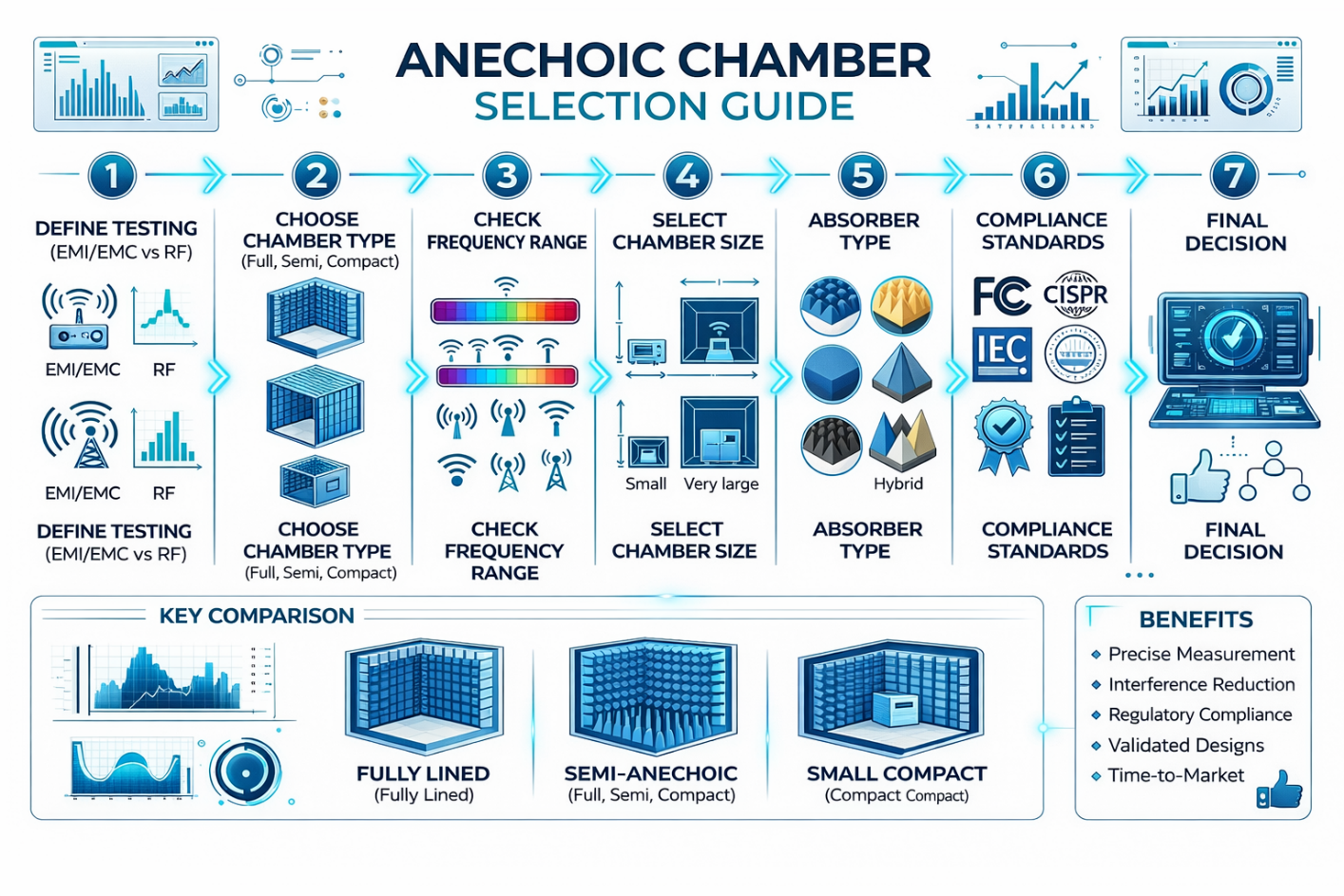
Understanding anechoic chamber typesis key to selecting the right setup for EMI/EMC and RF testing. A Full Anechoic Chamber offers maximum accuracy for antenna testing, while a Semi Anechoic Chamber is ideal for EMC compliance. A Compact Range Chamber provides space-efficient RF testing with far-field simulation.
Understanding the types is the first step in making the right choice.
1. Full Anechoic Chamber (FAC)
- Absorbers on walls, ceiling, and floor
- Ideal for antenna and precision RF testing
- Highest accuracy
2. Semi Anechoic Chamber (SAC)
- Reflective ground plane
- Common for EMC testing
- Cost-effective
3. Compact Range Chamber (CRC)
- Uses reflectors for far-field simulation
- Space-saving design
Comparison Table
| Feature | Full Anechoic Chamber | Semi Anechoic Chamber | Compact Range |
|---|---|---|---|
| Floor Type | Absorber | Reflective | Reflective |
| Accuracy Level | Very High | High | Medium |
| Cost | Expensive | Moderate | Moderate |
| Application | Antenna Testing | EMC Testing | Radar Testing |
| Space Requirement | Large | Medium | Compact |
Key Factors to Consider
Selecting the right anechoic chamber depends on key factors like testing requirements, frequency range, chamber size, and absorber type. For EMI EMC testing, semi anechoic chambers are ideal, while RF testing needs full chambers. Ensure compliance with standards like CISPR and high shielding effectiveness for accurate results and better ROI.
1. Testing Requirements
Define your primary use:
- EMI/EMC → Semi Anechoic Chamber
- RF/Antenna → Full Anechoic Chamber
Always align chamber type with your core application.
2. Frequency Range
Different tests require different frequency capabilities:
- Low frequency → Larger absorbers
- High frequency → Smaller absorbers
Ensure the chamber supports your required frequency spectrum.
3. Chamber Size
Size depends on:
- Equipment under test (EUT)
- Measurement distance
- Testing standards
Tip: Larger chambers provide flexibility but increase cost.
4. Absorber Type
Common absorber types:
- Pyramidal absorbers (high performance)
- Ferrite tiles (low frequency efficiency)
- Hybrid absorbers (best of both worlds)
Choose based on frequency and accuracy needs.
5. Compliance Standards
Ensure your chamber meets global standards:
- CISPR
- ISO
- IEC
- MIL-STD
Compliance ensures acceptance of test results worldwide.
6. Shielding Effectiveness
A high-quality chamber must:
- Prevent external interference
- Maintain internal signal integrity
Look for shielding effectiveness above 100 dB.
7. Budget vs ROI
Cost factors include:
- Construction
- Maintenance
- Calibration
Don’t just focus on upfront cost—consider long-term value.
Pro Tip
Future-proof your chamber investment
Always choose a chamber that supports slightly higher frequency ranges and larger EUT sizes than your
current needs. This avoids costly upgrades as your testing requirements evolve.
Common Mistakes to Avoid
Avoid common mistakes when selecting an anechoic chamber for your lab. Focusing only on cost, ignoring EMC compliance standards, or underestimating space can impact EMI/EMC testing accuracy. Choosing the wrong absorber type and not planning for future expansion can lead to higher costs and unreliable RF testing results.
- Choosing based only on cost
- Ignoring compliance standards
- Underestimating space requirements
- Selecting the wrong absorber type
- Not planning for future expansion
Use Case Examples
Automotive Industry
- EMI/EMC testing for EVs
- Semi anechoic chambers are widely used
Telecom Industry
- Antenna and 5G testing
- Full anechoic chambers preferred
Aerospace
- Radar and defense systems
- Compact range chambers
Benefits of the Right Choice
Choosing the right anechoic chamber ensures accurate and repeatable EMI/EMC testing results, faster certification, and reduced errors. It enhances RF performance validation, improves product reliability, and builds strong client trust while supporting compliance with global testing standards.
- Accurate and repeatable results
- Faster certification process
- Reduced testing errors
- Improved product reliability
- Better client trust
Frequently Asked Questions
1. What is the difference between full and semi anechoic chambers?
Full chambers absorb all reflections, while semi chambers have a reflective floor and are mainly used for
EMC testing.
2. How much does an anechoic chamber cost?
Costs vary widely from $50,000 to over $1 million depending on size, type, and performance.
3. Which chamber is best for EMC testing?
A semi anechoic chamber is typically best for EMC compliance testing..
4. What frequency range should I consider?
It depends on your application, but most labs require support from MHz to GHz ranges.
5. Can I upgrade an existing chamber?
Yes, but upgrades can be expensive. It’s better to plan for future needs initially.