
Table of Contents
- Importance of Robotic Positioners in Antenna Measurement
- How Robotic Positioners Work
- Applications of Robotic Positioners
- Key Features of the Modern Advanced Robotic Positioners
With the advancements in wireless communication technology, the need for accurate testing of antennas through reliable antenna test equipment solutions has been realized. The Role of Robotic Positioners in Antenna Measurement in RF Testing has become crucial since they can perform very precise positioning and automatic testing processes of antennas. The telecom industry, aerospace industry, the defense sector, the automotive radar industry, and the satellite communication industries depend highly on modern robotic positioners for their efficient antenna testing operations.
Today’s modern antennas used in 5G/6G/7G devices, Internet of Things (IoT) devices, Automotive Radars, and Wireless Communication Devices demand effective performance evaluations. In this case, manual positioning techniques have been considered to be very tedious and prone to introducing alignment issues when testing. Hence, many industries are employing robot-based antenna testing methods for more efficiency and effectiveness.
Importance of Robotic Positioners in Antenna Measurement
However, even minor positioning inaccuracies may result in errors when measuring the radiation patterns, gain, beam forming performance, and antenna polarization characteristics in advanced measurement systems. The reason behind such problems has been overcome in robotic positioners that provide smooth antenna movements when conducting RF tests.
Robotic antenna positioners allow performing automatic scans and aligning the antennas within an anechoic chamber testing facility. Since RF test automation does not require operator intervention, robotic test systems prove to be highly efficient and beneficial in industrial and research settings.
Accuracy in positioning becomes particularly critical when it comes to the testing of high-frequency antennas operating in microwave or millimeter-wave frequency bands, as misalignment would lead to inaccurate results.
How Robotic Positioners Work
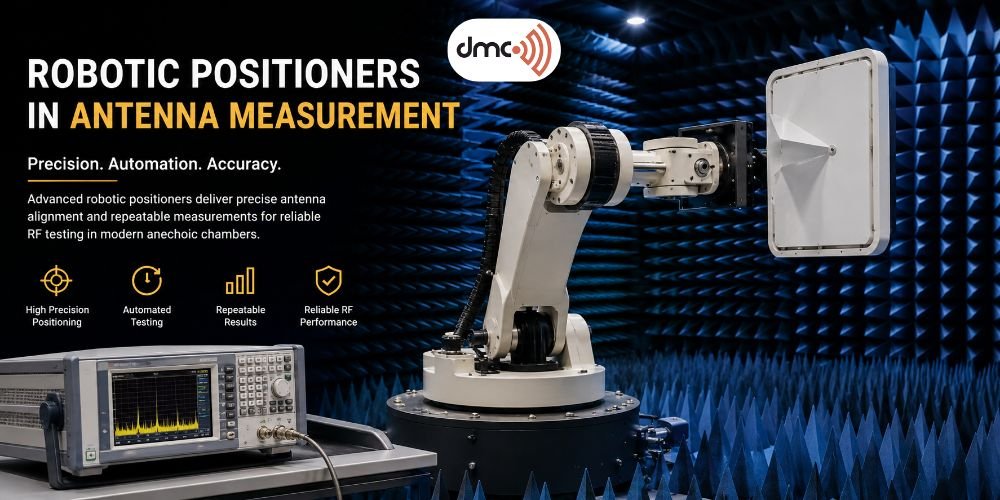
Antenna Positioning in Robotic Positioners for Antenna Measurement incorporates sophisticated motion control technology to turn and position antennas over several axis points. The technology is connected with RF analyzers, chamber controllers, and other software automation tools to conduct synchronous testing operations.
The robotic arm controls the orientation of the antenna through the manipulation of its azimuth, elevation, tilt, and rotation. During the process of testing the antenna, it will move the antenna into different orientations while measuring devices record RF performance.
Key Capabilities of Modern Robotic Positioners:
- Motion along multi-axes
- Automated scanning
- High accuracy positioning
- Radio remote control
- Synchronous data collection
- Programmable motion control
- Repetitive test sequences
These functionalities make robotic positioners the perfect candidate for OTA antenna tests.
Benefits of Robotic Antenna Testing
Accuracy Improvement
Accuracy improvement is one of the primary benefits associated with using an automated system for antenna testing. Robot systems minimize positioning mistakes that may be done by humans and provide precise alignment of antennas throughout the testing process.
Quick Measurement Processes
Positioning and aligning of an antenna manually take a lot of time. Automation of RF testing makes the measuring processes much quicker thanks to movement automation.
High Level of Repetitiveness
Repitition is important in RF testing. Automated robots perform the same sequence of testing operations each time.
Greater Efficiency
Robotic testing of antennas leads to greater efficiency in companies working with mass production and testing of antennas.
Precise Testing Results
With precision antenna positioning, it becomes easier to analyze radiation patterns, antenna gain, and other characteristics of antennas.
Applications of Robotic Positioners
Wireless Communication & 5G
Robotics is used in telecommunication to test the effectiveness of beamforming, MIMO system, and millimeter-wave communication devices.
Automotive Radar Test
Robots are utilized in the auto industry for testing the functionalities of radar sensors and automated driving systems using radio frequency chambers.
Defense and Aerospace Applications
Military radars, air traffic control technologies, and satellite antennas require highly precise measurement devices that can be further improved through robots.
Experimental Research Institutions
Robotics plays an important role in research facilities when conducting experimental RF tests and antenna development projects.
Internet of Things Testing
Testing of small-size IoT devices requires precise RF measurements and tests.
Role in Anechoic Chamber Testing
Robotic positioners can give precise and controlled motion for antennas in anechoic chambers due to the fact that these testing facilities ensure the absorption of radio waves reflections and prevent any form of electromagnetic interference.
The use of robotic systems and RF shielding is essential for performing the following tests:
- Radiation patterns test
- Gain tests
- Polarization tests
- Electromagnetic compatibility testing
- Over-The-Air performance tests
- Tests using Microwave Frequency Analysis
Key Features of the Modern Advanced Robotic Positioners
Precision Motion System
A robotic system uses highly precise motors and encoders to achieve accurate positioning while testing an antenna.
Multi-Axis Movement
Current robotic technology has made it possible to move across multiple axes to make sure that all parts of an antenna are tested.
Ability to Move Heavy Items
Robotic positioners have the ability to maneuver large antennas, radars, and communication tools.
Remote Control
Remote monitoring and control systems help increase the safety of operations and provide greater flexibility.
Future of Robotic Positioners in RF Testing
The future of Robotic Positioners for use in antenna measurements is associated with automation and AI-based RF technology applications.
Some possible future developments could be:
- Automation based on AI technology in antenna positioners
- Smart RF chamber automation
- Autonomous antenna measurement sy€stem development
- Real time adaptive motion control
- Advanced testing with millimeter-wave RF technology
- Analysis of RF data through cloud-based systems
Alongside the progress made in the communications field, the significance of robotic automation in the process of antenna testing cannot be ignored.
Robotic Positioning for Antenna Measurement plays crucial roles in modern-day Radio Frequency Testing Systems. Robotic positioning provides efficiency and automation that make them highly important in the process of increasing antenna measurement process efficiency.
Some of the applications of robotics are OTA testing, automotive radar testing, aerospace communication, and 5G technology, amongst others. Those companies willing to make an investment in good antenna measuring devices and automation technology will reap numerous benefits from their use.
Frequently Asked Questions
They are used to accurately move and align antennas during RF testing procedures.
It improves measurement accuracy, repeatability, and testing speed.
They are used in telecom, automotive radar, aerospace, defense, and research laboratories.
OTA testing evaluates antenna performance wirelessly in controlled RF environments.
They provide precise antenna positioning for reliable RF measurement results.