
Table of Contents
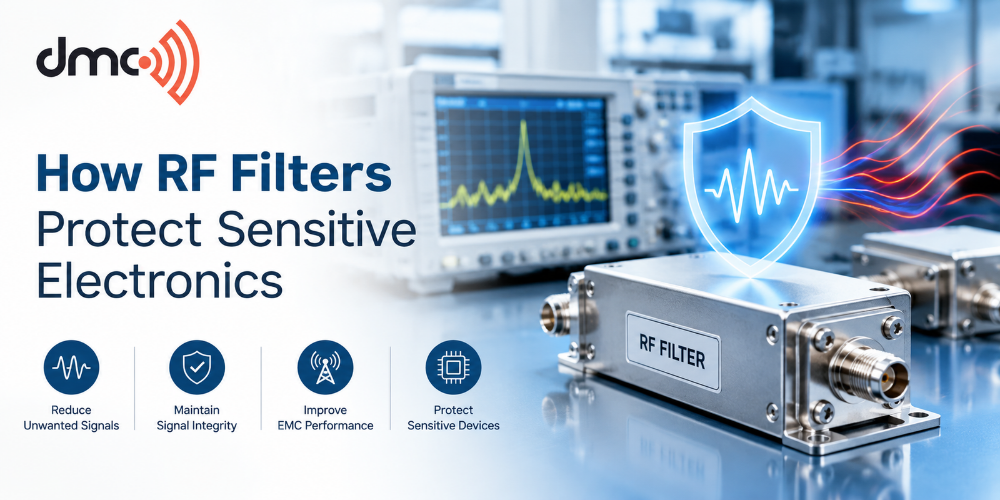
Electronic devices operate in an environment where there is always a potential risk of interference with RF frequencies. Such things as medical, communication, industrial control, laboratory devices, and wireless devices can be vulnerable to electromagnetic interference (EMI). RF filters are able to mitigate this issue through filtering of unwanted frequency components while allowing desired ones.
The company Diamond Microwave Chambers Ltd. acknowledges the necessity of control of the electromagnetic interference in tests and electronics. The choice of an appropriate filter might be useful for signal integrity, for electromagnetic compatibility (EMC), and for avoiding any problem related to the interference. But all these results will depend upon the filter design, installation, frequency of operation, and nature of the surrounding system.
What Are RF Filters?
Radio frequency filters are electronic devices or assemblies which allow passing of the signals within certain frequency intervals and block signals in other frequency intervals. Depending on their design, they might be used in signal channels, power channels, and communication devices.
Types of Filters Include:
Low Pass Filter: This passes low frequencies and attenuates frequencies above the required cut-off region.
High Pass Filter: This passes high frequencies and blocks low frequencies.
Band Pass Filter: It allows the selection of a certain frequency band to pass.
Band Stop Filter: It blocks certain frequencies and allows other frequencies to pass through.
The function of each filter is different, and its use is determined by the required frequencies and electrical requirements of the system.
How RF Filters Safeguard Sensitive Electronics
The RF filters safeguard electronic equipment by ensuring proper control of unwanted frequency components that may come through the signal lines, power lines, or any other circuit line. The ability of the RF filter to work will depend on its location as well as its specifications.
The benefits of the filter are:
- Minimization of unwanted signals: The RF filter can minimize the unwanted frequency components.
- Maintenance of signal quality: The correct filtering can assist in reducing unwanted frequency components.
- Enhancing EMC capability: Appropriate filters could help improve electromagnetic compatibility through appropriate shielding, grounding, and cabling practices.
- Facilitating measurement accuracy: Filters can help minimize interferences during measurement operations in laboratory settings when the right filter is used appropriately.
- Safeguarding system performance: Filtering interferences would help safeguard against malfunction caused by certain types of interference but not all types of electronic interferences.
The use of RF filters does not take the place of all other possible EMC solutions. Some of the other types of interference such as radiated interference, bad shielding, grounding issues, and conducted noise will still require further treatment.
Applications of RF Filters
These types of filters find applications in various industries that require proper functioning of electronics systems. The application depends on the design of the system and the electromagnetic environment.
The choice of filters must always take into account the operating parameters of the system and standards if any. The filter which is appropriate for a power circuit at low frequencies may not be suitable for an RF signal circuit.
Important parameters for the selection include:
Operating frequency: This involves the determination of the frequency band that has to be allowed to pass and those which need to be attenuated.
Attenuation: Observe the predicted attenuation at the right interference frequencies.
Impedance matching: You need to ensure that your filter matches the impedance of your source and load, respectively. The impedance in most cases is normally 50 ohms when dealing with radio frequencies.
Power handling capacity of the filter: You need to take into consideration the power handling capacity of your filter, particularly its voltage and current ratings.
Filter and cables layout: You need to take into consideration your cables and filter layout.
Environmental influences: You need to consider issues such as temperature, humidity, vibration, and all other environmental factors.
The filter data sheet is an essential source of information, but its performance may be affected by many more factors.
Quick Tip:
Pinpoint the source of interference first, before picking your filter. Decide whether interference comes from conducted signals in a power or signal cable, or if it is radiated through the air. Perform necessary measurements and consider the specification of your equipment before you choose the solution. Just picking a filter won’t help you eliminate interference due to poor shielding, grounding or cable routing.
The Importance of RF Filters in EMC Testing:
EMC testing checks the equipment performance in electromagnetic environment according to applicable requirements. RF filters could assist in preparing for the test or integrating a system.
Diamond Microwave Chambers Ltd. operates in the EMC testing environment, where controlling interference is one of the key factors. Based on the type of test that needs to be done, filters could be employed together with shielded chambers, anechoic chambers, appropriate grounding, and cable connection.
The proper answer can be defined based on the test requirement and the standard applicable. Filtering does not automatically mean EMC compliance; rather the entire equipment should undergo the test.
RF filters are an important device for controlling unwanted frequency signals and providing proper functioning of electronics. Through careful selection and placement of a particular filter, engineers can help alleviate some interference problems and ensure proper functioning of the signals and their EMC goals.
The company Diamond Microwave Chambers Ltd.understands that it is important to know about the application, frequency range, attenuation necessary, and installation conditions in the selection of RF filter. When RF filters are combined with proper shielding and grounding techniques, a more holistic approach to solving EMI problems becomes possible.
Frequently Asked Questions
RF filters control which frequency components pass through an electronic circuit. They help attenuate unwanted signals while allowing the required frequencies to pass according to the filter’s design.
They reduce specified unwanted frequency components that could interfere with electronic operation. Their effectiveness depends on the interference frequency, filter characteristics, installation, and system impedance.
RF filters are designed to control radio-frequency components. EMI filters specifically address electromagnetic interference and may operate across different frequency ranges, including RF frequencies. The terms can overlap depending on the application.
Consider the operating frequency, required attenuation, insertion loss, impedance, power handling, and installation environment. Measurements can help identify the interference source and guide filter selection.
No. RF filters can contribute to EMC performance, but compliance depends on the complete system, including shielding, grounding, cabling, circuit design, and applicable test requirements.