
Table of Contents
- What is Signal Integrity
- RF Filter Types and Applications
- Factors to Consider when Selecting RF Filters
The quality of the signal within an electronic system is a major determinant of its ability to communicate successfully. Noise and interference in form of signals from other devices and EMI could lead to poor functionality of systems requiring accurate measurement or data transmission. RF filters come into play here.
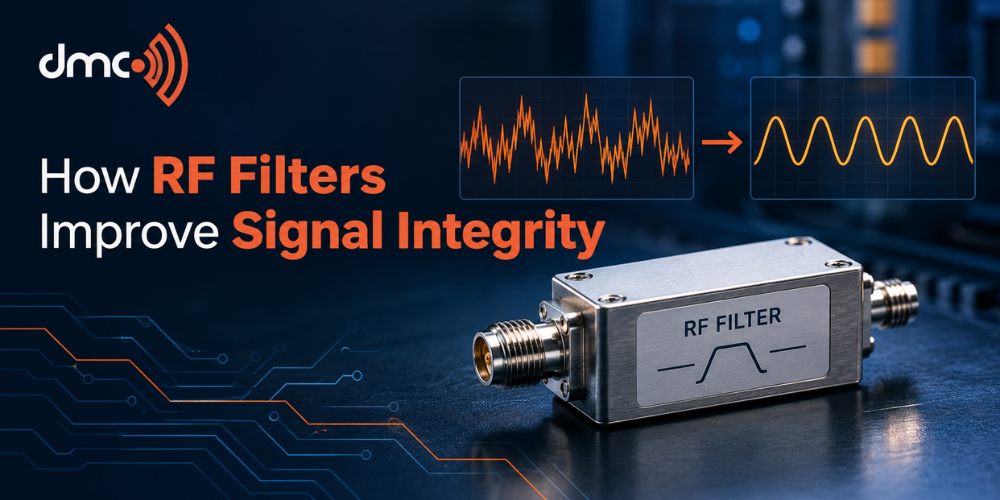
RF filters are components in electronics that enable specific radio frequency signals to pass through while suppressing other signals. These are vital in improving the quality of the signal and thus making it easier to perform effectively by the electronic system.
In the case of Diamond Microwave Chambers Ltd. there should be consideration of the importance of the RF filtering when coming up with RF, microwave, and EMC oriented environments and systems.
What is Signal Integrity?
Signal integrity concerns the ability of an electrical signal to retain its true characteristics during its transmission through an electronic environment. The characteristics include signal amplitude, signal timing, frequency components, and wave form.
SI issues may occur because of the presence of noise, reflection, crosstalk, EMI or restrictions from the transmission media itself. These SI issues depend on the system used, and they may result in errors in measurement or communication, among other problems.
Some of the common aspects that affect SI are as follows:
- Electromagnetic Interference (EMI): Undesirable electromagnetic energy.
- Radio Frequency Interference (RFI): Interference caused by unwanted radio frequency energy.
- Crosstalk: The phenomenon of having an undesired coupling of nearby signal lines.
- Impedance Mismatch: A mismatch of impedance leading to reflections on the transmission line.
- Power Supply Noise: Electrical power variations that are unintended and have an impact on circuits.
Though RF Filters can solve issues pertaining to frequency interference problems, they do not solve all problems of signal integrity.
Improvements Provided by RF Filters for Signals:
1. Reduction of Undesired Frequencies
The basic role of an RF filter is to suppress signals at any frequency other than the desired frequency range. For example, the low pass filter allows low frequency transmission while blocking high frequency signals outside its specific cut off region.
With the filtering of unwanted frequency signals, the filter will be able to prevent interference from other signal sources. The effectiveness of the filter will depend on the nature of the filter, attenuation characteristics, and frequency of operation.
2. Reducing Electromagnetic Interference
Strong unwanted RF signals can affect receivers, measurement equipment, and other sensitive electronics. Properly selected RF filters can attenuate interference entering through signal lines, power connections, or other filtered paths.
However, interference may also enter through unshielded cables, enclosure openings, or other unintended paths. Filtering alone cannot be an effective measure without the use of appropriate EMI shielding and grounding measures.
3. Facilitating Reliable Data Transfer
In communication systems, the presence of extraneous frequency bands may affect the performance of the receiver and other frequency bands operating adjacent to them. For instance, band pass filters enable passage of certain frequencies while blocking other frequencies within certain bands.
The efficiency of the technique depends on various factors such as filter bandwidth, insertion loss, and selectivity among others.
4. Protecting Sensitive Measurement Systems
Laboratory and RF test environments use low-level signals which might be susceptible to any outside interference. Appropriately selected RF filters will lower any unnecessary signals that may come from specific connections and thereby optimize the measurement environment.
When it comes to Diamond Microwave Chambers Ltd, RF filters are important in the wider context of EMC testing environment where filters, shielding techniques, and appropriate measurement practices may be used to control unwanted electromagnetic signals. Only the use of filters is not sufficient to provide accuracy and insulation against electromagnetic energy.
5. Improving Power-Line Noise Control
Noise can travel through electrical power connections and affect sensitive electronic equipment. EMI power line filters are designed to attenuate unwanted conducted noise over specified frequency ranges while supplying power to the connected equipment.
Filter choice must take into account issues of voltage, current, frequency characteristics, attenuation, leakage current, and safety standards. The wrong filter can cause high levels of insertion loss and failure to reduce noise.
RF Filter Types and Applications:
There are several filters that have varied applications. There is a need to choose an appropriate filter depending on the frequency and type of interference.
| Filter type | Main function | Typical application |
|---|---|---|
| Low-pass filter | Passes lower frequencies and attenuates higher frequencies | Harmonic reduction and signal conditioning |
| High-pass filter | Passes higher frequencies and attenuates lower frequencies | Removing low-frequency components |
| Band-pass filter | Passes a selected frequency band | RF receivers and wireless communication |
| Band-stop filter | Attenuates a selected frequency band | Reducing interference from a specific band |
| EMI power line filter | Attenuates conducted noise on power lines | Electronic equipment and EMC installations |
Filter performance is dependent on various factors.
Factors to Consider when Selecting RF Filters:
For effective selection of RF filters for signal integrity, just choosing a nominal frequency is not enough. The filter should meet the environmental and electrical demands of the application.
Factors to Consider when Selecting RF Filters:
For effective selection of RF filters for signal integrity, just choosing a nominal frequency is not enough. The filter should meet the environmental and electrical demands of the application.
Selection of a filter should be done with the following factors in mind:
- Frequency of operation: Ensure that the passband and the stop band coincide with the requirements of the operation.
- Insertion loss: This is the degree of loss of the signal of interest because of the filter.
- Attenuation: Check the effectiveness of rejection of unnecessary frequencies.
- Impedance matching: Ensure there is impedance matching with other circuits and transmission lines; 50 ohms in most radio frequency systems.
- Power rating: Ensure the filter can handle the power of the signal.
- Environmental considerations: Consider environmental factors such as temperature and humidity.
- Compliance issues: Confirm EMC and equipment specification issues.
Pro Tip:
Prior to designing an RF filter, you need to test for insertion loss, return loss, and attenuation within the specified frequency band. In some cases, it would be a good idea to test for conducted emissions and susceptibility.
The test equipment you use should have appropriate impedance terminations. Testing the overall system will show problems due to connectors, cables, or other coupling that would otherwise not occur when testing a single component.
The RF filters play an important role when it comes to achieving signal integrity due to their ability to attenuate unnecessary frequencies, reduce specific kinds of interference, and provide reliable operations in RF and electronic systems. This depends on the correct choice of filter parameters and proper integration of the component.
The company Diamond Microwave Chambers Ltd understands the significance of having good electromagnetic control in RF and EMC testing facilities. The combination of proper filtering with shielding, grounding, proper cable routing, and testing can be considered a more comprehensive way of dealing with interference.
Frequently Asked Questions
RF filters improve signal integrity by attenuating unwanted frequency components while allowing the required frequencies to pass. This can reduce interference and support reliable signal transmission.
The main types are low-pass filters, high-pass filters, band-pass filters, and band-stop filters. Each type controls a different portion of the frequency spectrum.
No. RF filters reduce selected interference within their effective frequency range and installation conditions. Shielding, grounding, cable management, and proper circuit design may also be necessary.
Insertion loss describes the reduction in signal transmission caused by inserting a filter into a system. It is commonly expressed in decibels (dB) and depends on frequency, impedance, and measurement conditions.
Consider the operating frequency, passband, attenuation, insertion loss, impedance, power handling, and environmental requirements. Verify the filter’s performance under conditions representative of the intended application.