
Table of Contents
- What Is an Anechoic Chamber?
- Why Aerospace & Defense Depend on Anechoic Chambers
- Types of Anechoic Chambers Use
- Comparison: Testing With vs Without Anechoic Chambers
In aerospace and defense, there is zero tolerance for error. Every radar signal, communication link, and
onboard electronic system must function flawlessly—even in the harshest electromagnetic environments. A minor interference issue can lead to mission failure, compromised safety, or even national security risks. This is precisely why anechoic chambers have become an essential part of modern testing infrastructure.
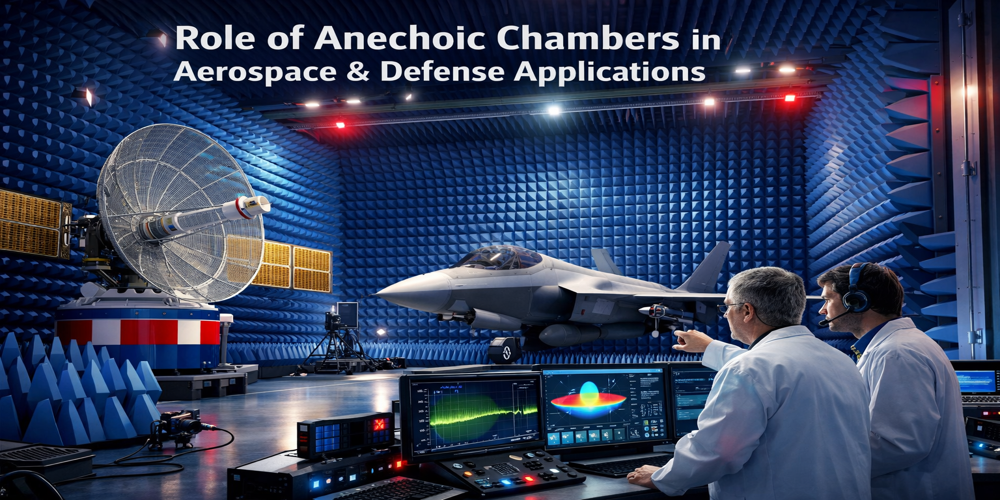
Anechoic chambers are highly specialized environments designed to absorb electromagnetic waves, eliminating reflections and external interference. In simple terms, they simulate a “perfect free-space” condition where engineers can accurately test how systems behave in real-world scenarios—without unpredictable disturbances.
What is an Anechoic Chamber?
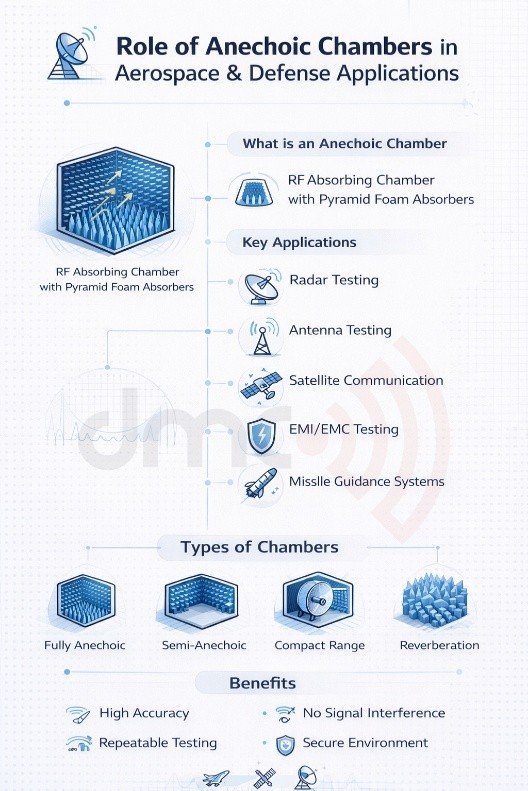
An anechoic chamber is a shielded room lined with RF-absorbing materials that eliminate reflections of
electromagnetic waves. This creates a controlled environment where engineers can perform precise
measurements without external interference.
Key Characteristics:
- Electromagnetic shielding (prevents outside interference)
- RF absorbers (minimize signal reflection)
- Controlled testing environment
- High accuracy and repeatability
Why Aerospace & Defense Depend on Anechoic Chambers
Aerospace and defense systems operate in environments filled with electromagnetic activity. From onboard
electronics in aircraft to ground-based radar systems, everything must coexist without interference.
Anechoic chambers provide the only reliable way to test these systems under controlled conditions.
Key Reasons for Usage:
1. Electromagnetic Compatibility (EMC) Testing
Ensures that electronic systems:
- Do not emit harmful interference
- Are immune to external electromagnetic disturbances
2. Radar System Testing
Anechoic chambers simulate open-space conditions to:
- Evaluate radar performance
- Measure radar cross-section (RCS)
- Detect stealth capabilities
3. Antenna Performance Evaluation
Used for:
- Radiation pattern measurement
- Gain and efficiency testing
- Beamforming validation
4. Satellite Communication Testing
- Validates signal strength and transmission accuracy
- Ensures reliability in space communication
5. Electronic Warfare (EW) Simulation
- Tests jamming and countermeasure systems
- Simulates hostile signal environments
Types of Anechoic Chambers Used
| Type of Chamber | Application Area | Key Feature |
|---|---|---|
| Fully Anechoic Chamber (FAC) | Antenna & radar testing | Absorbers on all surfaces including floor |
| Semi-Anechoic Chamber (SAC) | EMI/EMC testing | Reflective floor for practical setups |
| Compact Range Chamber | Radar cross-section (RCS) measurement | Uses reflectors for plane wave simulation |
| Reverberation Chamber | EMC immunity testing | Uniform EM field distribution |
| Outdoor Test Range (OTR) | Large-scale testing | Real-world simulation with minimal reflection |
Key Applications in Aerospace & Defense
1. Radar Cross Section (RCS) Testing
RCS determines how detectable an object is by radar. Anechoic chambers allow:
- Accurate measurement of stealth performance
- Optimization of aircraft and naval designs
2. Avionics System Testing
Modern aircraft rely heavily on electronics:
- Navigation systems
- Flight control systems
- Communication modules
Anechoic chambers ensure these systems function without interference.
3. Missile & Weapon System Testing
- Guidance systems rely on RF signals
- Testing ensures precision targeting and resistance to jamming
4. Unmanned Aerial Vehicles (UAVs)
- Validates communication links
- Ensures stable remote operation and signal integrity
5. Satellite Payload Testing
- Ensures antennas perform correctly in vacuum-like conditions
- Verifies signal transmission and reception
Benefits of Using Anechoic Chambers
High Accuracy
Eliminates reflections and noise, ensuring precise measurements.
Controlled Environment
Test conditions can be replicated consistently.
Compliance with Standards
Supports global standards like:
- MIL-STD
- DO-160
- IEC & CISPR
Risk Reduction
Identifies issues before deployment, avoiding costly failures.
Confidential Testing
Highly secure environment for defense applications.
Comparison: Anechoic Chamber vs Real-World Testing
| Parameter | Anechoic Chamber Testing | Real-World Testing |
|---|---|---|
| Environmental Control | Fully controlled | Unpredictable |
| Accuracy | Very high | Moderate |
| Repeatability | Excellent | Low |
| Cost | High initial setup | High operational cost |
| Interference | None | High |
| Safety | Safe & contained | Risk-prone |
Pro Tip
Always choose a chamber size and frequency range based on your application.
For aerospace and defense, investing in a compact range or fully anechoic chamber ensures higher
precision, especially for radar and stealth testing. Undersized chambers can lead to inaccurate
results due to boundary reflections.
Future Trends in Aerospace Anechoic Testing
- 5G & 6G integration in defense systems
- AI-driven testing and automation
- Advanced absorber materials (lightweight & broadband)
- Hybrid simulation environments (digital + physical testing)
- Space-based testing advancements
As defense technology evolves, anechoic chambers will continue to adapt, supporting next-generation
innovations like hypersonic weapons and autonomous combat systems.
Anechoic chambers are indispensable in aerospace and defense applications. They provide a controlled, interference-free environment essential for testing critical systems such as radar, antennas, avionics, and communication devices. From ensuring electromagnetic compatibility to enhancing stealth capabilities, these chambers play a vital role in mission success and national security.
Investing in high-quality anechoic testing infrastructure is not just a technical requirement—it’s a
strategic necessity.
Frequently Asked Questions
1. What is the purpose of anechoic chambers in defense?
They provide a reflection-free environment for testing radar, antennas, and electronic systems accurately.
2. Why is RCS testing important?
It determines how detectable an object is by radar, crucial for stealth technology.
3. What type of chamber is best for aerospace testing?
Fully anechoic chambers and compact range chambers are ideal for high-precision testing.
4. How do anechoic chambers improve safety?
They detect electromagnetic issues before deployment, preventing mission failures.
5. Are anechoic chambers used for satellites?
Yes, they are used to test satellite antennas and communication systems before launch.