
Table of Contents
- What Is an Anechoic Chamber?
- Why 5G and 6G Require Advanced Testing
- Why Anechoic Chambers Are Essential
- Comparison: Testing With vs Without Anechoic Chambers
- Types of Anechoic Chambers Used
As wireless communication technologies rapidly evolve, 5G is already transforming industries, and
6G is on the horizon promising even faster speeds, ultra-low latency, and massive device
connectivity. However, testing these advanced technologies requires highly controlled environments — and
that’s where anechoic chambers become indispensable.
A poorly designed or improperly installed chamber can result in unreliable test results, compliance failures,
and costly modifications. That’s why having a structured checklist before installation is crucial.
In this blog, we’ll explore why anechoic chambers are critical for 5G and 6G testing, their benefits,
applications, and how they support the future of wireless innovation.
What Is an Anechoic Chamber?
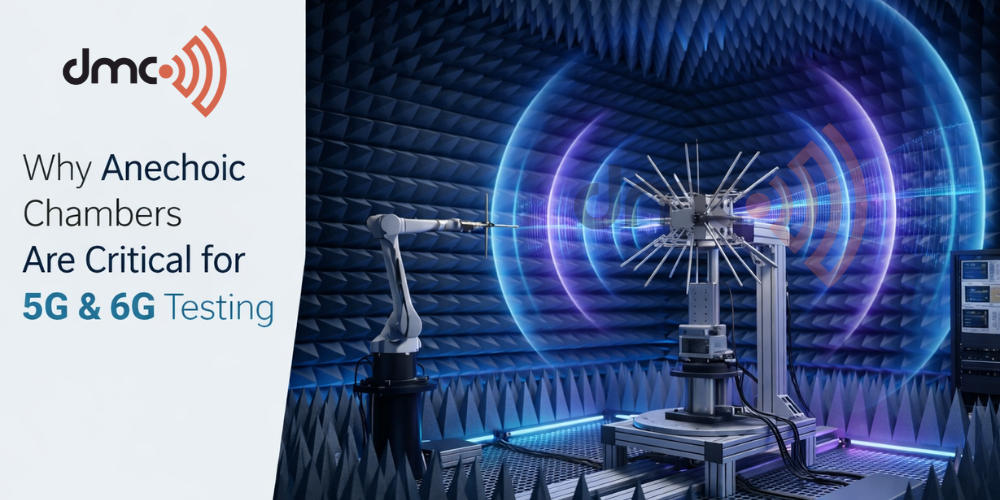
An anechoic chamber is a specialized room designed to completely absorb electromagnetic waves and
eliminate reflections. These chambers simulate a free-space environment, allowing engineers to
conduct accurate RF (Radio Frequency) testing without external interference.
Key Features:
- RF absorbers (pyramidal foam or ferrite tiles)
- Shielded walls to block external signals
- Controlled testing environment
- Minimal signal reflection
Why 5G and 6G Require Advanced Testing
Unlike previous generations, 5G and 6G technologies operate at higher frequencies, including millimeter
waves (mmWave). These frequencies behave differently:
- Shorter wavelengths
- Higher data rates
- Increased signal attenuation
- Sensitive to obstacles and interference
This complexity makes real-world testing unreliable without controlled environments.
Why Anechoic Chambers Are Essential
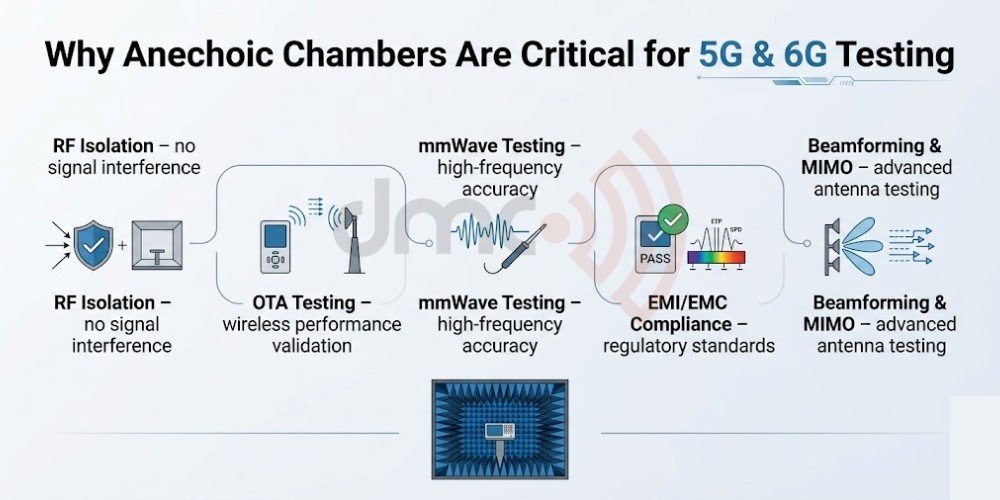
1. Accurate RF Measurements
Anechoic chambers eliminate reflections and noise, ensuring precise signal measurements — critical for
validating 5G/6G performance.
2. OTA (Over-the-Air) Testing
5G and 6G devices rely heavily on OTA testing, where signals are tested wirelessly instead of via
cables.
3. mmWave Testing Capability
High-frequency signals require:
- Directional testing
- Beamforming validation
- Antenna alignment
Anechoic chambers provide the perfect environment for this.
4. EMI/EMC Compliance
Regulatory compliance is mandatory. Anechoic chambers help test:
- Electromagnetic interference (EMI)
- Electromagnetic compatibility (EMC)
5. Repeatability & Reliability
Testing conditions remain consistent, enabling:
- Repeatable results
- Reliable product validation
Comparison: Testing With vs Without Anechoic Chambers
| Feature | With Anechoic Chamber ✅ | Without Chamber ❌ |
|---|---|---|
| Signal Accuracy | High precision | Unreliable |
| External Interference | Eliminated | High |
| Repeatability | Consistent results | Variable |
| mmWave Testing | Fully supported | Limited |
| Compliance Testing | Meets standards | Risk of failure |
| OTA Testing | Accurate | Distorted |
Role in 5G Testing
Key Applications:
- Base station antenna testing
- Smartphone RF validation
- IoT device performance testing
- Beamforming and MIMO testing
5G relies heavily on Massive MIMO (Multiple Input Multiple Output) and beamforming, which require highly accurate spatial measurements — only possible inside anechoic chambers.
Role in 6G Testing
6G will introduce even more complexity:
Expected Features:
- Terahertz (THz) frequency bands
- AI-driven networks
- Ultra-dense connectivity
- Holographic communication
Testing these requires:
- Even higher precision chambers
- Advanced absorber materials
- Hybrid testing environments
Anechoic chambers will evolve into smart RF testing ecosystems.
Types of Anechoic Chambers Used
1. Fully Anechoic Chamber (FAC)
- Absorbers on all surfaces (walls, ceiling, floor)
- Best for OTA testing
2. Semi-Anechoic Chamber (SAC)
- Reflective floor
- Used for EMI/EMC testing
3. Compact Range Chambers
- Designed for antenna measurements
- Space-efficient
Key Components of an RF Anechoic Chamber
- RF absorbers (foam or ferrite)
- Shielded enclosure
- Turntables for DUT (Device Under Test)
- Antenna measurement systems
- Signal generators & analyzers
Challenges in 5G/6G Testing
Despite their importance, anechoic chambers come with challenges:
- High initial cost
- Large space requirements
- Complex calibration
- Maintenance of absorbers
However, the benefits far outweigh these challenges, especially for industries focused on next-gen
wireless technology.
Pro Tip
Always choose a chamber designed for future frequencies (up to THz range) rather than just current 5G
requirements. This ensures your investment is future-proof for 6G testing and avoids costly upgrades
later.
Future of Anechoic Chambers
- AI-integrated testing environments
- Automated measurement systems
- Hybrid physical + simulation labs
- More compact and modular
These innovations will make testing faster, more accurate, and scalable.
Anechoic chambers are no longer optional — they are mission-critical infrastructure for 5G and upcoming 6G technologies. From ensuring accurate RF measurements to enabling OTA testing and compliance, they play a pivotal role in the development and deployment of next-generation communication systems.
As we move toward a hyper-connected future, investing in advanced anechoic chambers will be essential
for companies aiming to stay ahead in the wireless industry.
Frequently Asked Questions
1. Why are anechoic chambers used in 5G testing?
They eliminate interference and reflections, ensuring accurate RF and OTA testing.
2. What is OTA testing in 5G?
Over-the-Air testing evaluates wireless device performance without physical connections.
3. Can 6G be tested without anechoic chambers?
No, due to extremely high frequencies and precision requirements, controlled environments are essential..
4. What frequencies do 5G and 6G use?
5G uses sub-6 GHz and mmWave, while 6G is expected to use THz frequencies.
5. Are anechoic chambers expensive?
Yes, but they are a critical investment for accurate testing and regulatory compliance.