
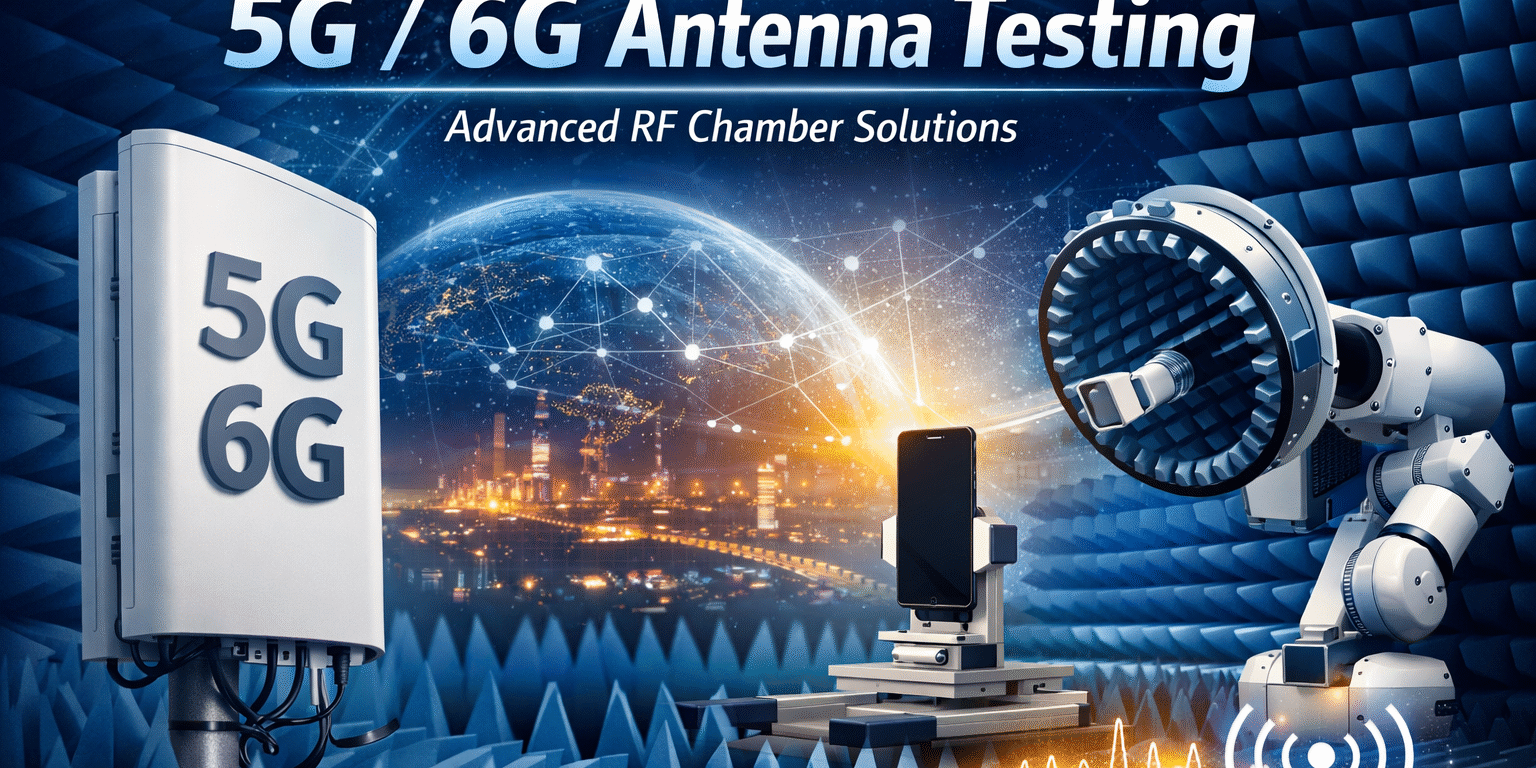
The rapid growth of wireless communication technologies has created an increasing demand for accurate and reliable antenna testing solutions. With the emergence of advanced networks, 5G / 6G antenna testing has become a critical step in ensuring that wireless devices deliver high-speed connectivity, low latency, and seamless performance.
From smartphones and IoT devices to autonomous vehicles and smart infrastructure, modern communication systems rely heavily on sophisticated antenna designs. To guarantee optimal functionality, manufacturers must perform comprehensive 5G / 6G antenna testing in controlled environments using advanced measurement equipment such as RF chambers and anechoic chambers.
This article explores the importance of antenna testing for next-generation wireless systems, the technologies involved, and how specialized test environments ensure reliable performance.
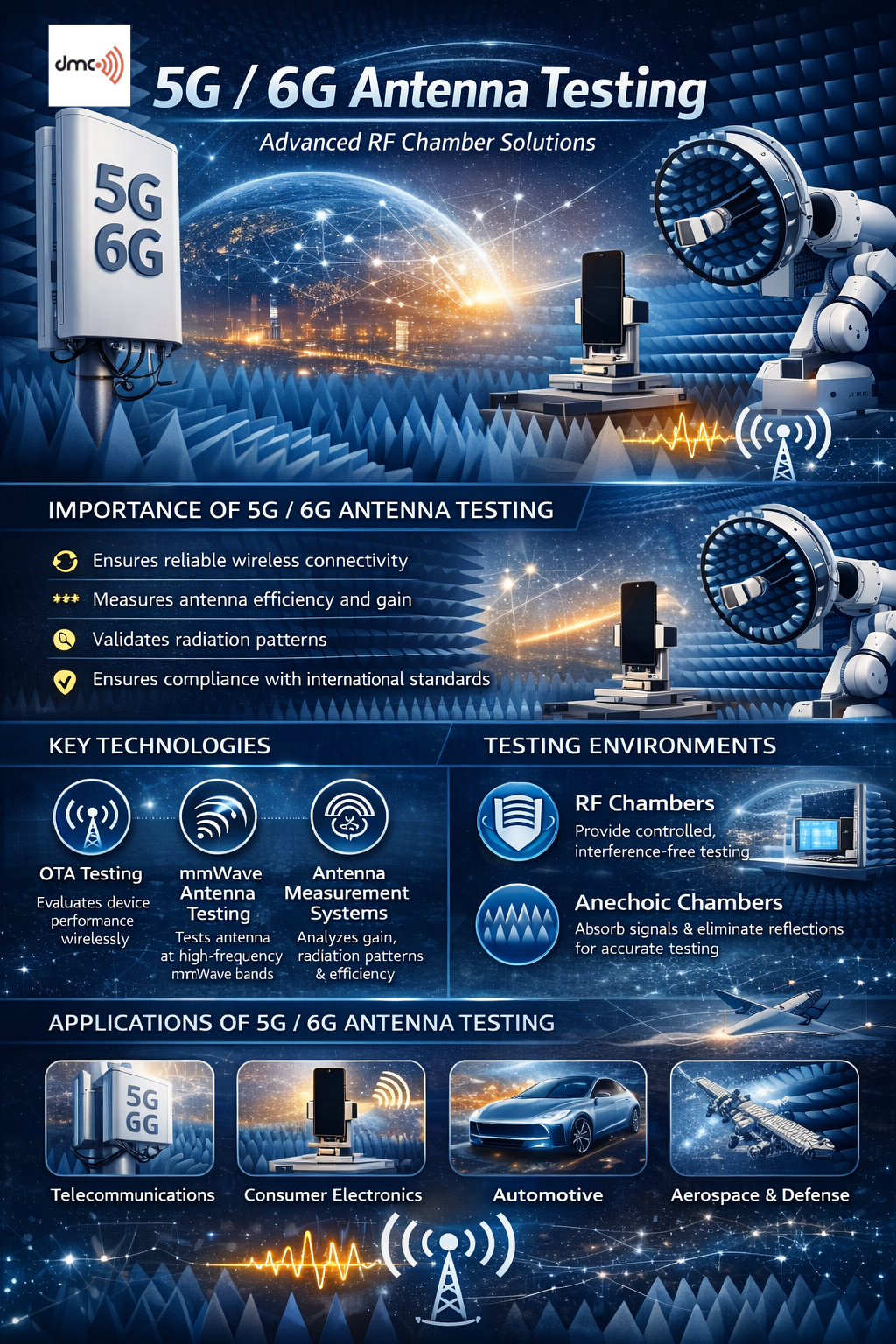
Understanding the Importance of 5G / 6G Antenna Testing
Wireless communication technologies have evolved significantly over the past decade. While earlier generations relied on lower frequency bands, modern networks operate across a wide spectrum, including high-frequency millimeter waves.
Because of this complexity, 5G / 6G antenna testing is essential for verifying the performance, radiation patterns, gain, and efficiency of antennas used in advanced communication devices.
Key reasons why 5G / 6G antenna testing is essential include:
- Ensuring reliable wireless connectivity
- Verifying antenna efficiency and gain
- Measuring radiation patterns
- Validating compliance with international standards
- Optimizing antenna design for high-frequency operation
Without precise testing, wireless devices may suffer from signal loss, interference, or inconsistent performance.
The Role of RF Chambers in Antenna Testing
A major challenge in antenna measurement is environmental interference. Signals from surrounding devices, reflections from walls, and electromagnetic noise can distort test results.
To overcome this issue, engineers use specialized RF chambers designed to eliminate unwanted signals and reflections.
RF chambers create a controlled environment where antennas can be tested without interference from external electromagnetic sources. These chambers allow engineers to measure antenna performance accurately and repeatably.
Modern RF chambers are widely used for:
- OTA testing
- Antenna radiation pattern measurements
- Electromagnetic compatibility testing
- Wireless device validation
- mmWave antenna testing
By simulating free-space conditions, these chambers enable precise measurement of antenna characteristics.
Why Anechoic Chambers Are Essential for Wireless Testing
One of the most advanced testing environments used in wireless engineering is the anechoic chambers. These chambers are specially designed to absorb electromagnetic waves, preventing signal reflections that could affect measurement accuracy.
In anechoic chambers, walls are lined with RF absorbing materials that eliminate reflections and simulate an open-space environment.
This allows engineers to perform accurate 5G / 6G antenna testing and evaluate how antennas behave in real-world conditions.
Benefits of using anechoic chambers include:
- High measurement accuracy
- Reduced electromagnetic interference
- Reliable antenna radiation pattern analysis
- Improved testing repeatability
- Compliance with global RF testing standards
Because of these advantages, anechoic chambers are widely used by telecom manufacturers, research institutions, and wireless device developers.
5G6G antenna testing and solutions (1)
Key Technologies Used in 5G / 6G Antenna Testing
The architecture of modern wireless networks requires advanced testing technologies. Engineers rely on sophisticated measurement systems to evaluate antenna performance across different frequency bands.
Some key technologies involved in 5G / 6G antenna testing include:
1. OTA Testing
OTA testing (Over-The-Air testing) measures wireless device performance without direct cable connections. Instead, signals are transmitted and received through antennas, allowing engineers to evaluate real-world communication performance.
OTA testing is particularly important for modern devices that use integrated antennas, such as smartphones and IoT products.
2. mmWave Antenna Testing
Modern wireless networks use millimeter-wave frequencies to achieve extremely high data speeds. These frequencies require specialized testing environments because they are more sensitive to interference and signal blockage.
mmWave antenna testing ensures that antennas can efficiently transmit and receive signals in these high-frequency bands.
3. Advanced Antenna Measurement Systems
High-precision antenna measurement systems are used to analyze antenna gain, radiation patterns, polarization, and efficiency.
These systems work in combination with RF chambers and anechoic chambers to provide accurate measurement data for antenna designers and engineers.
Applications of 5G / 6G Antenna Testing
As wireless technologies expand, the demand for reliable antenna testing continues to grow. Industries that rely on 5G / 6G antenna testing include:
Telecommunications
Telecom companies use antenna testing to ensure base stations and communication devices operate efficiently across multiple frequency bands.
Consumer Electronics
Manufacturers test smartphones, tablets, and wearable devices using OTA testing to guarantee strong connectivity and signal stability.
Automotive Industry
Connected vehicles require reliable wireless communication systems. 5G / 6G antenna testing ensures that vehicle antennas support navigation, connectivity, and autonomous features.
IoT Devices
Smart home devices, industrial sensors, and connected appliances must undergo wireless device testing to verify communication reliability.
Aerospace and Defense
Advanced communication systems used in aerospace applications require high-precision testing within specialized RF chambers.
Challenges in 5G / 6G Antenna Testing
While modern testing technologies offer advanced capabilities, engineers still face several challenges when performing 5G / 6G antenna testing.
These include:
- Increasing complexity of antenna designs
- Operation across multiple frequency bands
- Integration of multiple antennas in small devices
- High-frequency mmWave antenna testing
- Maintaining measurement accuracy
To overcome these challenges, testing facilities rely on advanced antenna measurement systems and specialized anechoic chambers designed for next-generation wireless technologies.
The Future of 5G / 6G Antenna Testing
As the wireless industry continues to evolve, the importance of 5G / 6G antenna testing will only increase. Future networks will support technologies such as:
- Ultra-fast data transmission
- Smart cities
- Autonomous transportation
- Advanced IoT ecosystems
- Immersive augmented and virtual reality
These innovations require highly efficient antennas capable of operating across complex frequency environments.
To support this growth, companies are investing in advanced RF testing solutions and next-generation RF chambers that can support emerging wireless standards.
Testing infrastructure will continue to evolve, ensuring that future devices deliver the performance required for next-generation communication networks.
The evolution of wireless communication has made 5G / 6G antenna testing an essential part of device development and network infrastructure deployment. Accurate testing ensures that antennas perform efficiently, maintain reliable connectivity, and meet global industry standards.
With advanced testing environments such as RF chambers and anechoic chambers, engineers can simulate real-world conditions and analyze antenna performance with exceptional precision.
As wireless technologies continue to advance, investing in reliable antenna measurement systems, OTA testing, and mmWave antenna testing will be critical for supporting the next generation of communication devices and networks.
Organizations that adopt advanced RF testing solutions will be better equipped to develop innovative wireless technologies and maintain a competitive edge in the rapidly evolving telecommunications industry.
FAQs
1. What is 5G / 6G antenna testing?
It is the process of measuring antenna performance to ensure reliable operation in advanced wireless networks.
2. Why are RF chambers used in antenna testing?
They eliminate interference and create controlled environments for accurate RF measurements.
3. What is OTA testing?
OTA testing measures wireless device performance using antennas without direct cable connections.
4. Why is mmWave antenna testing important?
It ensures antennas operate efficiently at high-frequency millimeter-wave bands used in modern networks.
5. What industries use antenna testing solutions?
Telecommunications, automotive, aerospace, and consumer electronics industries rely on antenna testing.