
Table of Contents
- Understanding RF Absorber Materials
- What Are Foam Absorbers
- Ferrite Tiles vs Foam Absorbers: Performance Comparison
- Hybrid Absorbers: The Best of Both Worlds
In modern electromagnetic testing environments, selecting the right RF absorber materials is critical for achieving accurate and reliable results. Whether you are designing anechoic chamber absorbers or optimizing EMC chamber materials, the debate around Ferrite tiles vs foam absorbers remains one of the most important decisions engineers face.
Both absorber types play a vital role in RF shielding solutions, yet they differ significantly in performance, frequency range, cost, and application. This guide provides a detailed absorber performance comparison to help you choose the right solution for your needs.
Understanding RF Absorber Materials
Before diving into Ferrite tiles vs foam absorbers, it’s essential to understand what microwave absorbers do. These materials are designed to absorb electromagnetic waves and minimize reflections within EMI testing chambers and anechoic environments.
The effectiveness of an absorber depends on:
- Frequency range
- Material composition
- Thickness and structure
- Chamber design requirements
What Are Ferrite Tiles?
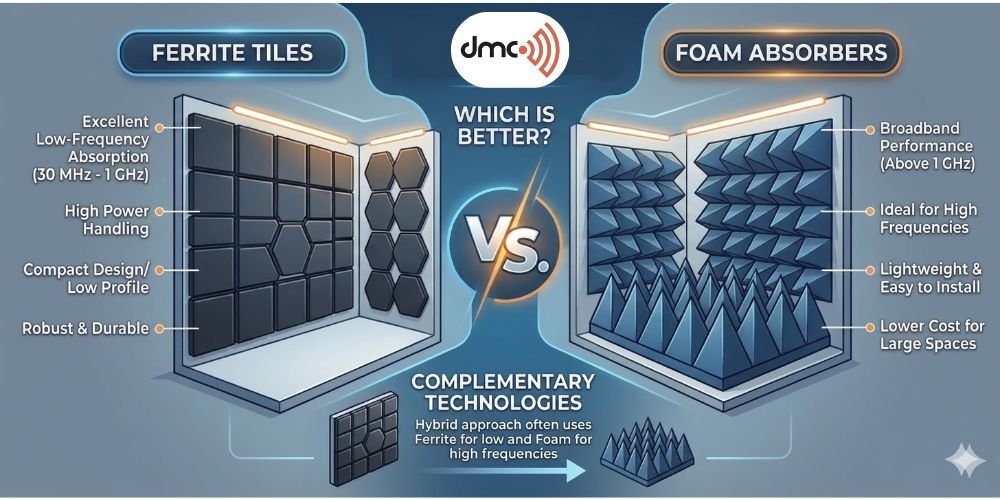
Ferrite tiles are dense ceramic-based EMC chamber materials known for their excellent low frequency absorption capabilities. They are typically installed on chamber walls to suppress reflections in lower frequency ranges.
Key Features of Ferrite Tiles
- Effective from ~30 MHz to 1 GHz
- Durable and long-lasting
- Thin and space-efficient
- Ideal for compliance EMI testing chambers
Advantages
Ferrite tiles excel in low frequency absorption, making them indispensable for EMC testing. They also provide consistent performance over time and require minimal maintenance.
Limitations
However, ferrite tiles are less effective in high frequency absorption, which means they are often combined with other materials in hybrid absorber.
What Are Foam Absorbers?
Foam absorbers are lightweight polyurethane-based anechoic chamber absorbers designed for superior high frequency absorption. They are commonly used in full anechoic chambers and antenna measurement setups.
Key Features of Foam Absorbers
- Effective from ~500 MHz to 40 GHz
- Pyramid or wedge-shaped design
- Lightweight and easy to install
- High-performance microwave absorbers
Advantages
Foam absorbers provide excellent high frequency absorption, making them ideal for antenna testing and RF measurements. Their structure allows gradual attenuation of waves, reducing reflections effectively.
Limitations
They are less effective at low frequencies and can degrade over time if exposed to environmental factors like humidity or dust.
Ferrite Tiles vs Foam Absorbers: Performance Comparison
1. Frequency Range
- Ferrite Tiles: Best for low frequency absorption
- Foam Absorbers: Best for high frequency absorption
This makes the Ferrite tiles vs foam Absorbers comparison highly dependent on your testing requirements.
2. Application in RF Chamber Design
In RF chamber design, ferrite tiles are commonly used in EMC chambers, while foam Absorbers dominate anechoic chambers.
For advanced applications, engineers often use hybrid absorbers, combining ferrite tiles with foam to cover a broad frequency spectrum.
3. Durability and Maintenance
- Ferrite tiles are robust and long-lasting
- Foam absorbers may require replacement over time
This makes ferrite tiles more suitable for long-term RF shielding solutions.
4. Space and Installation
- Ferrite tiles are compact
- Foam Absorbers require more space due to their shape
This is a critical factor in compact EMI testing chambers.
5. Cost Consideration
Foam absorbers are generally more cost-effective initially, while ferrite tiles offer better long-term value due to durability.
Hybrid Absorbers: The Best of Both Worlds
To overcome the limitations of both materials, many modern anechoic chamber absorbers use hybrid absorbers. These combine ferrite tiles for low frequency absorption and foam absorbers for high frequency absorption.
Benefits of Hybrid Absorbers
- Wide frequency coverage
- Improved absorber performance comparison results
- Optimized RF chamber design
- Ideal for advanced EMC chamber materials
Hybrid solutions are increasingly becoming the industry standard for high-performance RF shielding solutions.
Which Is Better?
The answer to Ferrite tiles vs foam absorbers depends on your application:
- Choose ferrite tiles for EMI testing chambers and low-frequency EMC compliance
- Choose foam absorbers for high-frequency RF and antenna testing
- Choose hybrid absorbers for comprehensive performance
In most modern applications, hybrid systems provide the best balance between performance and cost.
When comparing Ferrite tiles vs foam absorbers, there is no one-size-fits-all solution. Both materials play crucial roles in RF absorber materials and anechoic chamber absorbers.
For optimal results, engineers must evaluate:
- Frequency requirements
- Chamber type
- Budget constraints
- Long-term performance needs
By understanding the strengths and limitations of each, you can design efficient EMC chamber materials and advanced RF shielding solutions that meet today’s demanding testing standards.
Frequently Asked Questions
Ferrite tiles handle low frequencies, while foam absorbers are better for high frequencies.
They are mainly used in EMC chambers but can be part of hybrid absorber systems.
They provide excellent high frequency absorption for accurate RF measurements.
They combine ferrite tiles and foam Absorbers for wide band performance.
Ferrite tiles or hybrid absorbers are typically preferred for EMC applications.