
Table of Contents
- What Is Hybrid Absorber Technology?
- Advantages of Hybrid Absorbers Usage
- Performance Optimization In The Current Age Of RF Testing Facilities
- Why Hybrid Absorber Technology Trends Are Adopted in the Industry?
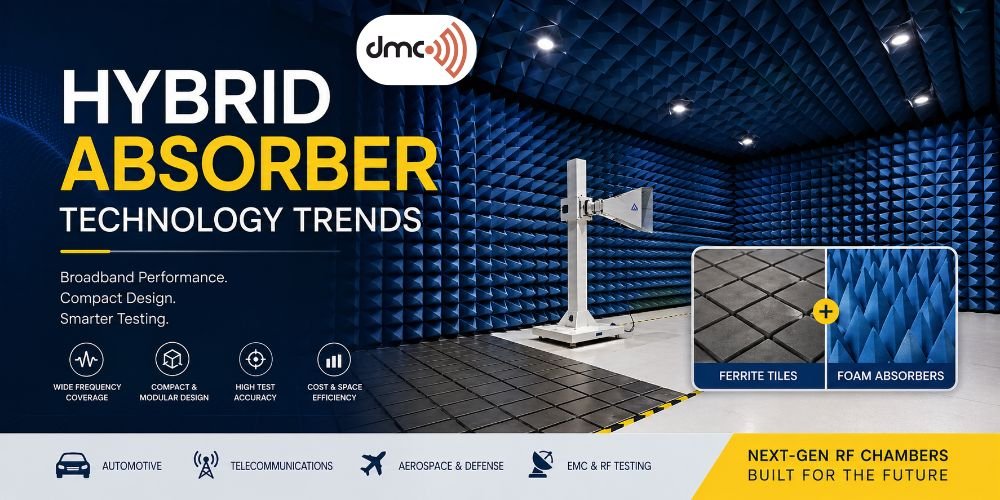
The fast development of EMC testing and wireless devices has raised the need for high-end RF chambers substantially. One of the latest technological trends in this area is Hybrid Absorber Technology Trends that allows creating a combination of several absorber materials to achieve excellent broadband RF absorbers performance on a large frequency range.
With today’s industrial sectors like automotive industry, aerospace sector, telecommunications, and defense needing extremely accurate electromagnetic interference testing conditions, conventional absorbers can hardly meet the challenge. Here hybrid absorbers come into play.
What Is Hybrid Absorber Technology?
The term “hybrid absorber” is commonly used to describe an integration of two major types of absorbers:
- Ferrite absorbers – work well at low frequencies
- Foam absorbers (pyramidal absorbers) – perform best at high frequencies
This combination ensures broadband RF absorbers performance that makes hybrid absorbers perfect for use in modern EMC chambers and antenna measurement systems.
Advantages of Hybrid Absorbers Usage
1. High Coverage in Frequency Range
The most important advantage of Hybrid Absorber Technology Trends is that this absorbers type provides high coverage in the frequency range, which is especially significant when talking about EMC compliance testing and automotive radar testing.
2. Optimal Use of Space
The use of hybrid absorbers reduces the requirement for chamber space since the system provides efficient absorption of RF signals in small RF chambers, particularly applicable in urban areas.
3. Enhanced EMC Testing Precision
The accuracy of electromagnetic tests depends on low levels of reflection. The Hybrid Absorber technology plays a crucial role in minimizing signal reflection and ensuring accurate testing processes.
Performance Optimization In The Current Age Of RF Testing Facilities
At present, performance optimization happens to be one of the major challenges in testing facilities.
With the help of the Hybrid Absorber Technology Trends, RF testing chambers can provide accuracy by minimizing signal reflection. Through a well-planned combination of ferrite absorbers and foam absorbers, engineers can develop RF chambers that offer optimal performance across several frequency bands.
The process allows for the testing of intricate devices such as automotive radar tests, IoT products, and wireless communication devices.
Importance in Advanced Wireless Technology Development
Significance in Advanced Development of Wireless Technologies
This provides engineers with the ability to conduct high-frequency tests free from any interference for maximum performance of the antenna. Hybrid absorbers play a vital role in the testing of millimeter-wave applications.
Modular & Customizable Design
Yet another characteristic of advanced absorber systems is their customization. With the help of Hybrid Absorber Technology Trends, manufacturers now have the option to develop customized absorber designs for particular purposes.
It does not matter whether you require an absorber system for testing of a compact electronic device or a complex one for automotive applications; you will get the best results with hybrid absorbers.
Key Technology Trends in Hybrid Absorbers
Engineering Advanced Materials
Recently developed materials include:
- Carbon-loaded foams to achieve high-frequency absorption
- Ferrite absorbers to boost low-frequency absorption rates
- Composites that provide thermal stability and durability
With the above mentioned material engineering trends, we are heading towards advanced microwave absorbers and RF performance.
Designing Thin Absorbers
Conventional absorbers tend to be quite thick. Yet, with new technologies, absorbers become very thin and highly efficient.
Integration with Smart Chambers
Current technology has enabled hybrid absorbers to become part of:
- Automatic EMC testing systems
- Artificial intelligence measuring devices
- Smart RF and EMC chambers
Sustainability and Eco-friendly Materials
Environmental problems have become highly significant, and manufacturers are taking into consideration:
- Eco-friendly absorbent materials which can be recycled
- Low-emission processes
- Durability
This ensures the attainment of global sustainability targets while ensuring that RF chamber protection remains highly effective.
Durable Products
When selecting RF chambers, it is important to consider their durability. This absorber would also stand up to various environmental factors such as changes in temperature, humidity, and stress.
The use of durable ferrite absorbers along with quality foam enhances the strength of the absorber. Thus, Hybrid Absorber Technology Trends provide accurate testing and eliminate the need for frequent repairs or chamber downtime.
Financial Benefits
Although the initial cost of installing hybrid absorbers can be relatively high compared to other absorber technologies, the overall financial gains from using them outweigh their disadvantages. Reduced chamber volume, lower maintenance costs, and improved testing capabilities ensure long-term cost efficiency.
Firms that use Hybrid Absorber Technology Trends usually benefit from high return on investments because of higher productivity and fewer upgrades in EMC testing solutions.
Application Areas of Hybrid Absorber Technology
Automotive Industry
For cars with electrical and ADAS systems, hybrid absorbers are important for:
- Testing of automotive radar
- Sensor verification
- EMC test
Significance for Testing of Electric Vehicles
Because of the emergence of more electric cars, the importance of EMC testing solutions became more evident. Hybrid absorbers will be useful in providing optimal settings for testing of components of electric cars, such as batteries and inverters.
Assistance with Autonomous and ADAS Vehicles
For autonomous cars, which require the use of radars and sensors, hybrid absorbers are useful for creating reflection-free zone areas where calibration and verification can be performed.
Telecommunications
Areas of application for hybrid absorbers include:
- Testing of 5G/6G networks
- Antenna measurements
- Signal integrity verification
They are vital for today’s antenna testing facilities and wireless infrastructure.
Aerospace and Defense
For precision testing of equipment, hybrid absorbers are required for the following tasks:
- RCS testing
- Satellite communication systems
- Military electronics
Adoption Globally and Industry Needs
From Europe, to Asia, and North America industries are increasingly adopting hybrid absorber solutions due to new testing needs that arise as electronics get more complex and regulations tougher. As such, the Hybrid Absorber Technology Trends are becoming globally adopted in RF and EMC testing facilities.
Why Hybrid Absorber Technology Trends Are Adopted in the Industry?
Benefits
- Broadband RF absorption
- Small chamber sizes
- Cost-effectiveness
- High accuracy of tests
- Durability over long periods of time
Challenges
- High capital costs
- Difficult installation
- Advanced knowledge about RF chambers is required
Even with the listed disadvantages, benefits outweigh them and make hybrid absorbers popular.
Looking into the Future
With the use of Hybrid Absorber Technology Trends in the coming years there is a possibility to see:
- Use of nanomaterials
- RF chamber optimization by using AI technology
- Advanced broadband absorption capabilities
Conclusions
With the demand from the industries for accurate testing technologies, hybrid absorber technology will become an integral part of the next generation of EMC testing facilities.
Frequently Asked Questions
It combines ferrite and foam absorbers for broadband RF absorption.
They improve accuracy in electromagnetic interference testing.
They are used in EMC chambers, RF chambers, and antenna measurement systems.
Wide frequency coverage with compact RF chamber design.
Yes, they reduce long-term costs in EMC testing solutions.