
Table of Contents
- What Is Meant by Low Frequency Performance in RF Chambers?
- Why Chamber Geometry Is Important
- Importance of Absorber Materials
- Improperly shielded low-frequency chambers might affect:
- Chamber Design for Effective Professional Performance
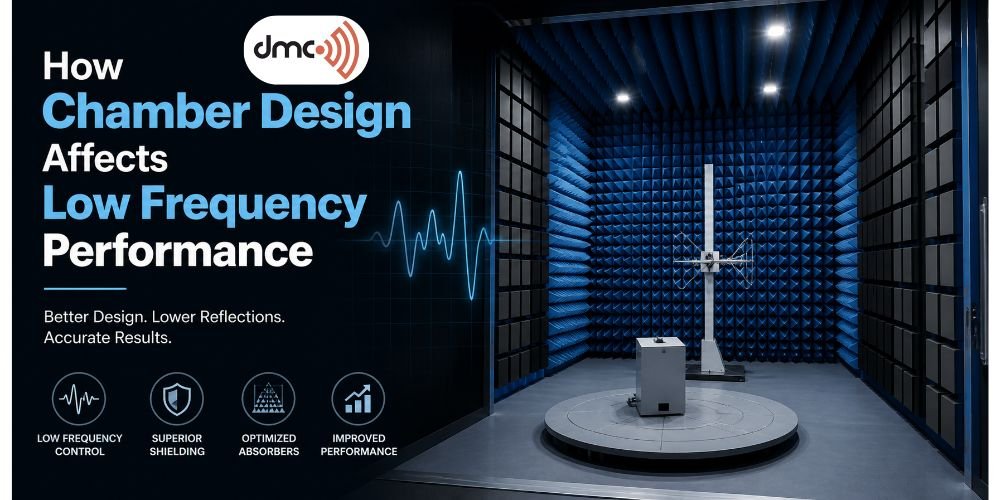
As far as EMC and RF testing goes, one of the critical subjects today is the Effect of Chamber Design on Low Frequency Performance because of its importance for many industries that need precise measurements of electromagnetic fields. Such applications range from testing radar systems installed in cars to testing electronics in aerospace products.
Good chamber design will ensure minimized interference, signal distortions, and other problems that might occur during measurements. In case of bad low frequency control, measuring equipment won’t be able to give reliable and correct results, thus delaying certification of products.
At Diamond Microwave Chambers Ltd, we offer RF and EMC chambers that are designed for excellence in low-frequency applications and reliable EMC testing.
What Is Meant by Low Frequency Performance in RF Chambers?
Low frequency performance is the ability of an RF or EMC chamber to control the absorption of electromagnetic waves at lower frequencies. Low frequencies are harder to control than high frequencies because of the longer wavelength that characterizes them.
The affected industries include:
- Automotive electronics
- Defense communications systems
- Aerospace equipment
- Wireless communications devices
- Medical electronics
Anechoic chamber construction is now increasingly centered on optimizing low frequency absorption without limiting the usable volume within the testing facility.
Why Chamber Geometry Is Important
An important variable that affects low frequency performance is chamber geometry. This refers to the physical characteristics of the chamber where waves travel.
Large Chambers Promote Better Wave Propagation
Low frequency waves need more room to attenuate properly.
Correct design of the chamber would include:
- Wall spacing optimization
- Correct ceiling height
- Suitable reflection management
- Appropriate absorber positioning
This will increase field uniformity and testing reliability.
Effect on Corner Areas and Edges
Corners play an important role in EMC chambers since low-frequency waves concentrate in corners due to their tendency to reflect from the edge.
Modern RF chambers use:
- Ferrite tiles as absorbers
- A combination of absorbers
- Multiple absorbers
All of which significantly reduce low frequency waves.
Importance of Absorber Materials
Absorber materials are very important in relation to How Chamber Design Affects Low Frequency Performance.
Ferrite Tile Absorbers
Ferrite tiles are extensively applied for low-frequency management since they effectively attenuate electromagnetic fields at low frequencies.
Pros are:
- Better low frequency absorption
- Frequency stability for EMC tests
- Minimized internal reflections
- Improved shielding efficiency
Hybrid Absorbers Technology
Contemporary testing chambers employ both ferrite tiles and foam absorbers to form hybrid absorbers technology. Hybrid absorbers provide a wide frequency spectrum while retaining their efficiency in low frequencies.
Advantages are:
- Wider band absorption
- Removal of chamber resonances
- Improved test accuracy
- Space-saving chamber configurations
The hybrid absorber systems are currently popular in advanced EMC testing chambers and car radar testing chambers.
Shielding Effectiveness and Low Frequency Stability
Chamber shielding is another essential factor affecting performance. The outside electromagnetic field can easily interfere with poorly built chambers.
The essential components of an efficient chamber shield are listed below:
- High-grade conductive panels
- Appropriate grounding
- Shielded doors and ventilation
- Radio frequency tight cables
Effective shielding ensures that there is an accurate signal reception and low-frequency value measurement.
Shielded Rooms for EMC Test Organizations Conducting EM Compatibility Tests
Impact of Shielding in Testing of Automobiles and Radar Systems
It is necessary to perform accurate testing of automobiles and radar systems.
Improperly shielded low-frequency chambers might affect:
- ADAS sensor tests
- Radar test
- EMC tests of automobiles
- Driving automation system test
Modern automotive testing centers now opt for high-end microwave chambers using hybrid absorbers for low-frequency testing.
As the evolution of electric cars and automation technology continues, the need for quality EMC chambers rises steadily.
Significance of Chamber Dimensions and Design
The dimension of the chamber affects how low frequency waves propagate.
Longer Distance for Wave Propagation. Wave propagation needs greater distance to ensure correct wave propagation. The following will happen due to smaller dimensions:
- Reflection
- Distortion of fields
- Unreliable measurements
Equipment Positioning Optimization . Incorrect equipment placement may impair the chamber’s performance.
Professional chamber engineers will determine the following parameters:
- Antenna placement
- Turntable positioning
- Separation distance of absorbers
- Cabling route optimization
To achieve optimal electromagnetic characteristics at all test frequencies.
Air Flow and Environment
Most people do not consider air flow systems when talking about How Chamber Design Affects Low Frequency Performance. But air flow vents and cooling systems could affect the shield effectiveness.
Today, advanced EMC chamber designs include:
- RF filtered air flow
- Shielded air ducts
- Noise-controlled cooling
Which enable maintaining a constant testing environment without affecting chamber effectiveness.
Controlled temperature and humidity systems could ensure reliable low frequency test results.
Emerging Trends in Chamber Design
The RF and EMC sector is actively inventing new solutions for low frequency performance improvement.
The emerging trends consist of:
- Hybrid absorber design
- Intelligent AI-driven chamber design
- High-performing compact chamber design
- Better performing ferrite absorbers
- Intelligent electromagnetic monitoring systems
There is an increasing requirement from manufacturers to have compact chambers that can perform various tests in low-frequency applications accurately.
Diamond Microwave Chambers Ltd offers state-of-the-art RF chamber designs for low-frequency applications.
Chamber Design for Effective Professional Performance
A well-designed chamber would ensure:
- EMC measurement accuracy
- Compliance testing efficacy
- Reduction of electromagnetic reflection
- Stability of signals
- Increased performance by low-frequency absorbers
Inadequate chamber design leads to non-certification, testing delays, and poor product validation.
How to Understand the Effect of Chamber Design on Low Frequency is crucial for conducting successful EMC and RF testing.
How to Understand the Effect of Chamber Design on Low Frequency is crucial for conducting successful EMC and RF testing.
In today’s manufacturing, EMC test chambers that can manage highly sophisticated low-frequency applications are essential. When done right, with the appropriate design of the chambers and absorbers, companies will find success with their electromagnetic tests. Diamond Microwave Chambers Ltd offers cutting-edge test chambers designed specifically for use in the automotive industry, aerospace industry, military applications, and telecommunications.
Frequently Asked Questions
Low frequency performance ensures accurate electromagnetic testing and reduces signal reflection errors.
Ferrite tile absorbers and hybrid absorber systems are commonly used for effective low frequency absorption.
Larger chambers improve wave propagation and reduce resonance issues during testing.
Hybrid absorber technology combines ferrite tiles and foam absorbers for broader frequency coverage.
Strong shielding prevents external electromagnetic interference from affecting test accuracy.