
Table of Contents
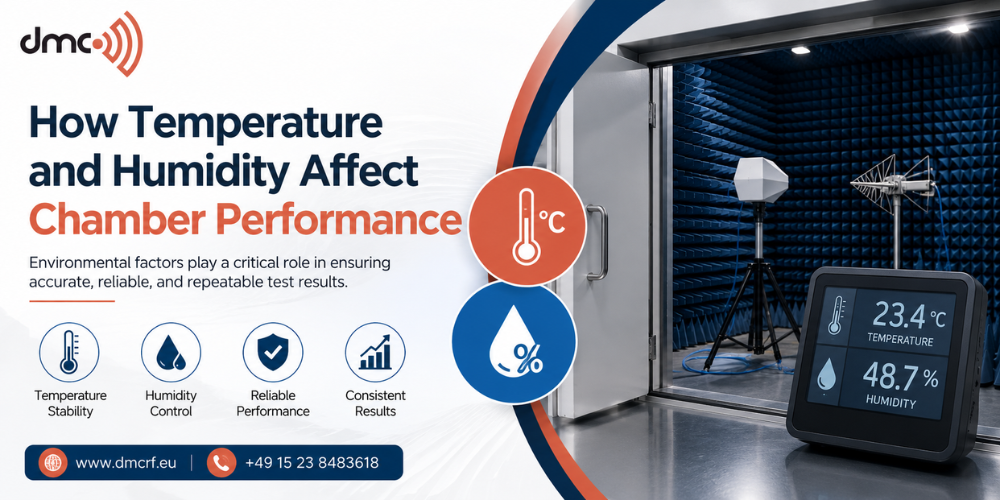
RF and EMC chambers are designed to create controlled electromagnetic environments where engineers can perform repeatable measurements. But chamber testing is not just a function of shielding, absorber material type, chamber size, and test instrumentation. Humidity and temperature may also affect the state of materials and measurement stability.
For Diamond Microwave Chambers Ltd, the knowledge of environmental conditions is of great importance to establish an accurate RF measurement environment. Control of environmental conditions allows for preservation of quality of chamber equipment and reduction of unneeded variability.
The importance of humidity and temperature is not necessary the reason for inaccuracies in chambers. It depends on the design of chamber, absorber material, equipment used, limitations of equipment and specific environmental conditions required for the test.
Effect of Temperature on RF Chamber Measurements
Changes in temperature will affect a number of equipment used in the RF chamber. The equipment may have a requirement for certain temperature range in order to function properly. The performance of equipment is affected when it is operated outside of the required range.
Important factors:
- To maintain constant room temperature during all measurements.
- To operate RF equipment within its specified operating temperature range.
- To allow the equipment to achieve thermal equilibrium prior to performing any measurements.
- Measuring the temperature variations during extended test sessions.
- Inspecting the RF chamber after some environmental changes.
How Humidity Can Affect RF Chambers:
Humidity is especially crucial due to the fact that moisture can affect the materials and the electronics used. In case the humidity level is high, it might contribute to the corrosion or other changes in the condition of the absorber systems and materials in case there is no proper environmental control.
Humidity should also be considered along with the temperature since condensation occurs when a surface temperature goes below the dew point of the surrounding air. There are special environmental testing standards where emphasis is put on the prevention of condensation during the humidity testing process.
In case of RF chambers, the following measures are recommended:
- Relative humidity monitoring regularly or at appropriate intervals.
- Prevention of the condensation on the chamber surfaces and equipment.
- Inspection of the absorber materials for any moisture problems.
- Protection of connectors, cables and other electronic devices from moisture exposure.
- Sufficient ventilation.
Temperature, Humidity and RF Absorbers:
The RF absorbers are essential for the suppression of the reflections and formation of the appropriate electromagnetic environment. The absorbers’ performance is influenced by the material properties, geometrical structure and frequency among other things.
Environmental exposure can become an additional maintenance consideration. For example, prolonged humidity or unsuitable temperature conditions may affect certain absorber materials, adhesives, coatings, or mechanical components. This does not mean that a specific humidity level will automatically cause a particular dB loss; actual effects depend on the absorber construction and manufacturer’s specifications.
Therefore, absorber condition should be assessed through inspection and, when required, chamber performance measurements rather than assumptions.
Impact on Stability of Measurements:
A properly maintained test chamber should ensure a consistent test environment. Chamber validation may consist of measurements of normalized site attenuation, site VSWR, field uniformity or shielding effectiveness, based on the chamber type and requirements for testing.
Environment monitoring should therefore be an integral part of any important testing activity. If there is an unexpected change in measurements, the entire test setup should be rechecked by the engineer rather than immediately attributing any change to temperature or humidity.
| Environmental Factor | Possible Effect | Recommended Action |
|---|---|---|
| High temperature | Equipment thermal drift or material stress | Maintain specified operating range |
| Low temperature | Equipment warm-up and condensation risk | Allow adequate stabilization |
| High humidity | Moisture exposure and material aging | Monitor and control RH |
| Rapid temperature change | Condensation and mechanical stress | Avoid abrupt transitions |
| Unstable conditions | Reduced test repeatability | Record and stabilize conditions |
Best Practices of Environment Management:
Good environment management practices should be a part of the chamber routine maintenance program.
- Monitor temperature and relative humidity.
- Adhere to equipment and absorber manufacturers’ environment requirements.
- Maintain chambers in closed condition when there is no testing configuration.
- Regularly inspect absorbers, seals, connectors, cables and metallic surfaces.
- Investigate any presence of condensation.
- Document environment conditions during important qualification or validation measurements.
Evaluate the performance of the chamber after major maintenance activities, absorber replacement or environmental incidents.
Pro Tip:
Do not use a generic temperature or humidity value as proof that an RF chamber is performing correctly. Set environmental limits in accordance with the particular chamber design, installed equipment, materials used for the absorbers, and test methods to be applied. After that, make sure you perform the chamber validation tests to check performance according to the set limits.
The Importance of Environmental Control:
Environment control, first of all, refers to repeatability of test results. Stable conditions inside the chamber mean that the engineer will have a better controlled environment to compare different devices, antennas, prototypes, and test setups.
For Diamond Microwave Chambers Ltd, design of the chamber means taking into account not only its electromagnetic performance, but also other issues like materials choice, maintenance access, ventilation, etc., as well as the environment in which it will operate. Proper environment control, taking into account such parameters as temperature and humidity, will allow you to spot possible problems before testing. In combination with chamber validation and procedures, environment control will become an essential element of reliable RF and EMC tests.
However, temperature and humidity are not the only elements that affect the performance of your chamber. Other parameters like improper conditions or fluctuations of them can affect equipment stability, materials and connectors, condition of the absorbers, and repeatability of the results obtained.
The best way to solve this problem is to control environmental conditions within limits set by the chamber and its equipment, avoid condensation, control materials, and measure electromagnetic performance of the chamber according to appropriate measuring methods.
Frequently Asked Questions
Not necessarily. The effect depends on the absorber material, construction, exposure, and manufacturer’s specifications. High humidity can contribute to material degradation or moisture-related problems, so inspection and performance verification are more reliable than assuming a fixed dB change.
They can contribute to measurement variation through equipment thermal behavior, material changes, or environmental instability. However, the actual impact depends on the complete test setup and equipment specifications.
Condensation introduces unwanted moisture onto surfaces and equipment and can contribute to corrosion, electrical problems, or material degradation. Controlled environmental testing procedures therefore take precautions to prevent condensation.
For important qualification, validation, or troubleshooting activities, recording environmental conditions can provide useful context when comparing measurements and investigating unexpected changes.
Diamond Microwave Chambers Ltd can support RF chamber design considerations involving shielding, absorber systems, chamber configuration, and testing requirements, helping customers develop controlled environments suited to their intended applications.