
Table of Contents
- What is ADAS Sensor Testing?
- Importance of RF Anechoic Chambers
- Role in Autonomous Vehicle Development
- Future Trends in ADAS Sensor Testing
Modern vehicles are rapidly evolving with advanced safety technologies, and Advanced Driver Assistance Systems (ADAS) are leading this transformation. From collision avoidance to lane-keeping assistance, these systems depend on high-performance sensors.
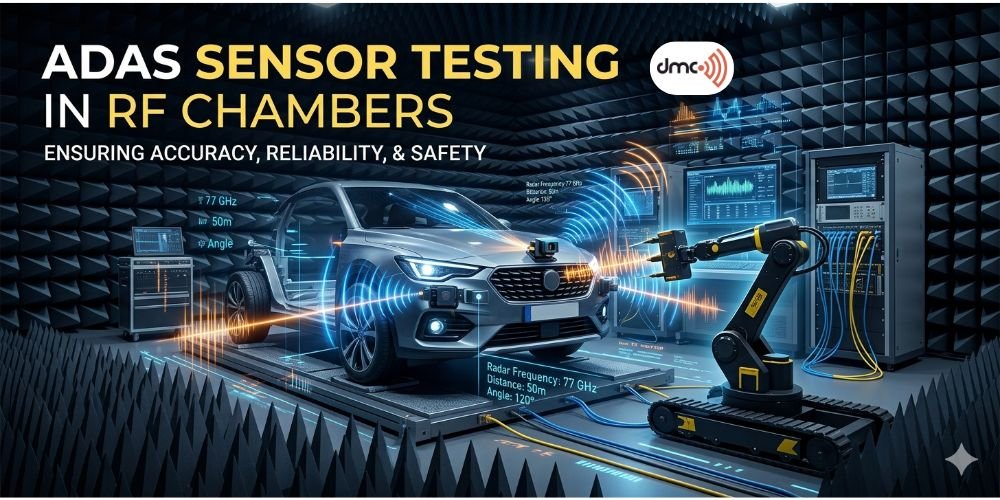
To ensure accuracy and reliability, ADAS Sensor Testing in RF Chambers plays a crucial role. With advanced ADAS testing solutions, manufacturers can validate sensor performance in controlled environments, ensuring safety in real-world driving scenarios.
What is ADAS Sensor Testing?
ADAS sensor testing involves validating multiple sensor technologies used in vehicles, including radar, LiDAR, cameras, and ultrasonic devices. These tests are essential to confirm that sensors perform accurately under different conditions.
Modern sensor validation systems are designed to simulate complex driving environments, helping engineers analyze sensor behavior under various electromagnetic and physical conditions.
Importance of RF Anechoic Chambers
RF anechoic chambers are specialized environments that absorb electromagnetic waves, eliminating reflections and external interference. These chambers are essential for precise automotive testing.
Key Advantages:
- Interference-free environment for accurate results
- Controlled conditions for repeatable testing
- Essential for EMC testing for vehicles
- Enables high-precision measurements
These features make RF chambers a core component of advanced ADAS testing solutions.
Types of Sensors Tested
Radar Sensors
Radar plays a critical role in detecting objects and measuring distance. Automotive radar testing in RF chambers ensures accurate detection and response in various driving conditions.
LiDAR Systems
LiDAR sensors create detailed 3D maps of the environment. Testing ensures reliability in obstacle detection and navigation.
Camera Systems
Cameras are essential for lane detection, object recognition, and traffic sign reading. They are tested alongside RF systems for full integration.
Ultrasonic Sensors
Used for parking and short-range detection, these sensors are validated for precision and reliability.
Key Testing Procedures
Electromagnetic Compatibility Testing
EMC testing for vehicles ensures that ADAS sensors operate without interference from other electronic systems and external signals.
Radar Cross Section Simulation
Used in automotive radar testing, this process evaluates how objects reflect radar signals, improving detection accuracy.
Signal Integrity Testing
Ensures that signals transmitted and received by sensors maintain clarity and strength.
Over-the-Air Testing
OTA testing validates wireless communication between systems, which is essential for connected and autonomous vehicle testing.
Role in Autonomous Vehicle Development
The future of mobility depends heavily on automation. Reliable autonomous vehicle testing requires precise validation of sensor systems.
By using RF chambers and advanced sensor validation systems, manufacturers can:
- Simulate real-world driving conditions
- Validate sensor fusion technologies
- Ensure system reliability under electromagnetic disturbances
This makes ADAS Sensor Testing in RF Chambers a foundational element in autonomous vehicle development.
Challenges in ADAS Testing
Despite its importance, ADAS testing comes with challenges:
- High infrastructure costs
- Complex testing environments
- Need for continuous upgrades
- Increasing system complexity
However, advanced ADAS testing solutions are continuously evolving to address these challenges efficiently.
Industry Standards and Compliance
Automotive manufacturers must meet strict safety and performance standards. RF chambers support compliance through:
- EMC certification processes
- Global automotive regulations
- OEM-specific requirements
Proper EMC testing for vehicles ensures systems operate safely in all environments.
Future Trends in ADAS Sensor Testing
The future of ADAS Sensor Testing in RF Chambers is driven by innovation.
Key Trends:
- AI-powered sensor validation systems
- Integration with 5G and V2X communication
- Enhanced automotive radar testing techniques
- Scalable solutions for autonomous vehicle testing
These advancements are shaping the next generation of vehicle safety technologies.
As vehicles become smarter and more connected, the need for reliable testing grows. ADAS Sensor Testing in RF Chambers ensures that sensors perform accurately, safely, and consistently.
With advanced ADAS testing solutions, cutting-edge RF anechoic chambers, and robust sensor validation systems, manufacturers can deliver high-quality, safe, and future-ready vehicles.
Frequently Asked Questions
They are systems and methods used to validate the performance of ADAS sensors.
They eliminate electromagnetic interference for accurate sensor testing.
It evaluates radar sensor performance for object detection and distance measurement.
It ensures electronic systems operate without electromagnetic interference.
It ensures safe and reliable performance of self-driving technologies.