
Table of Contents
- What Is Full-Vehicle EMC Testing?
- What Is Component-Level EMC Testing?
- Why Automotive Manufacturers Often Need Both
There are some significant reasons why the requirement of RF anechoic chambers arises in the aerospace industries.Aerospace items including aircraft, satellites, radars, communication devices, navigations systems, and defense electronics should work effectively without causing or being affected by any electromagnetic interferences. It is one of the many reasons that necessitates RF anechoic chambers for carrying out these tests.
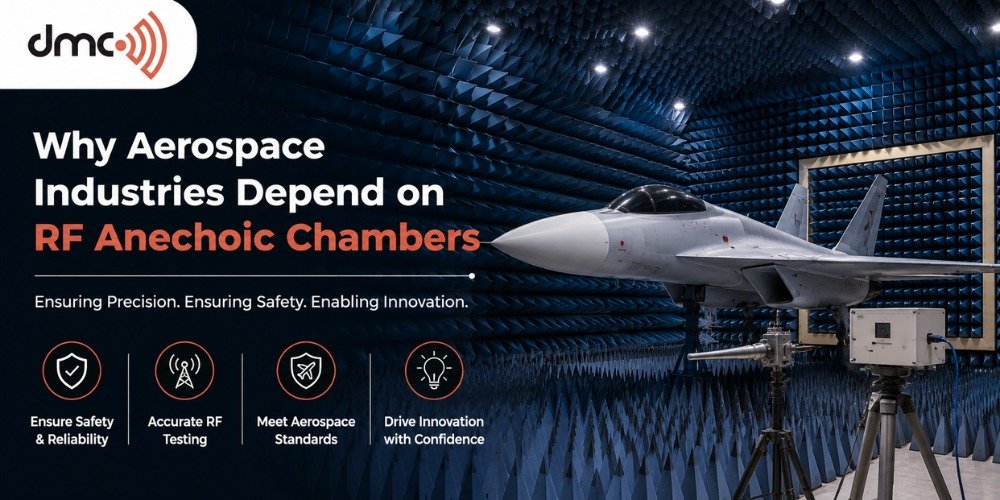
RF anechoic chambers create a special electromagnetic environment, within which testing of the equipment takes place without interference from any external source. They are usually constructed using electromagnetic shielding and RF absorbing materials to minimize the reflection and create a free space environment.
This kind of controlled electromagnetic environment is beneficial for the aerospace industry in every phase of product development.
What Is an RF Anechoic Chamber?
An RF Anechoic Chamber is an environment specifically engineered to avoid reflections of electromagnetic waves and to block any radio-frequency signal from penetrating the test area. While the chamber is protected from outside electromagnetic interference through shielding of its walls, the absorbers inside it serve to absorb electromagnetic energy.
In contrast to regular laboratories, an RF testing chamber enables higher control of electromagnetic parameters. As a result, more reliable and accurate measurements of device performance are possible.
For aerospace engineering, such a controlled environment will enable the measurement of antenna radiation patterns, gain, polarization, radar, electromagnetic compatibility, and wireless communications.
The design of the RF anechoic chamber will depend on the specific frequency band, equipment size, testing distance, and standards. The large chamber can accommodate aircraft parts or systems, whereas a small one can test small electronic assemblies.
Why Aerospace Testing Requires Electromagnetic Control:
Modern aerospace platforms contain a large number of electronic systems operating simultaneously. Navigation, communication, radar, telemetry, flight-control electronics, sensors, and data systems may all generate or receive electromagnetic energy.
If these systems interfere with one another, performance can be affected. Even a small amount of unwanted interference may become significant when a system is responsible for navigation, communication, sensing, or flight-related functions.
RF anechoic chambers help engineers identify potential electromagnetic problems before equipment reaches the aircraft, satellite, or operational platform. The above-mentioned problems concerning unnecessary emissions, vulnerability, antennas, and EMC can be detected under artificial conditions.
RF test chambers become a very important part of the process of developing products for the aerospace industry.
Applications of RF Anechoic Chambers in the Aerospace Industry:
There are many applications of RF test chambers in the aerospace industry. Common testing areas include.
| Aerospace Application | Purpose of Testing |
|---|---|
| Antenna Testing | Measures gain, radiation patterns, and polarization |
| Radar Testing | Evaluates radar transmission and reception performance |
| EMC Testing | Identifies electromagnetic emissions and compatibility issues |
| EMI Testing | Detects unwanted electromagnetic interference |
| Communication Systems | Evaluates RF performance and signal behavior |
| Satellite Components | Tests antennas, transceivers, and electronic subsystems |
| Avionics Testing | Supports electromagnetic performance verification |
| Wireless Systems | Evaluates wireless communication technologies |
These applications demonstrate why a properly designed antenna testing chamber can become an important part of aerospace research and manufacturing.
Antenna and Radar Testing:
Antennas play a critical role in many aerospace systems. They may serve in navigation, communication with satellites, telemetry, radar, communication with aircrafts, and detection purposes.
The antenna testing chamber enables one to assess such parameters of antennas as radiation patterns, gain, efficiency, beamwidth, and polarization in controlled conditions.
Similarly, radar systems must undergo testing because their operation relies on the transmission, reception, and processing of electromagnetic waves. The RF chamber allows engineers to test characteristics of radars by reducing reflections from the environment.
In sophisticated aerospace systems, it helps to achieve better accuracy in measurements.
AEMC and EMI Testing of Aerospace Electronics:
EMC is yet another important issue that needs to be considered. Electronic devices on aerospace should operate properly despite any electromagnetic activity caused by other systems installed or by external electromagnetic activity.
EMC testing checks how the equipment emits electromagnetic waves in excess and its tolerance to electromagnetic interference within certain levels.
EMI testing deals with unwanted electromagnetic interference that can influence electronics. Such an approach allows engineers to enhance the design of electronic products in terms of shielding, grounding, filtering, cables, and circuits.
The Function of RF Absorbing Materials:
Only the shielding of an enclosure does not make it effective for RF testing purposes. In order to make sure that no internal reflections affect the measurements and generate multi path signals, absorber materials need to be placed inside the chamber.
Various types of absorber materials can be chosen based on the particular frequency band being used by the chamber and its requirements. Various absorber materials, such as ferrite tiles, pyramids and hybrids, etc., can be utilized for building the chamber.
Pro Tip:
Do not choose your absorber based on its looks or frequency range. Performance of your chamber will depend on the total system of shielding, absorber design, geometry, doors, penetration, ventilation, and measuring devices.
Advantages of RF Anechoic Chambers for Aerospace Applications:
The primary benefit of RF Anechoic Chambers is that one can establish repeatable measurement conditions. The measurements do not depend on the uncontrollable environment outside.
The most important advantages are:
- Electromagnetic reflection reduction
- Minimal impact of external RF signals
- Repeatability of the measurements
- Controlled antenna measurement conditions
- Radar and wireless communication test capability
- Enhanced EMC and EMI analysis
- Detection of electromagnetic issues
- Product development and verification support
- Increased confidence in tests prior to system deployment
Repeatability of the test is especially useful when comparing various prototypes or evaluating modifications done to the existing design.
Modern Aerospace Testing and Development:
Aerospace technologies keep evolving through advancements in communications technology, autonomous vehicles, radar, satellites, and complex electronics.
These evolutions pose new demands for RF testing. High frequencies, high bandwidths, smaller components, and complex electronics may cause challenges during electromagnetic testing.
Modern RF testing facilities can be constructed for particular frequency range and measurements. Depending on the applications, RF testing facilities may include antenna rotation tables, turntables, measuring equipment, absorbers, shield equipment, and RF interfaces.
This way, RF testing facilities will stay up-to-date in regard to aerospace technological innovations.
Choosing the Correct RF Testing Chamber:
In order for an aerospace firm to select a proper RF testing chamber, there are several aspects to consider in addition to frequency range.
Such factors as the size of test object, measurement distance, antenna parameters, absorbers’ performance, shielding effectiveness, test standards, configuration and even future prospects should also be considered.
If an RF testing chamber is created only for today’s test requirements, it may become too small in case future tests involve higher frequency or larger test configuration. So, one should take into consideration both present and future testing requirements.
Aerospace systems require superior electromagnetic reliability since their performance in terms of communication, navigation, sensing, radar, and other avionics functions relies heavily on electronic performance. RF Anechoic Chambers are environments that make this possible through minimizing the effects of external interference and electromagnetic reflections on these systems.
Ranging from antenna measurements and radar testing to electromagnetic compatibility and electromagnetic interference evaluation, RF chambers are integral parts in aerospace product development processes. A well-designed chamber, effective shielding, appropriate absorbers, and configuration will go a long way in enabling engineers to get repeatable results.
As electronics in aerospace become more advanced, the need for reliable aerospace RF testing is bound to increase further.
Frequently Asked Questions
They provide a controlled electromagnetic environment that reduces external interference and reflections, enabling more reliable measurements of aerospace electronics, antennas, radar, and communication systems.
Antennas, radar systems, avionics, satellite components, communication equipment, wireless devices, sensors, and other RF electronic systems can be tested depending on chamber size and configuration.
RF absorbers reduce electromagnetic reflections inside the chamber, helping create conditions closer to free-space testing and improving measurement repeatability.
Yes. Appropriately designed chambers can support various electromagnetic compatibility and interference evaluations, depending on the required standards, frequency range, and test configuration.
The selection should consider frequency range, device size, measurement distance, shielding performance, absorber technology, testing standards, equipment requirements, and future testing needs.