
Table of Contents
- What Is An Acoustic Anechoic Chamber
- Acoustic vs RF Anechoic Chambers – Key Differences:
- Importance of RF Shielding
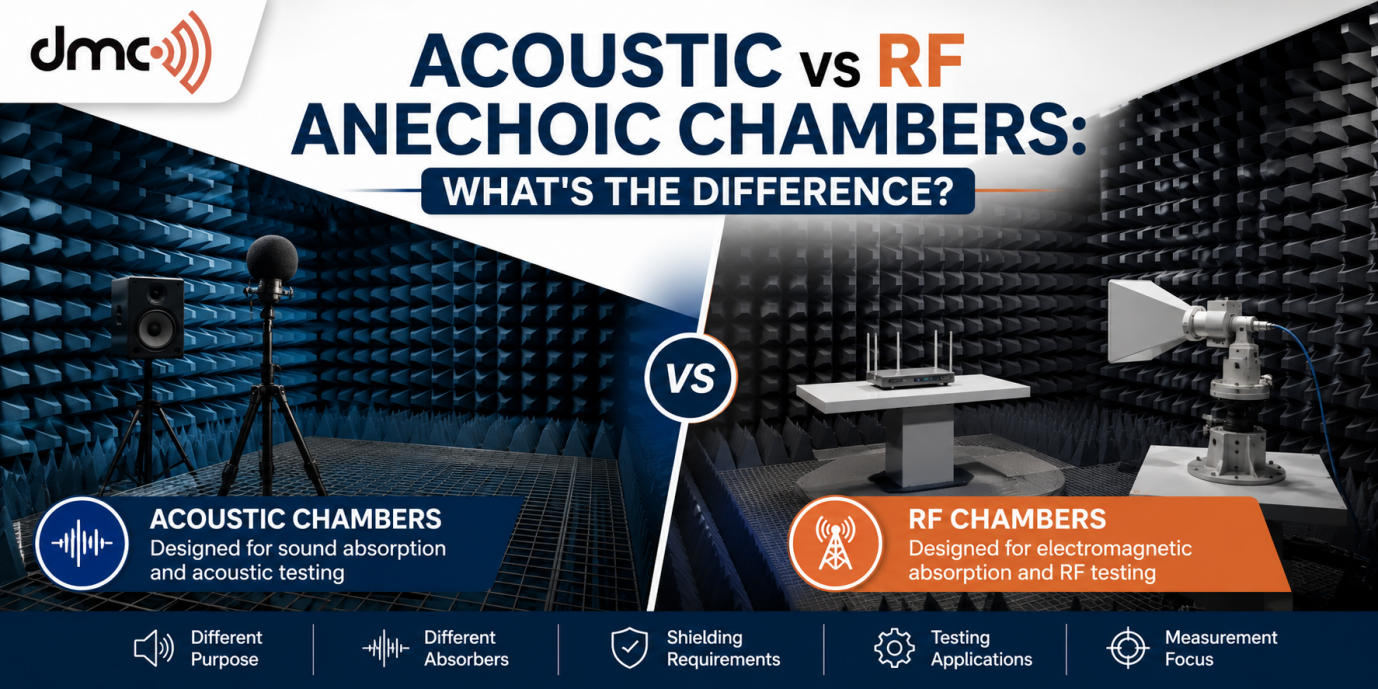
Anechoic chambers are testing facilities that have been designed specifically to reduce reflections. While the outside structure of both acoustic and RF anechoic chambers may be the same, they have been developed for entirely different purposes since one measures acoustics, while the other deals with electromagnetic and radio frequency energy.
Acoustic vs RF Anechoic Chambers is an important consideration for any manufacturer, engineer, laboratory, or testing facility looking for a reliable and repeatable measurement tool.
Anechoic chamber for acoustics is basically a room where the reflections of sound are minimized to the extent possible. The application domains of the acoustic chamber are many, including testing of microphones, loudspeakers, automotive noise, consumer electronic devices, etc.
Anechoic chamber RF prevents reflection of electromagnetic waves and reduces interference. The RF anechoic chamber has many applications such as antenna measurements, wireless communication, radars, EMI/EMC testing, and OTA testing.
What Is An Acoustic Anechoic Chamber?
An acoustic anechoic chamber is a special chamber for absorbing acoustic energy and ensuring no reflection of sound waves from walls, ceilings, and floor of a room.
In a regular room, sound waves bounce off hard surfaces. It makes it hard to conduct correct measurements due to interferences.
Acoustic chambers feature specialized materials that absorb acoustic energy within a chosen frequency band.
Common uses include:
- Tests of loudspeakers.
- Measurements of microphones
- Noise measurements of cars
- Testing of consumer electronics
- Development of audio devices
- Sound power measurements
- Noise source characterization
The main idea is to provide a special acoustic environment with minimum sound reflections.
RF Anechoic Chamber Definition:
The RF anechoic chamber is built to handle electromagnetic waves instead of audible sound.
The RF anechoic chamber uses shielding materials that are conductive in nature to block external RF signals from entering the chamber while at the same time stopping electromagnetic energy from exiting the chamber. RF absorbers are used within the chamber walls to minimize reflection.
Some uses of the RF anechoic chamber include:
- Antenna testing
- RF testing
- Wireless device testing
- Radar testing
- 5G and future wireless testing
- OTA testing
- EMI/EMC testing
- Automotive radar testing
- Electromagnetic compatibility testing
The objective is to give a controlled electromagnetic environment to test the device or antenna.
Acoustic vs RF Anechoic Chambers – Key Differences:
While both chamber types reduce reflections, their engineering requirements are significantly different.
| Feature | Acoustic Anechoic Chamber | RF Anechoic Chamber |
|---|---|---|
| Main purpose | Sound testing | Electromagnetic testing |
| Energy controlled | Acoustic waves | RF/electromagnetic waves |
| Main absorber | Acoustic foam/wedges | RF absorbers |
| Shielding | Usually not electromagnetic | Essential for RF isolation |
| Common testing | Audio and noise | Antenna, wireless, EMC and radar |
| Measurement equipment | Microphones and audio analyzers | Antennas, receivers and RF instruments |
| Frequency range | Audio frequencies | RF/microwave frequencies |
| Typical applications | Speakers, microphones, automotive noise | 5G, radar, OTA, EMC and antennas |
- Speakers, microphones, automotive noise
- 5G, radar, OTA, EMC and antennas
This comparison demonstrates the importance of choosing the right chamber. The chamber that is optimized for acoustic testing will not be able to deliver the necessary electromagnetic characteristics for the RF test.
How Absorbers Are Different:
Absorber technology is one of the key differences between acoustic and RF chambers.
Acoustic absorbers are constructed in such a way that they convert acoustic energy into heat. Physical design and thickness of absorbers depend on the required acoustic frequency range.
On the contrary, RF absorbers have their own design and properties. They are created to reduce electromagnetic reflections in a certain frequency range.
RF chambers may use such types of absorbers as:
- ferrite tiles
- carbon-loaded foam absorbers
- hybrid absorbers
- pyramidal RF absorbers
- special low-frequency absorbers
Importance of RF Shielding
One of the major differences between acoustic and RF Anechoic Chambers is electromagnetic shielding.
An RF testing room usually needs to have a conductive enclosure providing electromagnetic isolation from the surroundings. This reduces interference caused by mobile networks, radio transmitters, electric devices, and RF sources.
Shielding can be designed using conductive panels and precise joining seams, doors, ventilating systems, power filters, and cable pass-throughs.
Leakage even in tiny quantities can influence sensitive RF measurements. Thus, shielding is one of the aspects of RF testing room design.
Different Testing Equipment:
The equipment used inside the room is different depending on the type of testing.
In the case of acoustic test rooms, microphones, loudspeakers, audio analyzers, sound level meters, and acoustic equipment are used.
In the case of RF testing rooms, it may include measuring antennas, spectrum analyzers, network analyzers, signal generators, receivers, turntables, antenna positioning system, automated measurement equipment.
For the wireless product testing, there is the possibility of over-the-air testing in the RF chamber.
Applications in Modern Engineering:
The need for controlled testing chambers grows continuously, especially as products grow increasingly complex and connected.
Car makers test their radar and wireless systems in RF chambers, while consumer electronic firms test their products for wireless communication and antenna performance.
Acoustic chambers still serve a purpose in vehicle noise design, audio equipment, speakers, microphones, and other sound devices.
For companies utilizing acoustic technology as well as EM technology, it is important to know the differences between the two types of chambers.
Which Chamber to Choose:
The choice of chamber depends on the test objective.
When the requirement includes measuring sound generation, sound transmission, microphone response, or speaker performance, an acoustic chamber would fit.
If antennas, EM radiation, wireless communication, radar, OTA performance, or EMC measurement is needed, then an RF anechoic chamber would be preferable.
Engineers should also think about:
- Necessary frequency range
- Chamber size
- Absorber efficiency
- Shielding effectiveness
- Tests specifications
- Configuration of test equipment
- Door and access specification
- Ventilation and filters specifications
- Automated tests requirements
- Futures testing needs
A good defined chamber can result in increased repeatability of tests and avoidance of expensive redesigns.
Tip:
Never choose an anechoic chamber according to its appearance and size. Determine the frequency range, testing standard, absorber efficiency, shielding level, equipment configuration, and measurement purpose before designing the chamber.
RF Anechoic Chambers for Advanced Testing:
Nowadays, modern RF anechoic chambers are created to serve in advanced testing applications such as 5G, automotive radar, IoT,satellite communication, and antennatesting.
Higher frequencies may add certain complications during designing of a test environment because small details of a chamber may affect measurement results. Therefore, absorber selection, chamber shape, antenna placement, shielding, and equipment should be taken into account simultaneously.
For manufacturers and laboratories, a good RF testing chamber provides the repeatable environment to test electromagnetic performance of wireless products.
The major difference between Acoustic and RF Anechoic Chambers is energy that each of them is supposed to control. Acoustic anechoic chambers reduce sound reflections while RF anechoic chambers reduce electromagnetic reflections and ensure electromagnetic isolation.
Although both facilities use absorbers and controlled test chambers, the absorbers, shielded materials, instrumentation, frequency range, and application fields of both differ.
It is appropriate to select the right anechoic chamber depending on the requirements for the product testing. A properly designed RF anechoic chamber will assist in achieving the required objective for RF, antenna, wireless, EMC, radar, and OTA testing applications.
Frequently Asked Questions
Acoustic chambers control sound reflections, while RF anechoic chambers control electromagnetic reflections and external RF interference.
Generally, no. RF testing requires appropriate electromagnetic shielding and RF absorber systems designed for the required frequency range.
They are used for antenna measurements, OTA testing, wireless devices, radar, EMI/EMC testing, 5G testing, and electromagnetic measurements.
Common options include ferrite tiles, carbon-loaded foam, pyramidal absorbers, and hybrid RF absorber systems.
Consider the frequency range, chamber size, shielding performance, absorber specifications, testing standards, equipment, and intended application.