
Table of Contents
- What is AI-Driven Antenna Measurement Automation?
- Key Components of AI-Based Measurement Systems
- AI Automation Implementation Challenges
- Why Choose Diamond Microwave Chambers Ltd
The wireless communications industry is constantly changing, driven by developments in 5G, IoT, satellite communications, self-driving vehicles, and emerging wireless technologies. However, the increasing complexity of antenna design poses challenges for classic test and measurement techniques, which cannot satisfy the requirements of fast and accurate testing anymore. The rise of AI-Driven Antenna Measurement Automation promises to bring revolutionary changes to the industry.
In today’s testing laboratories, scientists are using artificial intelligence (AI) and machine learning to enhance testing procedures, decrease labor inputs and boost the reliability of the testing process. Using modern software and positioning robotics and advanced data analytics, engineers can get reliable test results in minimum time.
What is AI-Driven Antenna Measurement Automation?
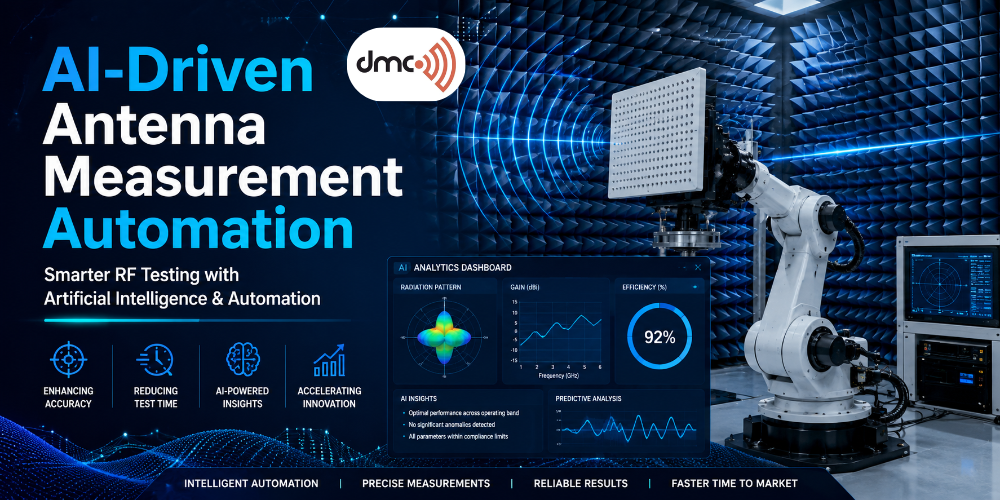
Definition of AI-Driven Antenna Measurement Automation, AI-driven antenna measurement automation is referred to as the use of artificial intelligence and test automation techniques in antenna measurement without any direct human involvement. This technology includes antenna placement, data acquisition, analysis, and post-processing of test results.
Unlike conventional techniques where human intervention is required for most processes, the role of AI in Antenna Testing is to make use of intelligent algorithms to improve efficiency and identify problems.
The ultimate aim is to develop smart testing facilities that can handle high volumes of measurements accurately.
Why Automation Matters in Antenna Testing
Due to increasing complexity in wireless devices, a comprehensive testing process is required.
The main problems associated with the conventional testing process are as follows:
- Time consuming testing process
- Human errors while conducting tests
- Variations in testing methodology
- High cost for conducting such tests
- Problematic data handling capabilities
Through automated antenna measurement systems, organizations can easily overcome these problems.
Key Components of AI-Based Measurement Systems
Several technologies work together to enable AI-Based RF Measurement solutions.
| Component | Function |
|---|---|
| AI Algorithms | Analyze measurement data and identify patterns |
| Machine Learning Models | Predict antenna behavior and optimize testing |
| Robotic Positioners | Automatically rotate antennas during measurements |
| Data Analytics Software | Process and visualize test results |
| RF Instrumentation | Capture antenna performance metrics |
| Test Chambers | Provide controlled measurement environments |
| Cloud Platforms | Store and manage large datasets |
These components collectively enhance the capabilities of modern RF Testing Automation systems.
How AI Improves Antenna Measurement Processes
There are some improvements that artificial intelligence provides at various stages during the measurement process.
Smart Test Planning
AI devices are able to determine the optimal test order, taking into account antenna parameters and its performance expectations. It results in avoiding redundant tests.
Error Detection in Real Time
The key benefit provided by Artificial Intelligence in Antenna Testing is the real-time error detection capability of AI algorithms. If anomalies are found, operators are immediately notified about it.
Automatic Data Processing
Manual processing of data traditionally implies considerable involvement of engineers. Thanks to Machine Learning for Antenna Testing, software can handle large amounts of data points on its own.
Performance Prediction
ML models can make predictions on antenna performance at certain environmental conditions.
Benefits of AI-Driven Antenna Measurement Automation
Many benefits can arise from the application of AI-Driven Antenna Measurement Automation.
Faster Testing Cycles
Automation allows removing repetitive manual actions and shortening testing periods.
Greater Accuracy
Use of artificial intelligence will reduce human errors and ensure the consistency of measuring procedures throughout several tests.
Operational Savings
The need for fewer manual resources and higher productivity may lead to cost savings in testing.
Increased Scalability
Modern Automated Antenna Measurement Systems can handle testing operations that involve multiple products and different frequency ranges.
Data-Driven Decision Making
In-depth analysis of collected data allows making rational choices when developing antenna designs.
Application Areas
The implementation of AI-Based RF Measurement is becoming widespread in various sectors.
Telecommunications
The Telecom industry uses automation for validating the performance of the 5G network equipment and preparing to launch 6G infrastructure.
Consumer Electronics
Testing antennas in consumer devices is essential for ensuring the adequate functionality of smartphones, wearables, and IoT devices.
Automotive Industry
Testing antennas in automobiles for different communication systems such as radar systems and vehicle-to-everything (V2X) is crucial as well.
Aerospace and Defense
For both military and aerospace organizations, RF Testing Automation is vital in relation to communication devices.
Aerospace and Defense
The military and aerospace agencies use advanced RF Testing Automation solutions when it comes to critical communication equipment.
Satellite Communications
Satellite production agencies need accurate and automated measurements in order to assess their antennas’ performance capabilities under challenging operational conditions.
Antenna Test Chamber Role
Testing requires well-controlled environments. The contemporary Antenna Test Chambers are crucial components in terms of implementing the AI-powered automation.
Such test chambers allow excluding any external interference and reflections which enables precise measurement of antennas.
With the assistance of AI algorithms and robotic positioning tools, the Antenna Test Chambers become excellent testing environments that can facilitate wireless technology development.
AI Automation Implementation Challenges
Despite all the advantages provided by the innovation, certain challenges related to its implementation might arise.
Initial Cost
High-end automation solutions require considerable investments in both hardware and software infrastructures.
Quality of Data
Any AI solution relies upon high-quality datasets. Low accuracy levels of measurement data can lead to the degradation of algorithms’ performance.
Automation Complexity
The integration of AI software into the RF equipment can be complicated.
Workforce Training
Companies would need to retrain their workers in order for them to operate automation testing environments effectively.
Future Trends in AI-Powered Antenna Testing
Prospects for the future of the field seem promising with ongoing technological advancement.
Upcoming trends are likely to be:
- Self-education measurement systems
- Automated test laboratories
- Antenna test systems based on the cloud
- Application of digital twins
- RF equipment predictive maintenance
- Antenna design using AI-driven assistance
In line with the development of new wireless technology, including 6G and higher, intelligent automation will become indispensable.
Why Choose Diamond Microwave Chambers Ltd
At Diamond Microwave Chambers Ltd, we offer the latest in Antenna Test Chambers, RF measurement equipment and facilities that cater to modern AI-Driven Antenna Measurement Automation needs.
We help businesses improve their testing procedures, reduce the time of development, and adhere to the latest wireless communication protocols. Whether you work on 5G technology, IoT devices, automotive components, or satellites, our solutions will assure your testing accuracy and performance.
Wireless communication becomes increasingly popular nowadays, and we see that the solution to this challenge is AI-Driven Antenna Measurement Automation. Employing artificial intelligence and machine learning technologies, automated testing and RF measurement solutions can help save time, energy, and efforts.
With increasing complexity of modern antennas, businesses will be obliged to utilize AI in Antenna Testing to provide increased reliability. Businesses who implement AI and machine learning technologies will stay relevant in the constantly changing sphere of RF.
Frequently Asked Questions
AI-Driven Antenna Measurement Automation uses artificial intelligence and automation technologies to perform antenna testing, data collection, and analysis with minimal human intervention.
AI improves testing accuracy, reduces measurement time, automates data analysis, and detects anomalies in real time.
Telecommunications, automotive, aerospace, defense, satellite communications, and consumer electronics industries commonly use Automated Antenna Measurement Systems.
Antenna Test Chambers provide controlled environments that eliminate interference and reflections, ensuring accurate RF measurements.
Benefits include faster testing, reduced costs, improved consistency, enhanced scalability, and better engineering insights.