
Table of Contents
- What Are RF Absorber Materials?
- Evolution of RF Absorber Technology
- Applications of Modern RF Absorber Materials
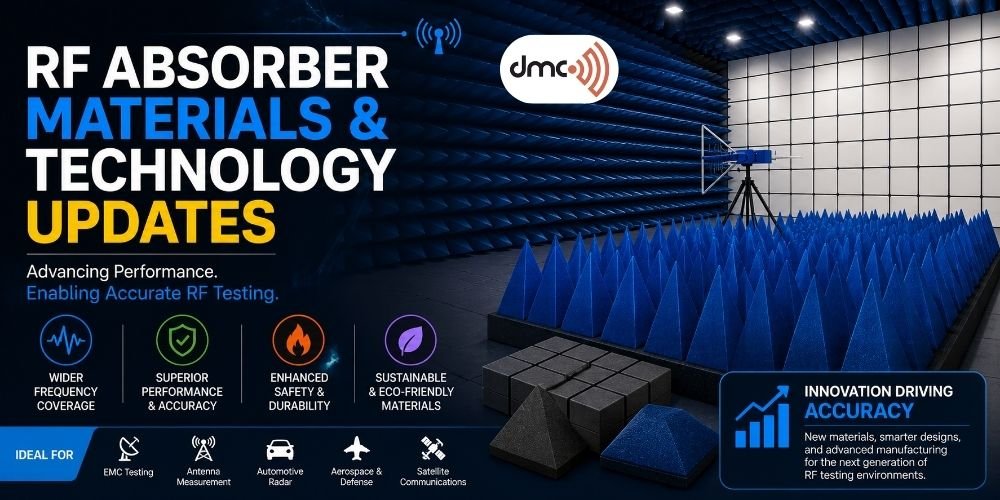
The performance of today’s RF testing facilities relies heavily upon the quality and effectiveness of their RF Absorber materials. This importance will grow as we look towards the future of wireless technology with 5G; as well as all the research into 6G, automotive radars, pervasively connected IoT devices, satellite communications, and advanced defense applications.
RF absorbent materials play an important part in controlling the undesired electric and magnetic energy (emfs) reflected back into the test environment by mitigating unwanted emfs and providing free-space simulation for testing antennas, wireless devices, radar systems and compliance to EMC regulations. Recent advances in material science and manufacturing processes have enhanced the performance, durability and maximum frequency range that specific RF absorbents can achieve.
Diamond Microwave Chambers Ltd has developed a wide range of high-performance RF chamber absorbents specifically engineered to support the increased demand for modern RF testing applications. By understanding current technology trends in RF absorbent materials, businesses can identify the appropriate types of absorber products for their own facility.
What Are RF Absorber Materials?
RF Absorber material is specially designed to absorb electromagnetic energy instead of reflecting it. These materials are typically used in an anechoic chamber or an EMC test room, radar testing facility and antenna measurement area.
The main purposes of RF Absorber materials include:
- Minimizing electromagnent reflections
- Reducing standing waves
- Improving measurement accuracy
- Simulating free-space conditions
- Improving performance when performing EMC tests
With out the correct absorber material, the reflections created will have a significant negative influence on test result which could lead to inaccurate readings and/or certification (as well as performance) failures.
Evolution of RF Absorber Technology
As RF absorber technology has progressed through time, it has developed from using only basic ferrite tiles to sophisticated hybrid technologies that have the ability to absorb RF energy across a vast bandwidth of frequencies.
The first generation of RF absorbers used ferrite materials to absorb RF energy effectively at low-frequency and had limitations in terms of use over broadband frequencies.
Some characteristics of first-generation absorbers were:
- Absorbing at low frequencies very well
- Manufactured with heavy construction
- Limited to use in specific bands or ranges of frequencies
- Can last for many years.
Modern Broadband Absorbers
The most advanced microwave absorber materials in use today combine several technologies for superior performance over a wider frequency range than ever before.
Modern features include:
- Many frequencies covered
- Lightweight and compact
- Fire-resistant
- Long-lasting in harsh environments
- Smaller footprint of the chamber
1. Pyramidal RF Absorbers
Pyramidal absorbers are the most commonly used type of RF absorber in both RF test chambers and antenna range testing.
Key Benefits:
- Excellent wideband absorption properties
- Lightweight construction
- Cost-effective to install
- Most suitable for antenna testing
Pyramidal absorbers are constructed from carbon loaded polyurethane foam shaped into a pyramid. The pyramid shape of these absorbers tapers the incident RF energy as it travels down through the various layers of the material, allowing for a gradual reduction in the amount of reflected RF energy.
2. Ferrite RF Absorbers
Ferrite RF absorbers are used extensively in EMC testing applications.
Some advantages of ferrite absorbers:
- Very good low-frequency performance
- Very compact size
- Long functional service life
- Effective below 1 GHz
Ferrites are essential components in many EMC testing chambers where it is critical to absorb RF energy at low frequencies.
3. Hybrid RF Absorbers
Pyramidal foam absorber is made of hybrid RF absorbers & ferrite tiles.
Pros of Hybrid Solutions:
- Greatly expands frequency range
- Greatly improves EMC compliance performance
- Slightly reduces overall size of chamber
- Greatly reduces reflected wave characteristics
Most modern compliance laboratories have adopted hybrid solutions.
New Technologies being released related to RF Absorbers
Carbon Loaded Foam Absorber Innovations
An example of innovation when it comes to RF Absorbers is the use of enhanced carbon loading techniques in the foam used for RF Absorbers.
Advantages of this innovation are:
- Increases efficiency in absorbing RF energy
- Provides better consistency in product between manufacturers
- Increases performance for frequencies higher than 1 MHz
- Decreases variability from lot to lot when making the foam
By using this type of foam for RF Absorbers, you can expect reliable, repeatable results in your RF Testing Laboratories.
Nanolithography in RF Absorber Material
Researchers have begun investigating the evolution of nanotechnology to develop new RF Absorber Materials.
The most likely benefits of these materials are:
- Reduced thickness of RF Absorber Designs
- Increased frequency coverage of RF Absorbers
- Reduced weight of RF Absorber material
- Improved thermal stability of RF Absorber material
Nano-Engineered materials should play an important role in the future development of RF Absorber Technology.
Sustainable Manufacturing Processes
Environmental sustainability has gained importance among every industry. Last few years manufactures of Absorbers have implemented the following improvements:
- Reduction in Waste
- Use of Recyclable Materials
- Decreased VOC Emissions
- Energy Efficient Manufacturing Processes
These advances help achieve environmental goals as well as increase operations’ overall efficiencies.
Safety regulations continue to change in the RF test equipment industry according to RF Test Facility Safety Codes, the latest advancements in absorber products include:
- Better flame-retardant properties
- Limiting smoke generation
- Meeting requirements of international safety codes
- Protecting facilities better from fire damage
These advances are particularly key for large anechoic chambers and defence sites.
Applications of Modern RF Absorber Materials
Testing for EMC Compliance Testing is done in an EMC Laboratory with advanced EMC Absorber Technology that enables an accurate evaluation of Emission and Immunity Performance of devices.
The benefits of using EMC Absorbers are:
- Decreased Reflection
- Compliance with International Standards
- Increased Repeatability
- Quicker Certification Process
Antenna Testing Facilities require strict control of the testing environment in order to achieve an accurate characterization of Antennas.
Modern Absorbers provide:
- Improved Gain Measurement
- Improved Accuracy of the Radiation Pattern
- Increased Repeatability
- Decreased Measurement Uncertainty
As Autonomous Vehicles increase in prevalence, so too will the need for Radar Testing Facilities.
Advanced RF Absorber materials allow for:
- Radar Target Simulation
- Validation of Vehicle Sensors
- Development of Advanced Driver Assistance Systems (ADAS)
- Millimeter Wave Testing
Defense is another area that uses Specialty Absorbers for Applications such as:
- Measuring the Radar Cross Section
- Electronic Warfare Testing
- Validating Satellite Communication
- Developing Military Antennas
Pro Tip
Find the Right Absorber for Your project
When selecting an Absorber, make sure that you are aware of all aspects of your facility. One of the most important considerations is to ensure that you have chosen an absorber which will meet your needs (both now and in the future) while also being safe to use.
Using a well-respected partner such as Diamond Microwave Chambers can help you determine the right combination of performance, life cycle, and investment return for your selected absorber.
Important Considerations When Choosing the Right Absorber
1) Frequency Range
Make sure that the absorbers you are considering will give you the required performance at all frequencies that are currently or eventually required.
2) Chamber Type
Chamber use varies and so too does the configuration of the absorbers.
Examples might be:
- Emission control testing or earthing
- Antenna testing, to meet requirements for antenna line-of-sight
- Radar test
- Space communications or outdoor-to-indoor transmission testing
3) Environmental Durability
When selecting an absorber consider:
- Application temperatures
- Application humidity
- Mechanical degradation
- Long term stability
4) Compliance to standards
Before investing in absorbers, check with local authorities to make sure that they comply with applicable standards for your application.
Future Trends in RF Absorber Technology
The following emerging technologies are anticipated to impact the development of absorbers in the future:
Chamber Design Optimized for AI
AI is starting to be used by engineers to help them find the best placement of absorbers and configure the chambers in which they will be placed.
Ultra-Wide Bandwidth Absorbers
Future absorbers will probably provide wider frequency ranges than 5G and will, as a result, support the new Industry Standard for 6G and beyond.
Lightweight Composite Materials
The reduction of chamber installation costs will continue with the development of composite materials while increasing the performance of these materials as well.
Smart Absorber Systems
Researchers are looking at ways to design adaptive absorber systems that adjust their electromagnetic characteristics in relation to the testing needs.
As wireless technologies develop and become more advanced, the development of RF Absorber Materials will continue to change quickly. The advancement of technical materials used in RF Absorbers continues to develop. Advanced carbon-loaded foams and hybrid absorbers, and nano-engineered materials, along with smart absorber technology will be helping testing organizations achieve higher testing accuracy and improved operational efficiency when testing with their RC absorber materials.
Modern-day RF absorbers in microwave chambers are still an integral part of building reliable RF testing environments, whether the applications for these RF absorbers is EMC compliance testing, Antenna Measurement, Automotive Vehicle Radar Validation, and Aerospace Development.
Diamond Microwave Chambers Ltd offers innovative absorber solutions for the RF testing industry that are engineered to meet the demanding standards of RF testing today. If you have further questions or would like to discuss how to effectively develop your RF Absorber Materials, contact our team today.
Frequently Asked Questions
RF absorber materials reduce electromagnetic reflections inside test chambers, improving the accuracy of RF, EMC, antenna, and radar measurements.
Ferrite absorbers perform best at lower frequencies, while pyramidal absorbers provide excellent broadband absorption at higher frequencies.
Hybrid absorbers combine ferrite and foam technologies, offering broad frequency coverage and superior chamber performance.
High-quality RF absorbers can last many years when properly maintained and protected from environmental damage.
Industries including telecommunications, automotive, aerospace, defense, electronics manufacturing, and research laboratories rely on RF absorber technology.