
Table of Contents
- Some of the Chamber Types Available Include
- Full Anechoic vs Semi Anechoic Chambers
- Importance of RF Absorber Materials
- Automation and Future-Proofing
Choosing the right Anechoic Chamber is one of the biggest challenges facing those working in RF testing, EMC testing, antenna testing, wireless device testing, and automotive electronics testing. With new developments taking place in wireless technologies, including 5G, Internet of Things (IoT), satellite communication, radars, and even 6G networks, the need for accuracy in testing has never been greater before.
The purpose of using the Anechoic Chamber is to have a test facility that provides controlled electromagnetics environment without any interference from the outside world. It is possible to conduct very accurate and repeatable tests in such environment. Yet not all chambers are the same – there are chambers that are more appropriate for particular requirements.
Some of the Chamber Types Available Include:
What Is an Anechoic Chamber?
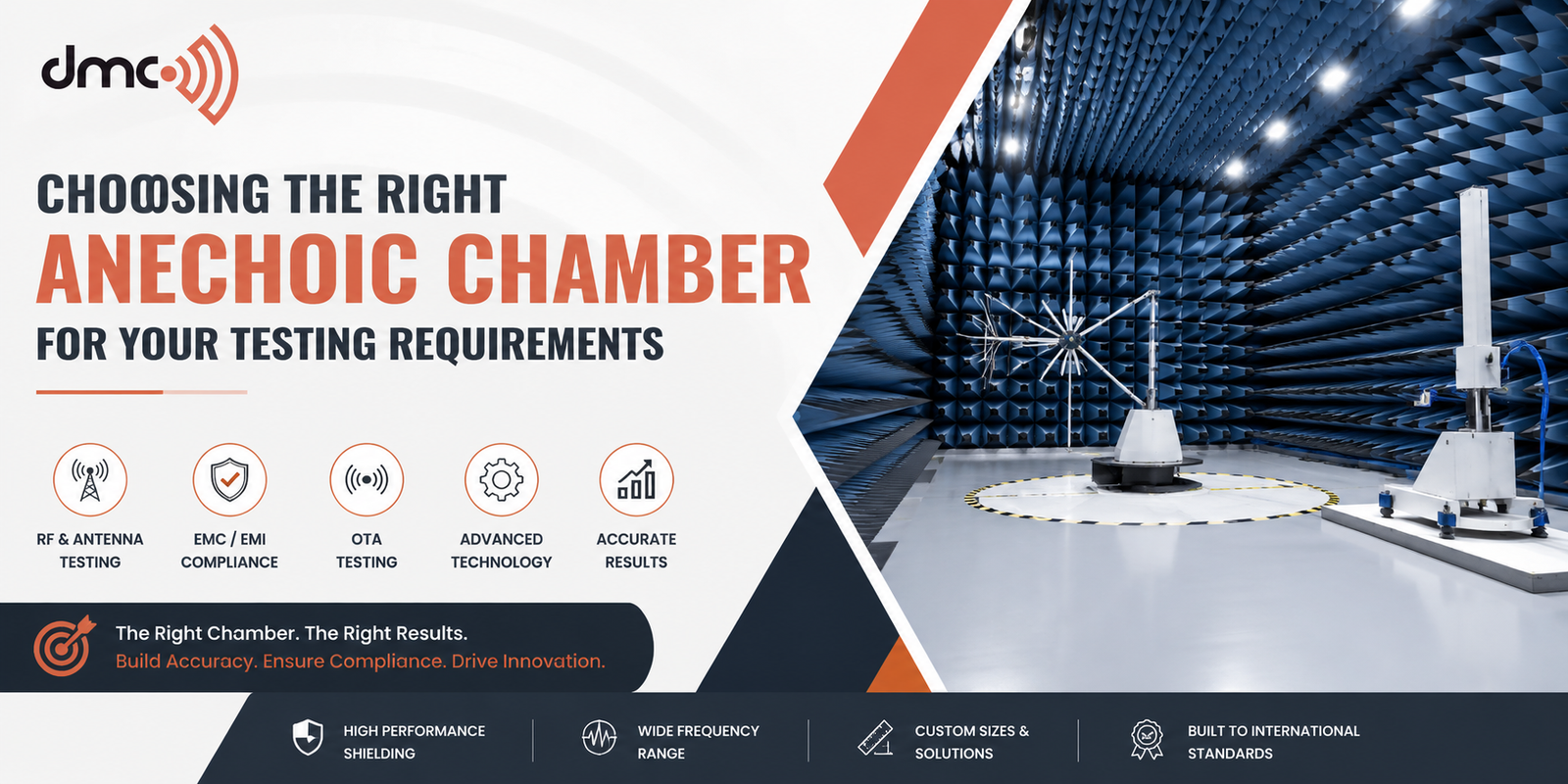
An Anechoic Chamber is an enclosure that has been specially built with lining of RF absorbing material that absorbs electromagnetic waves, such that the electromagnetic waves do not reflect from the walls, roof, and floor of the test enclosure.
The following are common applications of Anechoic Chambers:
- Antenna Pattern Testing
- OTA (Over-The-Air) Testing
- EMC Compliance Testing
- Radar Testing
- Wireless Device Testing
- Automotive Sensor Testing
- Aerospace Communication Testing
The main purpose of these enclosures is to mimic a free-space environment where testing of devices is conducted.
Why Choosing the Right Chamber Matters
Choosing the wrong chamber can result in incorrect results, unsuccessful certifications, higher testing expenses, and difficulties with further expansion.
An appropriately engineered RF Anechoic Chamber provides:
- Accurate results
- Regulatory compliance
- Lower retesting expenses
- Higher product quality
- Faster development cycles
- Scalability
Organizations planning to build their testing facilities must consider their needs thoroughly before choosing one of the options above.
Full Anechoic vs Semi Anechoic Chambers
Among the most commonly made choices is that between a full anechoic and semi anechoic chamber design.
Full Anechoic Chamber
In a Full Anechoic Chamber, there are absorber panels in all the surfaces, even the floor.
Advantages:
- Highest precision in measurements
- Ideal for testing antennas
- Perfect for OTA testing
- Very few reflections
Uses:
- Testing mobile devices
- Satellite communications
- Aerospace applications
- Antenna research and development
Semi Anechoic Chamber
A Semi Anechoic Chamber features absorber panels on walls and ceiling while the floor surface remains reflective.
Advantages:
- Compliance with EMC standards
- Can accommodate larger equipment
- Low cost of installation
Uses:
- EMC testing compliance
- Automotive electronics
- Industrial equipment testing
Frequency Range Considerations
Frequency needs will have a strong impact on the design of the chamber.
Low-frequency tests may need ferrite absorbers whereas high-frequency tests will require foam absorbers.
Frequency ranges may include the following:
- 30 MHz – 1 GHz
- 1 GHz – 6 GHz
- 6 GHz – 18 GHz
- 18 GHz – 40 GHz
- 40 GHz – Above for millimeter wave tests
Those who plan for future upgrades should go for the Anechoic Chamber that supports 5G and 6G technology tests.
Chamber Size Requirements
The dimensions of the DUT dictate the required dimensions of the chamber.
These considerations will involve the following:
- Dimensions of the product
- Distance between the antennas
- Size of the turntable
- Space allocation for test instruments
- Any future expansion plans
As such, the testing of a smartphone will require much less space compared to the testing of a radar in an automotive application or aircraft communication antenna.
Importance of RF Absorber Materials
RF absorbers are an essential part of any RF Anechoic Chamber.
Absorber categories include:
Ferrite Tile Absorbers
Advantages:
- Excellent low-frequency performance
- Durability
- Long-term functionality
Uses:
- EMC test chambers
- Compliance test laboratories
Foam Absorbers
Advantages:
- Great high-frequency absorption capabilities
- Lightweight structure
- Versatility
Uses:
- Antenna measurement test chambers
- OTA test chambers
Hybrid Absorbers
Advantages:
- Broad frequency range
- Advanced functionality
- Space-saving
Uses:
- Multi-functional RF test chambers
RF Shielding Performance
The efficiency of an Anechoic Chamber is greatly influenced by the shielding efficiency of the facility.
High-efficiency shielding protects against:
- External Radio Frequency Interference
- Signal Leakage
- Environmental Noise Contamination
A well-engineered Shielded Test Chamber guarantees accurate and reliable readings at all times.
Major elements of shielding are:
- Shielded Doors
- RF Filters
- Ventilation Honeycombs
- Conductive Walls
- Compliance and Industry Standards
It is important that the organization’s chamber meets the applicable international standards.
Popular standards are:
- CISPR
- IEC
- ANSI
- ETSI
- MIL-STD
- Automotive ISO Standards
Automation and Future-Proofing
Many modern test labs have incorporated automated technologies.
Modern Advanced Antenna Measurement Chambers may comprise:
- Robotics positioners
- Automated turntable
- Remote control systems
- AI-based measurement system
- Software systems
Such future-proof chambers will reduce upgrade expenses and increase efficiency in operation.
Price vs Performance
Even though it is important to consider the budget, choosing an antenna testing facility only because it is inexpensive may prove to be a bad choice.
The factors influencing the price of an antenna test chamber are:
- Dimensions of a chamber
- Shielding characteristics
- Absorption technology
- Automatization level
- Frequency range
- Requirements to compliance
One should look at the cost-effectiveness of an antenna chamber over its life cycle.
Pro Tip
When choosing an Anechoic Chamber, try to take into account your testing needs not only now but also in 5-10 years. With emerging technologies like 6G, advanced automotive radar, satellite communication, and Internet of Things (IoT) devices, it is likely that higher frequency and more advanced testing will be required.
When it comes to choosing an Anechoic Chamber, one must take into consideration many factors, which include objectives of testing, frequency range, chamber volume, absorbing materials used, level of shielding provided, regulations, and expandability. No matter whether you deal with antenna design, OTA testing, EMI testing, automobile parts, or aerospace communication equipment, having the correct testing facility is critical to getting accurate results.
Businesses who choose to construct an efficient RF Anechoic Chamber will get better testing results, quicker certifications, shortened development times, and quality products. Understanding the types of testing facilities will give businesses an opportunity to create a testing facility that will serve them both currently and in the future.
Frequently Asked Questions
An Anechoic Chamber is used for RF testing, antenna measurements, EMC compliance testing, OTA testing, and wireless device validation.
A full anechoic chamber has absorbers on all surfaces, while a semi anechoic chamber uses a reflective floor for EMC testing applications.
Telecommunications, automotive, aerospace, defense, electronics, and research organizations frequently use RF Anechoic Chambers.
RF absorbers minimize electromagnetic reflections, creating a controlled environment for accurate measurements.
The correct size depends on the device under test, antenna distance requirements, testing standards, and future expansion needs.