
Table of Contents
- What Is Modular Anechoic Chamber Construction?
- Top Benefits of Modular Anechoic Chamber Construction
- Applications of Modular Anechoic Chambers
Advanced wireless communication systems, automotive radar technology, aerospace electronics, and IoT devices have seen increasing needs in various sectors. Hence, there arises a need for manufacturers to test the performance of their products prior to deployment. An Anechoic Chamber is among the most essential test facilities when it comes to testing RF, EMC, antenna, and microwave measurements. Nevertheless, conventional design and construction of chambers takes a lot of time, requires significant resources, and lacks flexibility.
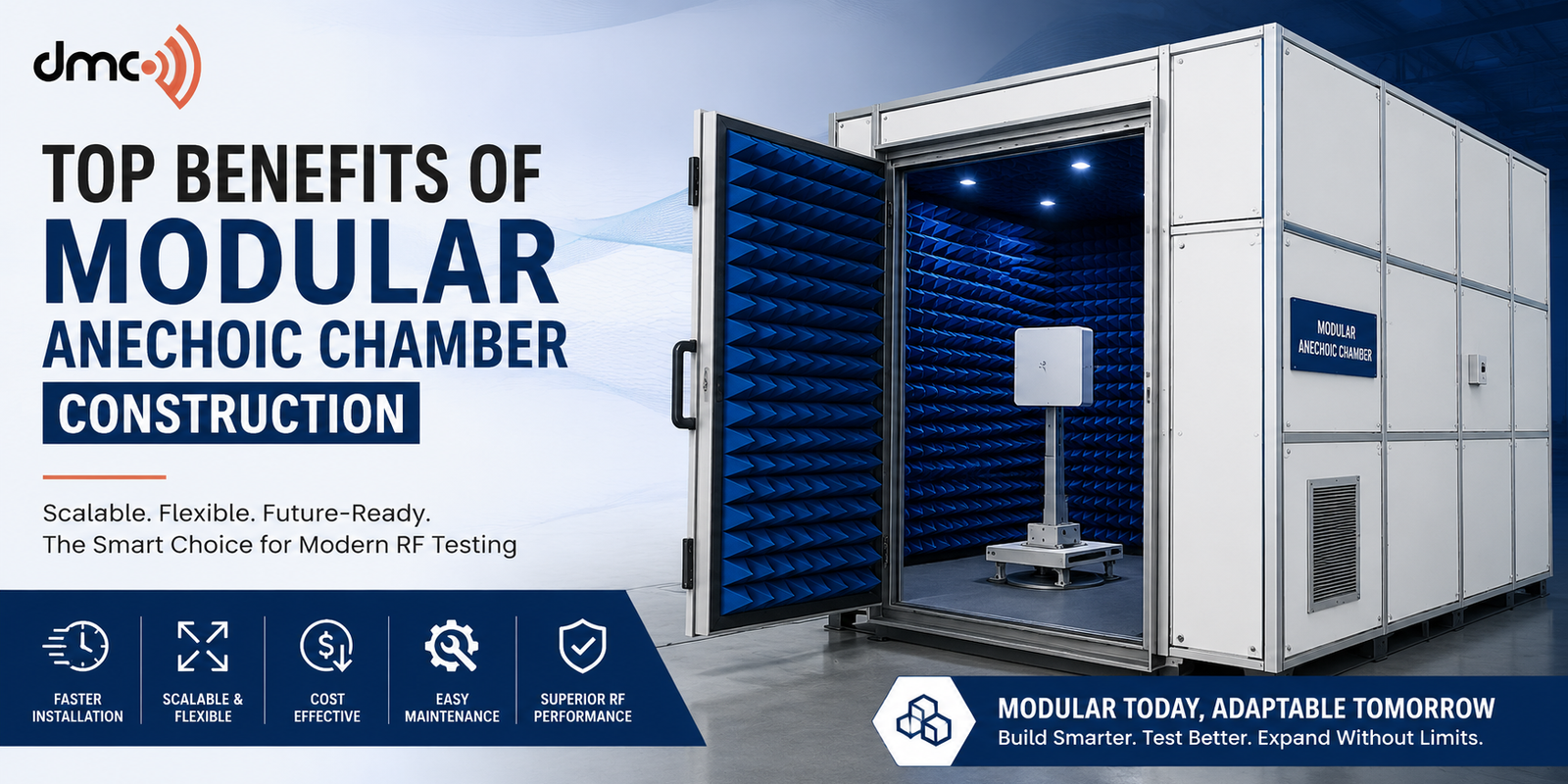
With that said, Modular Anechoic Chamber Construction has revolutionized the way testing takes place today. The use of pre-engineered panels, modular shielding systems, and absorbers makes it easier for firms to establish very effective testing facilities, without the difficulties that are normally associated with installation and future growth of the facility.
In this paper, we look at some of the key advantages of Modular Anechoic Chamber Construction and why it has become the preferred option today.
What Is Modular Anechoic Chamber Construction?
The term “modular anechoic chamber construction” refers to the method of constructing the RF test chamber by assembling shielded panels, absorbers, floor, and other structural elements.
Modular chamber construction allows flexible design options without any impact on RF parameters. Such chambers are extensively utilized for:
- Antenna testing
- EMC compliance testing
- Wireless device testing
- Automotive radar testing
- Aerospace communication testing
- OTA (over-the-air) testing
- Military and defense applications
Modern RF Anechoic Chambers designed with a modular approach ensure very high shielding effectiveness.
Why Modular Construction Is Gaining Popularity
In view of the fast-changing technologies, testing facilities have to be flexible enough to cope with new needs. The conventional chambers are often immobile and costly to change after installation.
The following features of modular chambers help to address this problem:
- Fast installation
- Low cost of ownership
- Easy maintenance
- Flexible configuration
- Operational flexibility
Top Benefits of Modular Anechoic Chamber Construction
1. Faster Installation Time
One of the most obvious benefits of Modular Anechoic Chamber Construction is its efficiency.
As all elements are prefabricated, the installation process will take much less time than traditional building processes. The shielding panels, the absorber system, and the RF door are delivered pre-assembled.
Advantages include:
- Decreased project duration
- Faster facility commissioning
- Minimum impact on operations
- Rapid return on investment
Businesses will be able to perform RF tests sooner.
2. Scalability for Future Expansion
Requirements in technology always keep changing.
The chamber that is built currently to cater for the current requirements may need modifications in the future so as to adapt to:
- Bigger antennas
- Improved 5G technology
- Future 6G technology
- Radar systems for automotive
- Communication systems for satellites
With modular construction, chambers can be made bigger, more absorbers added or improved on the shielding system without having to rebuild the whole chamber.
3. Reduced Construction Costs
Chamber design using traditional methods usually calls for extensive modification and laborious processes.
Modular systems can lower costs by:
- Use of standard modules
- Installation time-saving
- Labor savings
- Engineering savings
- Transportation savings
Overall cost savings while having great test performances.
Comparison Table: Traditional vs Modular Anechoic Chambers
| Feature | Traditional Chamber | Modular Anechoic Chamber |
|---|---|---|
| Installation Time | Long | Fast |
| Expansion Capability | Limited | Highly Flexible |
| Relocation Options | Difficult | Easy |
| Maintenance | Complex | Simplified |
| Initial Construction Cost | Higher | Lower |
| Upgrade Possibilities | Limited | Excellent |
| Downtime During Modification | High | Minimal |
| Long-Term ROI | Moderate | High |
4. Easy Relocation Capability
Testing laboratories tend to move their laboratories for reasons such as expansion, consolidation, and operational needs.
One of the advantages of Modular Anechoic Chamber Construction is that it is possible to move the anechoic chamber to a new site.
The advantages include:
- Capital protection
- Lower replacement cost
- Increased planning flexibility
- Long term use of the asset
It would not be necessary to construct a new chamber.
5. Simplified Maintenance
Testing accuracy requires routine maintenance.
Modular structures allow easier access to:
- Shields panels
- RF absorbers
- Power systems
- HVAC systems
- Lighting systems
Damage parts can usually be replaced one at a time instead of reconstructing.
6. Superior RF Performance
It is a common misconception that the modular chamber does not provide good testing quality. Modern Radio Frequency Testing Chambers are designed to provide high-quality performance, such as:
- High shielding effectiveness
- Low reflectivity
- Good absorber performance
- Stable measurement environment
- Accurate electromagnetic isolation
7. Greater Design Flexibility
Testing applications have specific needs.
Building of chambers through modules facilitates customizing of:
- Chamber volume
- Absorbers
- RF doors
- Ventilation system
- Equipment access panel
- Turntable
- Antenna positioners
All the above factors are necessary to have a chamber constructed to meet the requirements of each particular organization.
8. Supports Multiple Testing Applications
Many modern test setups can conduct several kinds of measurements in one room.
A modular anechoic chamber is suitable for:
- EMC testing
- RF measurements
- OTA testing
- Antenna characterization
- Radar testing
- Testing microwave components
Such flexibility helps increase the effectiveness of the laboratory work.
9. Better Long-Term Return on Investment
Chamber investments constitute major financial decisions.
This is due to the fact that modular systems provide:
- Expandability
- Reusability
- Reduced maintenance
- Faster installation
- Lower upgrade costs
Therefore, they usually yield higher long-term return on investments than traditional chambers.
The advantages include increased efficiency without expensive reinstallation in the future.
10. Sustainable Construction Approach
The concept of sustainability is becoming increasingly critical within all industries.
Modular construction helps achieve sustainability through the following ways:
- Minimizes wastage of materials
- Provides for reuse of components
- Reduces need for demolition
- Facilitates energy-efficient retrofits
It is possible to meet business goals without affecting
Applications of Modular Anechoic Chambers
Present day EMC Chambers and RF Shielded Chambers cater to many different sectors.
Some of the common uses are as follows:
Communications
Testing of antennas, base stations, wireless products, and advanced communication systems.
Automotive
Testing of radars, ADAS systems, vehicle communication systems, and EMC.
Aerospace
Testing of navigation aids, satellite communications, and aircraft electronics.
Defense
RF measurements and EM Compatibility Testing.
Consumer Electronics
Evaluation of smartphones, tablets, Internet of Things devices, wearables, and wireless accessories.
Pro Tip
Pro Tip: If one is planning to invest in Modular Anechoic Chamber Construction, go for one that allows for any future frequencies that may be needed or any future equipment upgrades. This will save a lot of money on modifications in the future.
As the level of sophistication associated with wireless technology grows higher and higher, the need arises for flexible and adaptable testing facilities. One example of this type of technology is Modular Anechoic Chamber Design because it combines efficiency, flexibility, and cost-effectiveness. Unlike traditional test facilities, modular chambers can be installed easily, are easier to maintain, and can even be relocated when necessary.
Whether used in RF Anechoic Chambers, EMC Chambers, antenna test or OTA testing facilities, modular chambers are definitely very useful in this regard.
Frequently Asked Questions
It is a chamber-building approach that uses prefabricated shielded panels and absorber systems that can be assembled, expanded, or relocated easily.
Yes. Modern modular chambers are widely used for EMC testing, RF testing, antenna measurements, and OTA validation.
Yes. One of the primary advantages is scalability, allowing future expansion without rebuilding the entire facility.
High-quality modular chambers can achieve excellent shielding effectiveness and RF performance comparable to conventional chamber designs.
Telecommunications, automotive, aerospace, defense, electronics manufacturing, and research organizations commonly use modular chamber solutions.