
Table of Contents
- What Are Automotive EMC Chambers
- How Automotive EMC Chambers Work
- Automotive EMC Chambers for Electric Vehicles
The automotive industry is currently developing in terms of the incorporation of electric cars, self-driving cars, connected mobility, and ADAS. However, even though the innovations positively affect the performance and the safety of the cars, they make the electronics of a vehicle more complicated as well. All electronics emit electromagnetic energy, and if it affects other systems, it negatively influences their performance, reliability, and passengers’ safety. Therefore, Automotive EMC Chambers become crucial in this case.
Automotive EMC Chambers are used by manufacturers to ensure that all the electronic systems function without interfering with each other in terms of the emissions. This special environment allows engineers to perform EMC testing and ensure that there will be no problems later.
Vehicle compliance with the regulations is a mandatory process for any manufacturer in order to protect itself from any troubles.
What Are Automotive EMC Chambers?
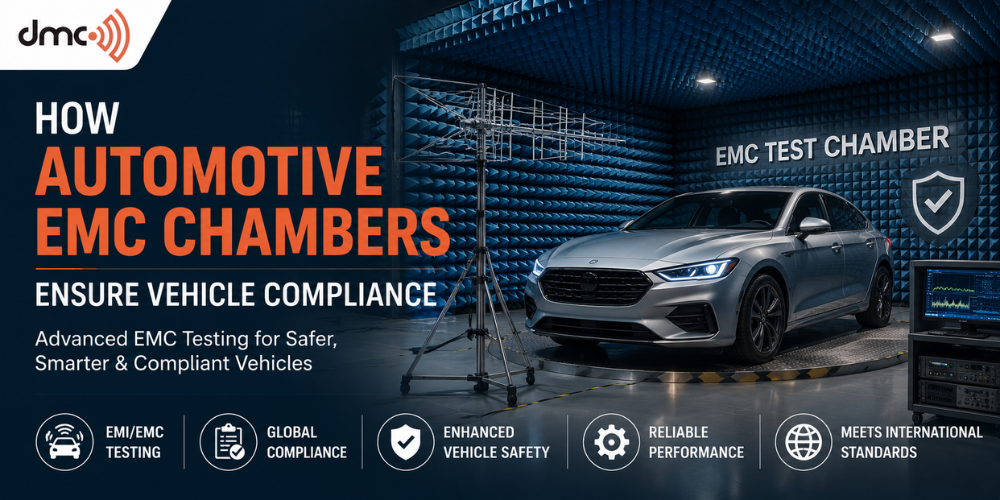
Auto EMC Chambers are special shielded laboratories designed to test electromagnetic emissions and immunity of various automotive products and complete vehicles.
Such chambers provide shielding against external electromagnetic signals, at the same time do not allow test signals inside to escape from the laboratory. The chamber’s walls are covered with absorbing RF materials to reduce reflection and achieve highly accurate and repeatable measurement results.
An Auto EMC Chamber allows you to test the following:
- Electric vehicles (EVs)
- Hybrid vehicles
- Passenger cars
- Commercial vehicles
- ADAS modules
- Radar systems
- Infotainment systems
- Battery Management Systems (BMS)
- Vehicle communication modules
- Charging systems
The chamber ensures laboratory environment similar to the real electromagnetic one, but with all possible accuracy.
Why Automotive EMC Compliance Matters
Automobiles today incorporate numerous ECUs, wireless communications devices, sensors, cameras, and high-voltage electrical systems. Inadequate EMC testing may lead to problems with electromagnetic interference.
Risks that can arise include:
- Incorrect deployment of airbags
- Failure of sensors
- Loss of GPS signals
- Communication failure
- Faulty battery management
- Problems with autonomous driving systems
- Interference with infotainment
- Interference with radar
Regulatory bodies need to see proof of compliance by manufacturers before any automobile is sold worldwide.
How Automotive EMC Chambers Work
EMC Chambers in Automotive Applications use RF shielding, absorber materials, antenna, and measuring equipment to emulate an electromagnetic environment.
The procedure is typically comprised of:
1. Vehicle Configuration
The vehicle/subsystem is placed in the chamber by the engineers.
The sensors and the measuring devices record how the system operates during the test.
2. Emissions Testing
The emissions are measured by the chamber. It verifies whether these emissions comply with regulations.
3. Immunity Test
Generation of high-frequency electromagnetic signals takes place in the chamber.
Engineers make sure that the vehicle keeps working normally under influence of these signals.
4. System Assessment
Data acquisition systems check:
- Stability of the electronics
- Communication abilities
- Accuracy of sensors
- Reliability of control systems
- Wireless capabilities
5. Compliance Report
Detailed reports document all measurements, supporting regulatory certification and product validation.
Automotive Systems Tested Inside EMC Chambers
The Modern Automotive EMC Chambers provide an option to test nearly all electronic subsystems.
Some examples include:
- Electronic Control Units (ECUs)
- Battery Management Systems
- Electric drive systems
- Automotive radar
- LiDAR sensors
- Cameras
- GPS receivers
- Automotive communication systems
- Infotainment systems
- Wireless power chargers
- Autonomous driving systems
- Power converters
- DC/DC converters
- On-board chargers
All electronic components need to satisfy EMC standards before their installation into the vehicle.
Benefits of Automotive EMC Chambers
Benefits of Using Automotive EMC Chambers in Vehicle Development
Greater Product Safety
EMC Testing helps to detect any electronic interference prior to the sale of vehicles, making roads safer.
Faster Regulatory Approval
It helps in obtaining regulatory approval by complying with global standards easily.
Reduced Development Costs
Early detection of EMC problems ensures that no costs have to be incurred to modify the vehicle.
Greater Product Reliability
Electronic components perform reliably irrespective of electromagnetic conditions.
Automotive EMC Chambers for Electric Vehicles
Electrical Vehicles exhibit higher electromagnetic activity because of high-voltage power electronics.
Typical tests include:
- Motor controllers
- Battery Packs
- Fast Charging Systems
- Inverters
- High Voltage Cables
- Power Electronics
Effective EMC validation avoids interference between propulsion systems and vehicle electronics.
With the increasing use of EVs across the world, Automotive EMC Chambers are crucial to automotive OEMs.
ADAS and Autonomous Vehicle Testing
ADAS relies on seamless communication among sensors.
Automotive EMC Testing includes:
- Performance of radar
- Camera functionality
- Sensors fusion
- Vehicle Communication
- Emergency Braking
- Lane Assist
- Adaptive Cruise Control
The proper functioning of the sensors is directly related to passenger safety.
Choosing the Right Automotive EMC Chamber
Choosing an appropriate EMC chamber is dependent on the purpose of testing. Important factors include:
- Chamber volume
- Frequency range
- Performance of RF absorber material
- Shielding efficiency
- Standards compliance
- Automation
- Accuracy of measurement
- Future scalability
Manufacturers may choose to develop modular chambers that are able to meet changing automotive needs.
Pro Tip
EMC validation should be incorporated right from the early stages of development of the vehicle instead of waiting for its certification process. Early EMC testing will ensure fewer engineering changes, reduced development cycles, minimize risks during certification, and reduce production costs significantly.
The Future of Automotive EMC Chambers
Automotive electronics are continually evolving through technologies such as 5G, autonomous driving, V2X communication, artificial intelligence, and over-the-air software updates. This makes the need for more EMC tests grow.
The Future of Automotive EMC Chambers is bound to incorporate greater automation, AI-powered data analysis, robotic positioning systems, remote testing capabilities, and integration of digital twins into chambers. It will make testing faster and more efficient and reduce human effort.
By investing in state-of-the-art Automotive EMC Chambers, automotive manufacturers create an advantage that will allow them to ensure product quality and certification and comply with international regulations. With evolving automotive technology, EMC testing is
Frequently Asked Questions
They are used to test electromagnetic emissions and immunity of vehicles and automotive electronic systems to ensure compliance with international EMC standards.
It prevents electromagnetic interference that could affect vehicle safety, communication systems, sensors, and electronic controls.
Passenger cars, electric vehicles, hybrid vehicles, commercial vehicles, autonomous vehicles, and connected vehicles all require EMC testing.
Common standards include CISPR 25, ISO 11452, ISO 7637, UNECE R10, and applicable SAE EMC standards.
Yes. Modern EMC chambers are designed to accommodate complete vehicles as well as individual automotive electronic components.