
Table of Contents
- What Is an Anechoic Chamber?
- Key Differences Between Semi-Anechoic and Full Anechoic Chambers
- Industries That Use Semi-Anechoic Chambers
In terms of accurate testing of electromagnetic phenomena, the choice of the appropriate testing environment is essential. In particular, engineers, manufacturers, and research institutions use special facilities that are designed to test electromagnetic radiation, antennas, wireless communication systems, and compliance with standards. The most widely used testing environments are a semi-anechoic chamber and a fully anechoic chamber.
Although both these testing environments are designed to minimize electromagnetic reflections from walls, ceilings, and floors, their usage varies significantly depending on the specific tests required. To understand the difference between a semi-anechoic chamber and a fully anechoic chamber is important to determine which testing facility is the best one for certain tests.
This paper is aimed to provide information about the operation of these facilities.
What Is an Anechoic Chamber?
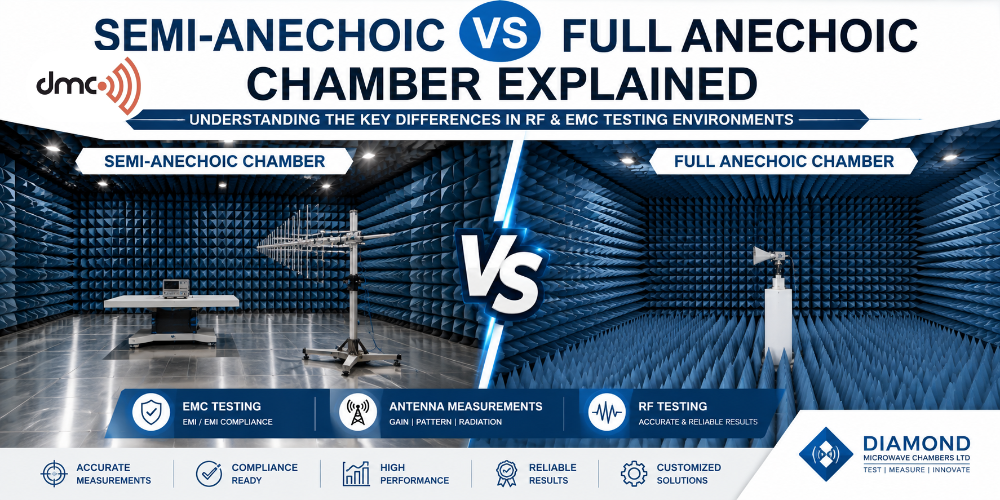
An anechoic chamber is a special type of enclosure that absorbs any electromagnetic waves and prevents them from reflecting. All interior surfaces – walls, ceiling, and sometimes even the floor – are covered with RF absorber materials creating free-space conditions.
These enclosures create a controlled environment needed for tests of various wireless products including antenna, automotive electronics, aviation electronic systems, radars, military communications equipment, and consumer electronics.
The main types are:
- Semi-anechoic chamber
- Full anechoic chamber
However, although both are equally accurate for testing, there is a noticeable difference in chamber interiors.
What Is a Semi-Anechoic Chamber?
As its name suggests, semi-anechoic chamber has absorber materials covering only its walls and ceiling. The floor of the chamber is a reflective and conductive surface that replicates real-world conditions. The floor usually consists of a metal ground plane.
This chamber type is frequently used for EMC testing chamber due to the necessity to measure signals above a reflective ground plane under many standards.
Applications of Semi-Anechoic Chambers include:
- EMI/EMC compliance testing
- Automotive EMC testing
- Consumer electronics testing
- Industrial equipment testing
- Regulatory testing and certification
What Is a Full Anechoic Chamber?
The walls (sides) of an anechoic chamber (including floor) are lined with RF absorbing material to create an environment that closely resembles free space with minimal reflections in any direction.
The floor is lined with absorbing material, so unwanted floor reflections are also minimized, making an anechoic chamber the best place to perform accurate RF measurements.
Full anechoic chambers are used primarily for:
- Antenna Measurement
- Radar Testing
- Satellite Communication Testing
- Wireless Device Characterization
- Aerospace & Defense Applications
- Research & Development
No other type of electromagnetic wave measurement environment will provide the level of accuracy found in a full anechoic chamber.
Key Differences Between Semi-Anechoic and Full Anechoic Chambers
| Feature | Semi-Anechoic Chamber | Full Anechoic Chamber |
|---|---|---|
| Floor Surface | Reflective Metal Ground Plane | RF Absorber Covered Floor |
| Reflection Level | Moderate Floor Reflections | Minimal Reflections |
| Main Purpose | EMC Compliance Testing | Antenna and RF Measurements |
| Standards Compliance | CISPR, IEC, MIL Standards | Antenna and Propagation Standards |
| Measurement Accuracy | High | Very High |
| Installation Cost | Lower | Higher |
| Maintenance | Moderate | Higher Absorber Maintenance |
| Typical Users | EMC Labs, Manufacturers | Research Labs, Aerospace, Defense |
Why EMC Testing Uses Semi-Anechoic Chambers
The majority of the EMC standards mandate that products be tested while positioned above a conductive ground plane. The reflective surface of the ground in semi-anechoic chambers simulates real-world installation conditions where electronic devices effect one another through conductive surfaces located in close proximity to each other.
Through this setup, the following critical measurements can be accurately obtained:
- Radiated emissions
- Electromagnetic interference
- Susceptibility testing
- Compliance certification requirements
In most cases for manufacturers attempting to meet CE, FCC or military standards, semi-anechoic chambers tend to be the method of choice.
Why Antenna Testing Uses Full Anechoic Chambers
When taking antenna measurements, you want to optimize for reflection to get an accurate reading. Small amounts of reflection can dramatically change both gain (how strong a signal is) and how well the antenna radiates, polarizes and performs.
The primary functions of an anechoic chamber are:
- Measurement of free space
- Increased repeatability of measured results
- More precise far-field measurements
- Better characterization of radar cross section
- More reliable characterization for wireless devices
Anechoic chambers are very useful for doing advanced RF research and developing antennas.
Industries That Use Semi-Anechoic Chambers
Many industries utilize semi-anechoic chambers for regulatory compliance purposes, such as automotive, consumer electronics, and industrial equipment manufacturers.
Automotive manufacturers have multiple electronic systems in vehicles, which are required to comply with electromagnetic compatibility (EMC) regulations. Semi-anechoic chambers allow testing of the following types of automobiles and their components:
- Electric Vehicles (EVs)
- Battery Management Systems (BMS)
- Advanced Driver Assistance Systems (ADAS)
- Vehicle Communication Modules (VCM)
Consumer electronics manufacturers commonly perform EMC testing using semi-anechoic chambers on devices such as:
- Smartphones
- Tablets
- Laptop Computers
- Smart Home Devices
Industrial equipment (electronic devices used in producing products; e.g., pumps, compressors) must function without generating interference through electromagnetic radiation. Semi-anechoic chambers provide validation of compliance with EMC regulations before the device is released to the market.
Full anechoic chambers are used for applications that require the highest precision possible for RF type testing.
Aerospace & Defense – Military applications where full anechoic chambers are used include but are not limited to RADAR equipment, military communications systems, electronic warfare systems, and testing antennas for aircraft.
Wireless equipment manufacturers depend on full anechoic chambers to test:
- 5G antennas
- Base stations
- IoT devices
- Satellite communication systems
Research Institutions
These advanced electromagnetic studies and antenna technologies are being developed by universities and research facilities using these facilities.
Cost:An important consideration in selecting a chamber is cost. Semi-anechoic chambers typically have fewer absorber materials to purchase and install as they have reflective floors. This will reduce the total amount spent on chamber installation and ongoing maintenance.
Full anechoic chambers have absorber coverage on all surfaces; therefore, the installation of a full anechoic chamber requires higher levels of complexity and a higher overall cost for the organization.
Organizations must assess the following prior to investing in a testing chamber:
- Testing requirements
- Compliance requirements/standards
- Required measurement accuracy level
- Available funds for testing
- Future development plans for testing expansion
If your primary purpose is to perform EMC compliance testing for commercial products, then a semi-anechoic chamber is generally the least expensive option. However, if the objectives of the work being performed involve antenna characterization, radar systems, or other advanced wireless research, then a full anechoic chamber will provide significantly more accurate measurements and long-term flexibility for future testing.
How to Choose the Right Chamber
The selection between Semi-Anechoic Chamber and Full Anechoic Chamber is dependant on your specific application. You will want to choose a Semi-Anechoic Chamber for the following applications:
- EMC certification testing
- Regulatory compliance testing
- Validation of automotive EMC
- Cost effective test environment
You will want to choose a Full Anechoic Chamber for the following applications:
- Antenna performance testing
- Radar system testing
- Validation of satellite communications
- High accuracy RF research
Working with experienced chamber manufacturers will ensure that the testing facility is compliant with today’s standards and prepared for future technology advancements.
Both types of chambers serve very important functions in the world of electromagnetic testing. Semi-Anechoic Chambers have been designed specifically for EMC compliance and regulatory testing, while Full Anechoic Chambers provide an environment free of any reflections that are needed for advanced antenna and RF measurements.
By understanding how these differ, organizations can make smart investment choices and produce accurate, repeatable test results. Whether the purpose of the test is EMC certification, antenna development, radar analysis or new wireless technologies, selecting the correct type of chamber will produce reliable performance validation and compliance.
Frequently Asked Questions
A semi-anechoic chamber has a reflective metal floor, while a full anechoic chamber uses RF absorbers on all surfaces, including the floor.
A semi-anechoic chamber is generally preferred for EMC testing because it meets most regulatory compliance requirements.
They minimize reflections from all directions, providing highly accurate free-space measurement conditions.
Yes. They require absorber coverage on all six surfaces, increasing construction and maintenance costs.
Yes, but measurement accuracy may be lower due to reflections from the conductive floor.