
Table of Contents
- What Are EMC Compliance Test Procedures?
- Key EMC Test Categories
- Conducted Emissions Testing Procedure
EMC (Electromagnetic Compatibility) is a crucial parameter in modern electronic products. Whether you make electronic devices, automobiles, industrial machinery, medical instruments, or wireless communication products, EMC Compliance Test Procedures will help ensure compliance and efficient operation in the real world.
Increasingly complex electronics have many opportunities for electromagnetic interference (EMI), which affects the performance of electronics. The EMC test procedure helps to find such issues and solve them before bringing the product to the market.
The purpose of this guide is to discuss important EMC Compliance Test Procedures, standards, equipment, and other aspects of certification.
What Are EMC Compliance Test Procedures?
EMC Testing Procedures refer to standard procedures that determine whether an electronic equipment is emitting electromagnetic emissions below the set levels and is capable of working effectively even when subjected to electromagnetic emissions.
The main goals of conducting EMC testing include:
- Ensuring compliance
- Reducing electromagnetic interference
- Enhancing reliability of products
- Preventing malfunctions
- Market expansion globally
- Building customer trust
EMC tests are carried out by manufacturers during the development and certification of their products.
Why EMC Compliance Testing Matters
Today’s electronics devices work in an environment where there is a lot of electromagnetic energy around. If not taken into consideration during the design phase of the product, they may suffer from:
- Interference with other equipment
- Communication problems
- Performance issues
- Non-compliance to regulations
- High costs associated with redesign
Good EMC Compliance Test Procedures assist in detecting such risks in advance.
Key EMC Test Categories
EMC testing generally falls into two primary categories:
| Test Category | Purpose | Typical Standards |
|---|---|---|
| Emissions Testing | Measures unwanted electromagnetic energy produced by equipment | CISPR 11, CISPR 22, CISPR 32 |
| Immunity Testing | Evaluates resistance to electromagnetic disturbances | IEC 61000 Series |
| Conducted Emissions | Measures interference on power and signal lines | CISPR Standards |
| Radiated Emissions | Measures electromagnetic energy emitted into free space | ANSI, CISPR |
| Conducted Immunity | Tests resistance through cables and conductors | IEC 61000-4-6 |
| Radiated Immunity | Tests resistance to external RF fields | IEC 61000-4-3 |
Each category is an important component of comprehensive EMC compliance testing.
Radiated Emissions Testing Procedure
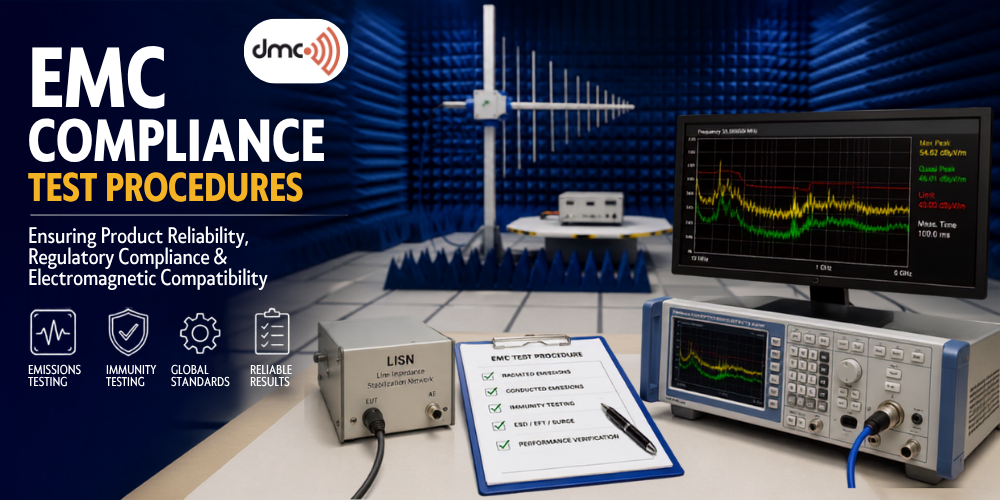
Radiated Emissions Testing involves measuring the electromagnetic energy that radiates off of the device.
Procedure
- Put Equipment Under Test (EUT) in EMC testing enclosure.
- Placing of the calibrated antennas at predetermined distance.
- Turn EUT to establish peak emissions.
- Check emission levels in specific frequency bands.
- Evaluate test data against standards.
Test Chamber
Commonly used:
- Semi-anechoic chamber
- Full anechoic chamber
- Open area test sites (OATS)
RF test chambers give accurate results and are less prone to interference.
Conducted Emissions Testing Procedure
Emissions testing by conduction examines the emissions by conduction of electromagnetic interference.
Steps
- Connect EUT to a Line Impedance Stabilization Network (LISN).
- Run the device under normal operating conditions.
- Measure the electromagnetic interference via EMI receivers.
- Compare readings to relevant standards.
Conducted emissions testing is particularly critical for devices running on AC mains power.
Radiated Immunity Test Steps
The radiated immunity test is performed to ensure that a product is capable of operating under external electromagnetic fields.
- Generate radio frequency signals.
- Amplify radio frequency signals using RF amplifiers.
- Transmit amplified radio frequency signals using calibrated antennas.
- Illuminate the EUT at different levels of field strength.
- Test product functionality while it is exposed to the fields.
Conducted Immunity Testing Procedure
Conducted immunity test is done by examining the impact of introducing disturbance to the equipment via cables and conductors.
Procedure
- Introduce RF disturbance to power and signal cables.
- Increase signal amplitude following the required specifications.
- Check the performance of the system.
- Note any impairment in performance.
Electrostatic Discharge (ESD) Testing
ESD or electrostatic discharge is one of the most common EMC problems associated with electronic devices.
Compliance Testing for ESD
The testing procedure entails:
- Contact discharge testing
- Air discharge testing
- Testing multiple discharge points
- Testing both positive and negative polarities
Most manufacturers employ IEC 61000-4-2 standards for testing of ESD.
Electric Fast Transient Testing (EFT)
This test measures the immunity of the product to switching transients typical in an industrial setting.
The source of this problem can be:
- Relays switching
- Motor operations
- Industrial control circuits
In this test, burst signals are transmitted through the power and communication lines of the device.
Surge Immunity Testing
Surge testing examines how well a product can be protected from voltage surges containing a lot of energy.
Examples of Surge Sources
- Lightning hits
- Utility switching
- Grid disturbances
EMC Test Equipment Used in Compliance Procedures
Successful EMC Compliance Test Procedures require specialized equipment.
Common EMC Standards
Different industries follow specific EMC standards.
Popular Standards
Commercial Electronics
- CISPR 32
- FCC Part 15
Industrial Equipment
- IEC 61000-6 Series
Medical Devices
- IEC 60601-1-2
Automotive Applications
- ISO 11452
- CISPR 25
Military Systems
- MIL-STD-461
Selecting the correct standard is a crucial step in EMC certification planning.
EMC Chamber Requirements
A correct EMC testing procedure depends significantly on the right environment for testing.
The EMC lab uses:
- Semi-anechoic chamber
- Full anechoic chamber
- Shielded rooms
- Reverberation chambers
Such environments reduce any reflection and noise, thus guaranteeing reliable testing results.
Institutions that require professional testing services frequently use sophisticated RF chambers and EMC labs.
Pro Tip
Emc testing should be carried out early in the process of developing the products. Carrying out pre-compliance tests will assist in detecting emission and immunity problems which will not lead to expensive redesigns hence minimizing the time used in developing the product and the cost involved in the certification process.
Best Practices for EMC Compliance Success
For successful EMC compliance,
- Consider EMC needs when designing the products.
- Utilize appropriate grounding techniques.
- Effective shielding should be adopted.
- PCB layout should be optimized.
- Pre-compliance tests should be conducted.
- Accredited EMC laboratories should be used.
- Proper test documents should be maintained.
Testing compliance all through the development process should be ensured.
The above procedures assist in minimizing failures and speeding up the certification process.
Adherence to EMC Compliance Test Procedures is very important for ensuring successful performance of the products and the whole process of certification. Proper testing such as emissions, immunity, end, surge and transient among others will help manufacturers detect the issues before the release of the products.
Frequently Asked Questions
EMC Compliance Test Procedures are standardized testing methods used to verify that electronic devices meet electromagnetic compatibility requirements and regulatory standards.
EMI testing focuses on electromagnetic interference generation, while EMC testing evaluates both emissions and immunity performance.
Radiated emissions testing ensures that a product does not emit electromagnetic energy beyond regulatory limits that could interfere with other devices.
Common standards include CISPR 32, FCC Part 15, IEC 61000 series, ISO 11452, and MIL-STD-461.
Typical equipment includes EMI receivers, spectrum analyzers, LISNs, RF amplifiers, antennas, EMC chambers, and ESD simulators.