
Table of Contents
- What Is Antenna Pattern Measurement?
- How Antenna Pattern Measurement Works
- Factors That Affect Measurement Precision
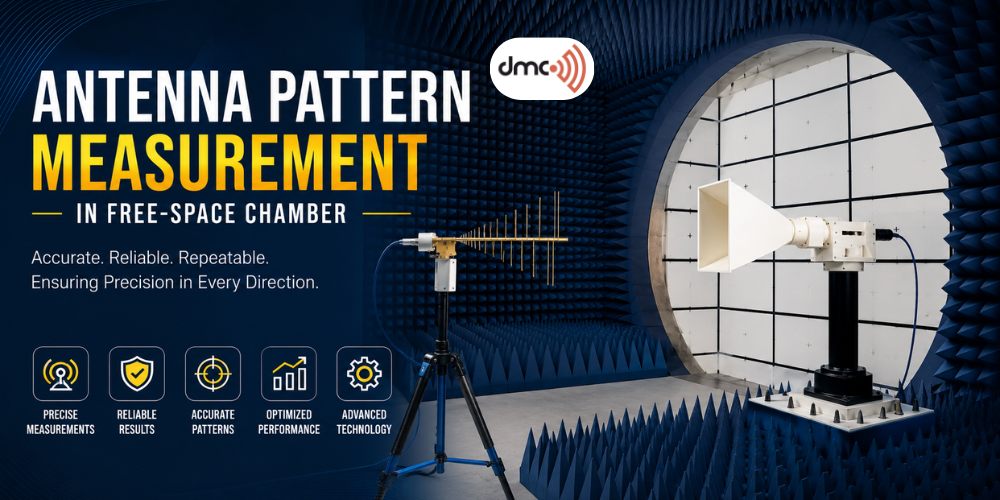
One of the most important aspects in the development of the modern radio frequency (RF) and wireless technologies is Antenna Pattern Measurement in Free-Space Chamber. This procedure should be performed, regardless of whether the antennas are developed for the purposes of telecommunications, aeronautics, military industry, automotive radar, IoT, or satellite communication. The use of free-space chamber creates an ideal testing environment without any reflections or extraneous electromagnetic interference.
With wireless technologies moving on to higher frequencies and advanced communication systems, there has been a need to accurately characterize antennas. This is where testing in free-space chamber comes into play.
What Is Antenna Pattern Measurement?
Pattern measurement means taking measurements for electromagnetic radiation distribution by an antenna in different directions. Pattern measured provides information about the characteristics and performance of the antenna.
A graphical representation of the radiation pattern shows the signal strength in relation to direction. It gives us the following information:
- Mainlobe characteristics
- Side lobe level
- Beam width
- Front-to-back ratio
- Directivity
- Polarization performance
- Antenna gain
Antenna radiation pattern testing is useful for antenna design optimization by manufactures.
Why Use a Free-Space Chamber?
An ideal electromagnetic environment can be created in a free space chamber by reducing reflections and any outside interference.
Advantages of using a free-space chamber include:
- Low electromagnetic interference
- No influence from outside environmental factors
- Higher accuracy in measurements
- Repeatable test results
- Shorter testing periods
- Compatibility with various frequencies
It is therefore important to use the free space chamber for RF antenna testing and antenna characterization studies.
How Antenna Pattern Measurement Works
The measurement process consists of mounting the antenna under test (AUT) in a free space environment, where a reference antenna sends out or receives signals. Then, the AUT is rotated at different angles, and the readings are recorded.
From the obtained data, analyses are performed, and graphs are made to show how the antenna works at different angles.
Usually, the following steps are followed for measuring the antenna performance:
- System calibration
- Installation of the antenna under test
- Making far field conditions
- Rotating the antenna at specific angles
- Taking the measurements
- Performing data analyses and developing radiation patterns
Importance of Far-Field Antenna Measurements
Far-field antenna measurement is one of the critical procedures for free space chambers. This is because at the far-field point, there are steady electromagnetic waves that enable the precise measurements of antenna parameters.
The smallest possible far-field distance is determined by the following factors:
- size of the antenna
- Frequency of operation
- Wavelength
Measurement in the far-field area makes sure that measurements are not influenced by the near-field effect.
Far-field antenna measurement is widely used in various industries for certification, testing, and scientific purposes.
Applications of Antenna Pattern Measurement
Measurement of Antenna Patterns in the Free-Space Chamber is commonly practiced in various sectors.
Telecommunications
Network carriers and telecom hardware providers conduct tests on antennas in order to ensure the optimal coverage area and improve the quality of the signal as well as support 5G and future 6G technologies.
Defense and Aerospace
The military and aerospace industries have very high standards for the measurement of antenna patterns in order to guarantee the quality of communication, radar operation and navigation.
Automotive Industry
The radar system and vehicle-to-infrastructure communication in modern cars need precise antenna pattern verification.
Satellite Communications
Satellite antennas should comply with stringent radiation pattern criteria.
IoT and Consumer Electronics
Wireless devices such as smart sensors, wearables, and connected appliances have to undergo antenna gain measurement and OTA antenna testing prior to their commercialization.
Factors That Affect Measurement Precision
There are several factors that can affect the precision of antenna pattern measurement results.
Chamber Geometry
It is very important to design the chamber in a way that would minimize reflections and provide reliable measurements.
Performance of RF Absorbers
The performance of high-quality absorbers decreases reflections that may affect the radiation patterns.
Antenna Positioning
Accurate positioning of an antenna is needed to ensure measurement repeatability.
Antenna Calibration
It is important to calibrate the antennas, cables, and measuring instruments periodically.
Environmental Stability
Environmental variables include temperature, humidity, and stability of equipment.
Free-Space Chamber as Compared to Open Area Measurements
While open area measurements have been traditionally applied in antenna tests, there are considerable benefits to using free-space chambers.
| Feature | Free-Space Chamber | Open-Area Test Site |
|---|---|---|
| Environmental Control | Excellent | Limited |
| Repeatability | High | Moderate |
| Weather Dependency | None | High |
| External Interference | Minimal | Potentially Significant |
| Testing Speed | Faster | Slower |
| Data Accuracy | Very High | Variable |
For advanced RF antenna testing, free-space chambers have become the preferred solution.
Emerging Trends in Antenna Testing
The necessity for precise measurement of the antenna pattern keeps increasing with the advancement in wireless technologies.
Some current trends include:
- Automatic measurement systems
- Data analysis using artificial intelligence technology
- Antenna testing at millimeter wave range
- Massive MIMO antenna testing
- OTA antenna testing for 5G and 6G
- Chamber simulation software
- High frequency radar antenna validation
Such trends help businesses realize fast product cycles without losing measurement precision.
Pro Tip
Always double-check the required distance to measure far-field before you start measuring antenna radiation pattern in the free-space chamber. Any slight deviation from the required measurement distance may seriously affect the radiation pattern, gain, and other parameters of the antenna pattern measurement.
The Antenna Pattern Measurement in Free-Space Chamber is a significant process involved in designing the latest wireless systems. The free-space chamber enables a test environment that is free from any reflections for measuring various parameters like gain, directivity, radiation pattern, efficiency, and polarization of an antenna. With increasing use of communication technology in different industries, the importance of antenna measurement increases.
Frequently Asked Questions
It is the process of evaluating antenna radiation characteristics in a controlled environment that minimizes reflections and electromagnetic interference.
A free-space chamber provides accurate, repeatable measurements by simulating ideal electromagnetic conditions.
Common parameters include gain, directivity, beamwidth, polarization, radiation efficiency, and side lobe levels.
Near-field measurements occur close to the antenna, while far-field measurements evaluate stable radiation patterns at greater distances.
Telecommunications, aerospace, defense, automotive, satellite communications, IoT, and consumer electronics industries widely use antenna testing.