
Table of Contents
- What Are CATR (Compact Antenna Test Range) Systems?
- Applications of CATR (Compact Antenna Test Range) Systems
- Benefits of Investing in CATR Systems
- Future Trends in Compact Antenna Test Range Technology
With continuous advancements in wireless communication technologies, performance of the antenna is one of the most important considerations for providing reliable connection. Whether it be 5G, satellites, aerospace, defense systems, automotive radars or any other wireless communication technology, accurate measurements of antennas are indispensable in those technologies. This is where CATR (Compact Antenna Test Range) Systems come into action.
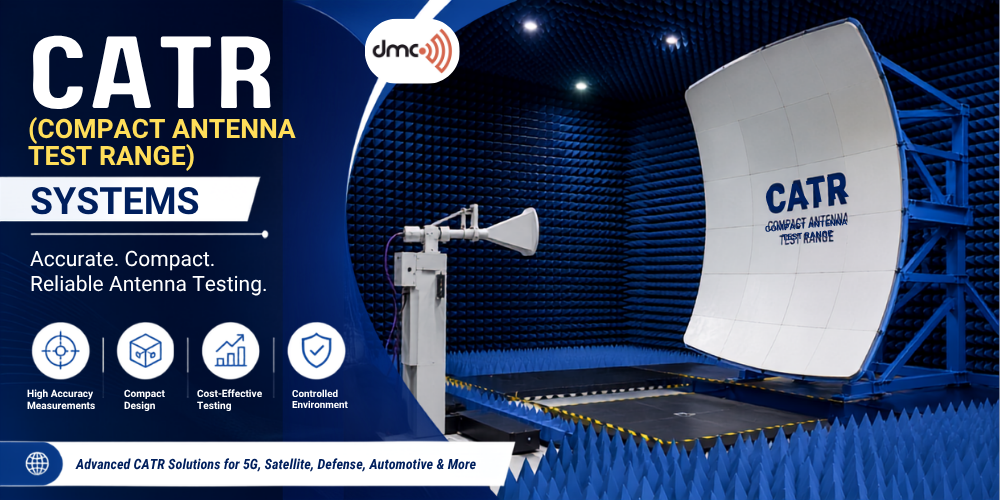
CATR (Compact Antenna Test Range) Systems refer to high-tech test facilities capable of replicating the far field conditions in an enclosed space. In case of outdoor antenna ranges, there is a requirement of considerable distance between the antenna and the test equipment. But with CATR, a special kind of reflector is used to create plane wave in the test facility.
The organizations dealing with antenna designs, wireless devices and RF systems are increasingly turning towards CATR antenna testing solutions.
What Are CATR (Compact Antenna Test Range) Systems?
CATR (Compact Antenna Test Range) System means an antenna measuring system that provides the ability to generate a quiet zone that can generate electromagnetic waves with conditions similar to far field conditions. It uses a specially designed reflector, usually parabolic in nature, to convert spherical waves generated from the feed antenna into plane waves.
The use of a CATR makes it possible for engineers to conduct antenna tests without the need for long distances involved in traditional outdoor ranges. Therefore, Compact Antenna Test Range systems can produce reliable, reproducible, and economical antenna measurements.
Modern CATR antennas are often included as part of RF test chambers and anechoic chambers.
Importance of CATR Antennas
Very accurate measurements are needed due to the increased complexity of modern wireless technologies. Antenna performance influences the signal quality, range, data transmission speed, and reliability of the entire communication system.
There are many advantages to CATR antenna testing:
- Simulation of far field conditions indoors
- Decreased test space needed
- High repeatability
- Ability to test large antennas
- Reduced interference from the environment
- Faster product development
All these advantages make Compact Antenna Test Range systems highly desirable in precision RF testing industries.
Key Components of a CATR System
A CATR (Compact Antenna Test Range) system includes many subsystems cooperating with each other to form a test environment that provides the highest level of accuracy.
1. Feed Antenna
The feed antenna produces the electromagnetic waves to illuminate the reflector. This should be done constantly in a stable manner.
2. Precision Reflector
It is the key element of the system. The reflector changes spherical waves into plane waves providing a quiet zone needed for the accurate measurements.
3. Quiet Zone
It is the zone where testing of the antenna is performed. In this zone, electromagnetic fields resemble ideal far field conditions.
4. Positioning System
Modern positioning devices help rotate and orient an antenna being tested, which makes it possible to measure its radiation patterns, gain, and polarization characteristics.
5. RF Instrumentation
Measurement of an antenna’s performance is carried out using VNAs (Vector Network Analyzers), spectrum analyzers, and special measurement software.
6. RF Shielded/Anechoic Chamber
CATR systems are usually installed in RF chamber to protect measurement process from any outside interference.
Applications of CATR (Compact Antenna Test Range) Systems
The Compact Antenna Test Range technology is employed in various sectors.
Aerospace and Defense
Military radars, satellite communication, and electronic warfare technology all need accurate antenna test and measurement. The CATR technology provides the precision required.
Satellite Communications
Testing large satellites antennas requires far field conditions. The Compact Antenna Test Range allows testing in such an indoor environment.
5G and Telecommunications
With the advent of the 5G technology, there is now a higher need for accurate antenna test and measurement. The CATR technology allows manufacturers to test their beamforming antennas, massive MIMO systems, and advanced communication devices.
Automotive Radar Testing
In the present day automotive industry, there are a lot of radar sensors being used. CATR technology enables the testing of these radar antennas and sensor modules.
Research and Development
Technology companies and laboratories are using antenna measurement systems for research and development purposes.
Comparison of CATR and Traditional Antenna Test Ranges
| Feature | CATR Systems | Traditional Outdoor Range |
|---|---|---|
| Space Requirement | Compact | Very Large |
| Environmental Control | Excellent | Limited |
| Measurement Accuracy | High | Moderate |
| Weather Dependency | None | High |
| Repeatability | Excellent | Variable |
| Testing Speed | Fast | Slower |
| Operational Cost | Lower Long-Term | Higher Long-Term |
| RF Interference | Minimal | Possible |
This comparison highlights why many organizations are transitioning to Compact Antenna Test Range systems for advanced antenna measurements.
Benefits of Investing in CATR Systems
A company which is working on developing its RF products will find many advantages with respect to testing capabilities through CATR technology.
Increased Accuracy of Measurement
The controlled environment reduces the problems due to reflection, interference, and varying environment.
Quicker Product Development Process
Tests can be carried out anytime without having to depend upon outdoor weather conditions.
Space Saving Technology
CATR technology is capable of simulating far-field conditions in a smaller area than antenna ranges.
Effective Compliance Testing
Accurate measurements facilitate the process of compliance testing.
Cost Efficiency in the Long Run
While installation costs might be high, testing costs are reduced.
Pro Tip
Tip: In choosing the right CATR System, consider the precision of its reflector, size of its quiet zone, frequency range, and chamber integration. With the correct design of CATR System, you get more accurate measurements and secure investments for the future developments of wireless technology.
Choosing the Right CATR System
Consider several things before you decide to acquire a Compact Antenna Test Range.
- Frequency range required
- Size and weight of antennas to be measured
- Quiet zone dimensions required
- Accuracy of measurements
- Automation requirements
- Compatibility with chambers
- Future testing requirements
Collaborating with RF chamber and antenna testing solutions providers can be helpful in this matter.
Future Trends in Compact Antenna Test Range Technology
Indeed, the future of the CATR antenna testing process depends on new wireless technology trends such as 6G technologies development, space internet systems, self-driving cars, and sophisticated military devices. The growing popularity of these fields means that there would be a higher need for precise antenna measurements.
Current CATR solutions are increasingly using automation, artificial intelligence, sophisticated data analysis and robotic systems to optimize and simplify the test process. In this way, the organizations get the opportunity to speed up their product development processes, ensuring high-quality measurements at the same time.
Moreover, the increasing size of the quiet zone along with the higher frequencies available provide an opportunity for the application of millimeter-wave and sub-terahertz frequencies support.
CATR (Compact Antenna Test Range) Systems have turned into an essential tool for modern antenna testing. It is because CATR creates far field conditions in a compact indoor environment thus providing outstanding measurement accuracy and repeatability.
Any organization that wants to have precise measurements on their antennas, lower costs in testing, and speed up product development process needs to think about buying CATR antenna testing solutions. The evolution of wireless technology means that the future testing of RF will not do without CATR.
Frequently Asked Questions
A CATR system is an antenna measurement solution that creates far-field testing conditions in a compact indoor environment using precision reflectors.
They provide accurate, repeatable measurements while reducing space requirements and eliminating environmental interference.
Industries include aerospace, defense, telecommunications, satellite communications, automotive, and research institutions.
CATR systems provide controlled indoor testing conditions and require significantly less physical space than traditional outdoor ranges.
Yes. Modern CATR systems are widely used for 5G antenna measurement, beamforming validation, and OTA testing applications.