
Table of Contents
- Why 6G Requires Advanced Antenna Chamber Testing
- Evolution of Antenna Chamber Technologies
- The Growing Importance of OTA Testing
In the world of wireless communications, a rapid transition into the future of communication is under way towards the next generation. Though 5G deployment is ongoing all over the world, 6G technology is knocking at the doors of the future. The research community, the development community, and the testing laboratories are preparing for the upcoming communication frequencies and antennas. The topic of The Future of 6G Antenna Chamber Testing is gaining significance among the manufacturers and engineers all over the world.
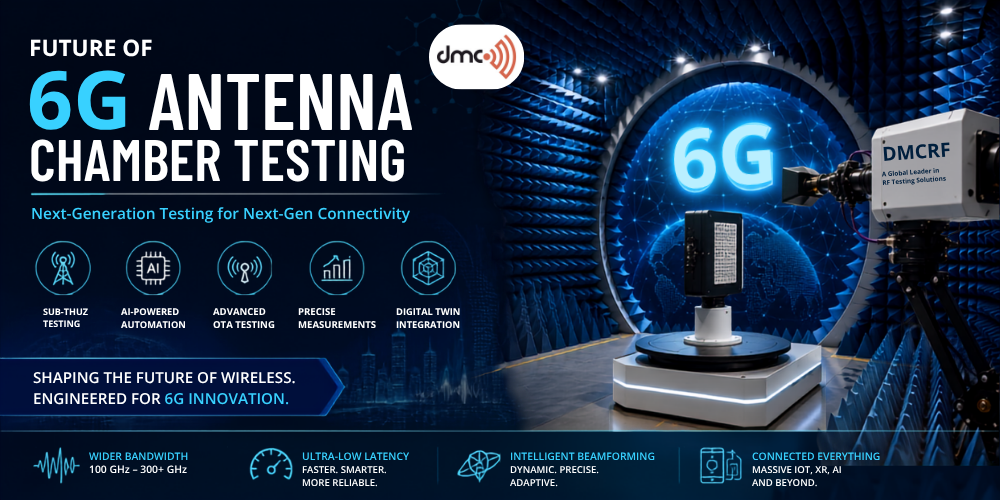
The 6G technology will operate in the sub-terahertz (sub-THz) frequency band and will offer ultra-high-speed connection with zero latency. In addition to the developments that we have seen in 4G and 5G, 6G will have novel concepts such as holographic communication, digital twins, autonomy, and extended reality. To test the effectiveness of these new concepts and technologies, innovative antenna testing chambers will be necessary.
The advancements in 6G antenna testing, OTA testing, and RF chamber testing solutions are absolutely essential.This article highlights some of the future trends, issues, and innovations in antenna testing.
Why 6G Requires Advanced Antenna Chamber Testing
As compared to earlier wireless technologies, 6G will make use of much higher frequencies and more complicated antennas. The conventional testing techniques might fail to ensure the needed level of accuracy and efficiency in testing these advanced communication technologies.
The following are some of the factors that make 6G testing unique:
- Sub-THz frequencies
- Very large antenna arrays
- Beam forming by means of artificial intelligence
- Need for ultra low latencies
- Machine type communications on a massive scale
- Sensing and communication systems combined together
These features necessitate highly accurate anechoic chambers for performing measurements of radiation patterns, efficiency, beam steering, etc.
Evolution of Antenna Chamber Technologies
Various technological innovations will impact the evolution of 6G antenna measuring systems in the future.
1. Sub-THz Frequency Testing
The 6G technology development involves the use of frequencies above 100 GHz and up to 300 GHz or even more. The test equipment should offer:
- Higher accuracy of measurement
- New methods for calibration
- Lower losses of signal
- Increased dynamic range
Testing of antennas operating at such frequencies requires the creation of special testing chambers for the antennas.
2. Automated Measurement by Means of Artificial Intelligence
In the field of RF testing, artificial intelligence enables:
- Automation of the testing process
- Predictive maintenance
- Faster analysis of the results
- Detection of anomalies
- Chamber optimization
With AI-based testing systems, human involvement will be minimized and the tests will become more repeatable.
3. Digital Twin Usage
A digital twin provides a virtual copy of an actual device and its environment.
Advantages of the usage of digital twins include:
- Fast validation of designs
- Cost savings through reduced prototyping
- Performance optimization in a virtual environment
- Increase in efficiency of testing.
4. Massive MIMO Validation
The 6G system will probably feature larger antenna array elements compared to present 5G systems.
For testing such systems, we will need:
- High resolution positioning systems
- Advanced OTA test platforms
- Beam forming verification capabilities
- Multi-angle radiation patterns analysis
Advanced CATR systems will be used increasingly for verifying larger antenna arrays.
Comparison of Current and Future Antenna Testing Requirements
| Parameter | 5G Testing | 6G Testing |
|---|---|---|
| Frequency Range | Up to 100 GHz | 100 GHz – 300+ GHz |
| Antenna Complexity | Massive MIMO | Ultra-Massive MIMO |
| Beamforming | Advanced | AI-Driven Dynamic Beamforming |
| OTA Testing | Essential | Critical |
| Automation | Partial | Extensive AI Automation |
| Digital Twin Usage | Limited | Integrated |
| Data Rates | Multi-Gbps | Terabits per Second |
| Chamber Precision | High | Extremely High |
The Growing Importance of OTA Testing
OTA testing will be even more important in the 6G era.
Conducted tests do not completely cover all aspects of the modern antenna since antennas are getting incorporated into devices. OTA testing allows engineers to test the wireless performance in reality.
OTA testing of future wireless devices in the 6G era will include:
- Beam steering
- Multimedia users communication
- Mobile devices’ performance
- Reliability of signals
- Interference management
- Sensing capability
The future advanced OTA chambers will create very realistic testing environment.
Challenges Facing 6G Antenna Chamber Testing
Accuracy in Measurement
With the rise in frequencies, even minor inaccuracies in positioning can make a difference. Precision engineering will be necessary.
Calibration Difficulties
In sub-THz, the calibration process has to be very precise for accurate measurements to take place.
Cost of Infrastructure
The building of an RF chamber for the frequencies of 6G requires large expenditures.
Processing Needs
The future test environment will create massive amounts of measurement data that need processing.
Standardization
International standards for 6G testing have not yet been developed.
How Advanced Chamber Solutions Support 6G Development
Future testing requirements have already been anticipated by the manufacturers of modern chambers.
Such innovative approaches to test chamber design as the following are being used now:
- Compact Antenna Test Range (CATR)
- RF Shielded Enclosure
- Fully Anechoic Chamber
- Multi-Probe OTA Systems
- Near-Field System
- Positioning Equipment
This is the basis necessary for future antenna testing and devices validation on 6G networks.
Pro Tip
Plan and build antenna test chambers now. Companies involved in development of wireless devices should opt for test chambers designed for future frequency improvements, automation and OTA tests expansion.
Future Outlook
The future of wireless communications will require precise and trustworthy measurement results with regard to antennas. As 6G technology transitions from research laboratories into commercialized applications, the testing demands will become more and more complicated.
Future 6G Antenna Chamber Testing will include sub-THz testing, intelligent automation, digital twins, and state-of-the-art OTA testing technologies. Through the purchase of next generation RF chambers, CATR systems, and anechoic chamber testing tools today, organizations will gain the upper hand in the future when it comes to wireless innovation.
With increasing requirements for ultra fast and ultra reliable connectivity, antenna chamber testing will become very significant in the development of 6G technology.
Frequently Asked Questions
6G antenna chamber testing involves evaluating antenna performance, beamforming behavior, OTA characteristics, and radiation patterns for future wireless communication systems operating in sub-THz frequencies.
OTA testing measures real-world antenna performance without direct cable connections, making it essential for validating advanced beamforming and integrated antenna systems.
6G is expected to utilize frequencies above 100 GHz and potentially extend into the sub-terahertz spectrum for ultra-high-speed communications.
AI will automate test procedures, identify anomalies, optimize measurement processes, and reduce testing time while improving accuracy.
Common solutions include full anechoic chambers, compact antenna test ranges (CATR), RF shielded enclosures, near-field systems, and advanced OTA testing chambers.