
Table of Contents
- Understanding Automotive Radar Testing
- What Is EV EMI EMC Testing?
- Major Standards for Automotive EMC Compliance
- Advantages of Sophisticated Automotive Testing Facilities
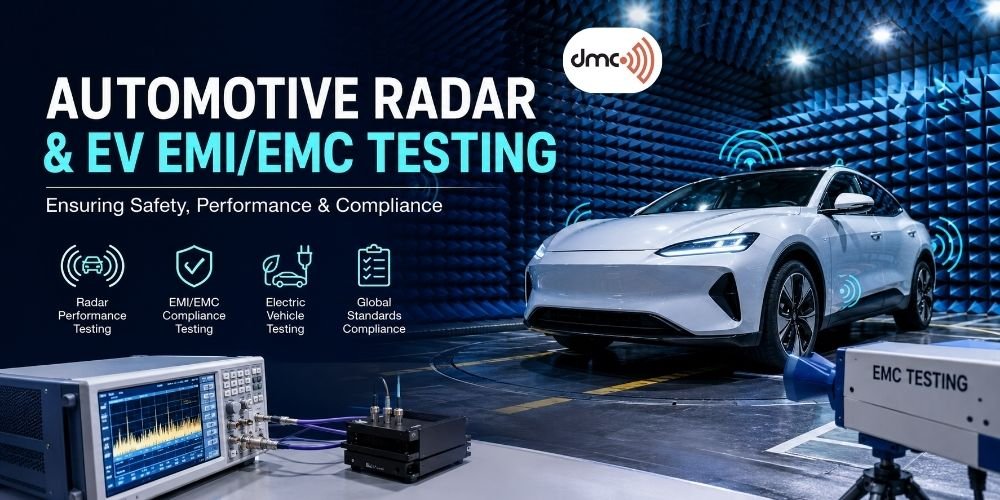
Due to advancements in technology such as autonomous driving systems, highly-developed driver assistance systems (ADAS) and the rapid increase in electric vehicles (EV) being used, the automotive industry is going through a major change. Automotive Radar (testing) and Electric Vehicle (EV) EMI / EMC testing are critical to ensuring vehicles have adequate safety and are functioning properly, and they comply with regulations due to the fact that vehicles will be more and more connected as well as being technically advanced.
Today’s vehicles consist of multiple electronic control systems, radar sensors, communication modules, battery management systems and power electronics (high voltage); thus, it is important that the electronic systems work without causing or experiencing electromagnetic interference as disruption to the electronic systems could result in the malfunction of the radar sensor, disrupt the communication of the vehicle or cause an unsafe situation. Automotive Radar Testing and Electric Vehicle EMI / EMC (Testing) are very important in evaluating the performance of (the) vehicle (under) real world electromagnetic conditions. Automotive manufacturers, automotive suppliers and automotive testing laboratories will use specialized Automotive EMC Chambers, specialized Radar Measurement Chambers and advanced RF testing solutions to test and evaluate the vehicle’s performance.
Understanding Automotive Radar Testing
Radars in Vehicles are Very Important. All Modern Vehicles Use Radar Systems to Facilitate Advanced Driver-Assistance Systems (ADAS) and Autonomous Driving. Radar Systems Utilize Radio Frequency Signals to Detect Objects Near the Vehicle, Measure How Far Away They Are, Calculate Their Speed, and Identify Any Possible Obstacles on the Road Where You Will Be Driving.
Examples of Uses of Automotive Radar Systems Are:
- Adaptive Cruise Control (ACC)
- Blind Spot Detection (BSD)
- Forward Collision Warning (FCW)
- Automatic Emergency Braking (AEB)
- Lane Change Assistance
- Parking Assistance Systems
Automotive Radar Operating Frequencies Are Generally from 24 GHz to 77 GHz and Also 79 GHz, but All Vehicle Manufacturers Must Test their Vehicle Radars for Vehicle Safety and Usability.
Key Objectives of Automotive Radar Testing
To verify Automotive Radar Testing:
- Detecting accuracy
- Range performance
- Velocity measurement accuracy
- Angular Resolution
- Target identification
- Signal integrity
- Environmental robustness
Testing is generally done using specialized Automotive RF Chambers that simulate open-space conditions while also reducing unwanted reflections and interference.
What Is EV EMI EMC Testing?
Electric Vehicles include many high voltage systems including; a battery pack, charging circuit, high frequency inverter, low frequency inverter, and electrical motor. Each of these components creates electromagnetic emissions which can interfere with other electronic systems in close proximity.
The purpose of Electric Vehicle EMI EMC Testing is to evaluate the performance of an electronic system in an electromagnetic environment and to ensure compliance with internationally recognized automotive standards.
EMI, which stands for Electromagnetic Interference, refers to the unintended release of electromagnetic radiation, which can disrupt the normal functioning of electronic systems.
The term EMC, meaning Electromagnetic Compatibility, is a standard used to monitor and test the operation of electronic devices, ensuring that they do not generate or experience high levels of interference.
There are two main purposes for Electric Vehicle EMC testing.
- To guarantee the vehicle will operate safely
- To ensure that the vehicle complies with all regulations
- To ensure that a communications system operates reliably
- To ensure that radar systems operate reliably
- To protect against electromagnetic disturbances
Automotive EMC Chambers for Testing
To obtain accurate measurements in a testing environment, electromagnetic conditions must be controlled.
The following are examples of various types of EMC chambers used in the automotive industry for EMC compliance testing.
Semi-Anechoic Chambers
Semi-anechoic chambers are prevalent in automotive EMC testing. These chambers contain RF absorbers on their walls and ceiling while providing a conductive ground plane.
Examples of automobile applications are:
- Radiated emissions testing
- Radiated immunity testing
- Vehicle level EMC assessments
Full Anechoic Chambers
Full anechoic chambers completely eliminate reflections from all angles.
Examples of automotive applications are primarily:
- Automotive radar testing
- Antenna characterization
- Advanced driver assistance systems (ADAS) sensor validation
- Autonomous vehicle sensor characterization
Reverberation Chambers
Reverberation chambers create statistically uniform electromagnetically fields used for immunity testing.
Examples of automotive applications:
- EMC robustness evaluations
- Evaluation of electronic modules
Major Standards for Automotive EMC Compliance
Automotive manufacturers must comply with global EMC standards before vehicle commercialization.
Important Standards
| Standard | Purpose |
|---|---|
| CISPR 25 | Vehicle component emissions |
| ISO 11452 | Immunity testing for components |
| ISO 7637 | Electrical transient testing |
| UNECE R10 | Vehicle EMC approval |
| SAE J551 | EMC measurement methods |
| SAE J1113 | Vehicle component immunity |
Compliance with these standards helps manufacturers meet regulatory requirements across international markets.
Automotive Radar Testing Procedures
Assessment of the performance of the automotive radar systems involves various tests to determine how well they perform.
- Range Testing: This assesses the maximum range of the radar when detecting targets at different ranges and conditions.
- Angular Accuracy Testing: This determines the accuracy of the radar in determining the location of targets.
- Doppler Testing: This is performed on moving objects to assess the accuracy of velocity measurements by the radar.
- Multi-Target Testing: This evaluates the performance of the radar when there are multiple vehicles, pedestrians or other objects present.
- Environmental Testing: This evaluates the ability of the radar to function correctly in varying temperatures, humanities, vibrations, simulated rain, and dust conditions.
The above tests will evaluate the operational performance of automotive radars for use in actual driving situations.
Throughout the development of Electric Vehicles (EVs), there are a number of Extensive EMC testing procedures that are done.
- Conducted Emissions Testing: This measures the amount of Electromagnetic noise that is conducted into the ground through Power and Communication lines connected to the Electric Vehicle.
- Radiated Emissions Testing: Evaluates the amount of electrical energy emitted into space from Electric Vehicle components.
- Immunity Testing: Determines the ability of Electric Vehicles to operate correctly when subjected to external electrical noise.
- Charging system EMC testing: Verifies that the charging system for Electric Vehicles does not produce excessive electrical noise while charging.
- Battery System Testing: Assures that the EMC performance of the Battery Management System and High Voltage components of the Electric Vehicle are within acceptable limits.
Challenges in Automotive Radar & EV EMI/EMC Testing
The rapid advancements in vehicle technology have posed new challenges for testing vehicles.
The number of sensors being utilized in vehicles continues to rise exponentially:
- Radar sensors
- LiDAR
- Cameras
- GNSS Receivers
- Vehicle-to-Everything (V2X) Modules
Each of these technologies must be tested in conjunction with each other, requiring large, sophisticated test facilities to perform the various tests required.
As the use of automotive radar systems is increasingly moving towards the millimeter wavelength (mm Wave) region of the electromagnetic spectrum, the test chambers and measurement equipment utilized must be very advanced and accurate.
Electric vehicles produce considerable levels of electromagnetic emissions as a result of the high-power electronic switching systems utilized in these vehicles, which presents challenges for the testing of the vehicle’s electromagnetic emissions and accurate measurement of these emissions.
The development of autonomous vehicles relies heavily on the fusion of the information received by multiple sensors. Any degradation in the performance of sensors due to electromagnetic interference could affect the decision-making process of the vehicle and the performance of the safety systems in the vehicle.
Advantages of Sophisticated Automotive Testing Facilities
Top-notch automotive EMC chambers provide many advantages, including:
- Accelerating validation of products
- Minimizing redesign costs
- Enhancing compliance with regulatory standards
- Increasing dependable performance of vehicles
- Boosting the customer’s confidence in the product
- Enhancing the safety of vehicles
- Getting into the marketplace faster
As manufacturers develop products, they will be able to find and fix problems much sooner than in the past. This will mean fewer expensive problems later in the product’s life cycle.
Pro Tip
To ensure your Automotive Radar and Electric Vehicle (EV) EMI and EMC testing are adequately covered, select a chamber that can handle both current and future frequencies. The evolution of autonomous vehicles and next-generation electric vehicle technology will require that you invest in chambers that can accommodate products in the future. By using modular chambers, you can reduce the cost of future infrastructure by allowing you to perform long-term testing with the same piece of equipment.
The future of Automotive Radar and EV EMI and EMC testing will be determined by the introduction of autonomous vehicles, connected mobility solutions, digitally defined vehicles, and advanced electric power trains. As these new technologies are developed, testing requirements will become increasingly complex and demanding.
The testing of next-generation automotive radar will focus on higher-resolution sensing as well as enhanced classification of objects and validation related to sensor fusion. EV EMI EMC testing will focus on the challenges of ultra-fast charging systems, high power battery architectures, and V2G communications technologies.
Advanced automotive EMC chambers, radar measurement chambers, and integrated test environments will continue to be key enablers of validating performance, safety, and compliance. Organizations who invest in modern test infrastructure today will have a significant advantage in supporting future automotive innovations and retaining their competitive edge in the ever-changing mobility market.
Frequently Asked Questions
Automotive Radar Testing evaluates radar sensors used in ADAS and autonomous vehicles to verify detection accuracy, range, velocity measurement, and overall performance.
EV EMI EMC Testing ensures electric vehicle electronics operate reliably without causing or experiencing electromagnetic interference.
Common standards include CISPR 25, ISO 11452, ISO 7637, UNECE R10, SAE J551, and SAE J1113.
An Automotive EMC Chamber provides a controlled environment for evaluating electromagnetic emissions, immunity, and radar performance.
EMC testing identifies interference issues that could affect critical systems such as radar sensors, communication modules, battery management systems, and safety electronics.