
Table of Contents
- What Are 6G Testing Facilities?
- Why 6G Requires Advanced Testing Facilities
- Technologies Affecting the Future of Testing Centers for 6G Communications
- Challenges in Building 6G Testing Facilities
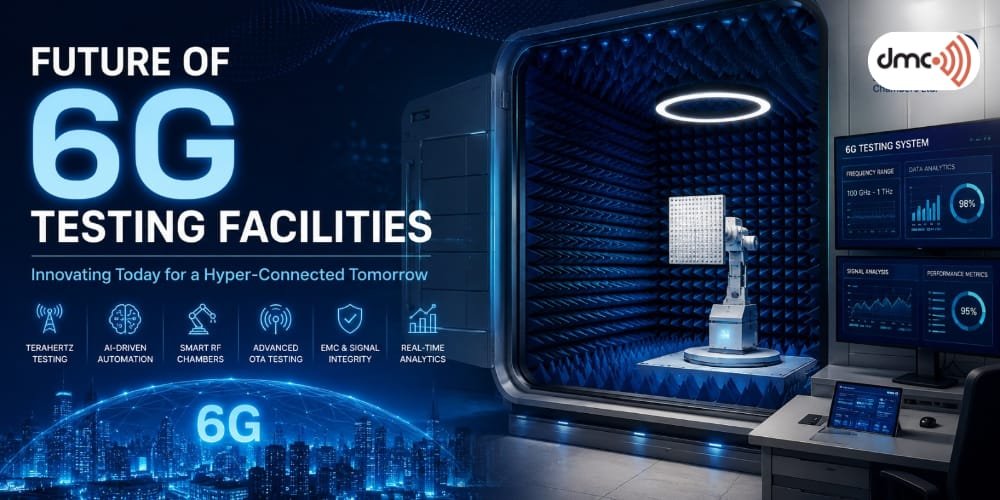
The industry of wireless communication continues to progress towards another technological revolution, 6G communication systems. At a time when 5G technology is being rolled out in countries around the world, researchers, telecom providers, and RF engineers are working on technologies to be used to build future ultra-fast and intelligent 6G networks. The Future of 6G Testing Facilities can be defined in terms of what would be needed from test facilities to ensure effective validation of 6G-enabled devices, such as antennas, satellite, autonomous devices, and other wireless infrastructure. Advanced facilities for 6G testing should provide support for terahertz range, AI-based automation, and advanced EM compatibility testing.
Diamond Microwave Chambers Ltd has joined the development and advancement of RF test facilities to prepare for future next generation wireless communication technologies.
What Are 6G Testing Facilities?
The 6G testing labs are unique spaces used for testing, measuring, and validating emerging wireless communication technologies which use frequencies higher than the 5G frequencies.
The laboratories used for these purposes include:
- 6G anechoic chambers
- Terahertz chambers
- EMC testing equipment
- OTA (Over-The-Air) testing equipment
- AI-enabled RF testing equipment
- Smart antenna measurement equipment
The sixth generation of wireless communication is unique because it depends on frequencies that are greater than 100 GHz, such as the terahertz spectrum range.
Why 6G Requires Advanced Testing Facilities
The future of wireless communication is associated with an incredibly complicated situation where:
1. Validation of Frequency at Terahertz
6G wireless communication requires testing systems capable of working in the terahertz range and processing very short wavelengths.
2. Validation of Ultra-Low Latency Wireless Communication Systems
The future wireless communication systems would be expected to have extremely low latencies to enable:
- Autonomous vehicle communications
- Smart factory systems
- Remote robotic surgery
- Automation systems
3. AI-Driven Wireless Communication Systems
AI technology will be an integral part of wireless communication. Hence, there would be a significant need for AI-enabled RF validation systems.
4. Connections with Millions of Devices at Once
The upcoming generation of wireless communications requires that connectivity with large numbers of devices be made, thus necessitating scalable testing.
Technologies Affecting the Future of Testing Centers for 6G Communications
The next generation of RF chambers will be made possible through many technologies.
AI Based Automation
Artificial intelligence will enable automation of numerous RF testing activities like:
- Signal Analysis
- Fault Detection
- Antenna Location
- Optimal Measurement
- Predictive Maintenance
Future intelligent RF testing laboratories will employ machine learning algorithms that will enable fast and accurate RF testing.
Terahertz Testing Chamber
Another important innovation for the Future of 6G Test Facilities will be the development of Terahertz testing chambers.
The purpose of Terahertz testing chambers will be to:
- Minimize signal reflections
- Enable ultra-high frequencies
- Enhance measurement accuracy
- Perform high frequency OTA testing
At higher frequencies, RF absorbers used traditionally become ineffective; therefore, new absorber solutions will be required for future testing.
Advanced OTA Testing Systems
6G OTA tests would be very important due to the following factors in future wireless systems:
- Beamforming Antennas
- Reconfigurable Intelligent Surfaces
- Massive MIMO
- Dynamic Spectrum Sharing
OTA testing helps in assessing the effectiveness of the system in wireless environments without the need for wires.
Role of Anechoic Chambers in 6G
With respect to modern anechoic chambers used for 6G, these would be smarter, more flexible and automated. An echoless chamber helps in achieving an environment that is free from external EMI.
Important features include:
- Antenna measurements
- Low reflection of signals
- High-frequency testing capability
- EMC testing enhancement
- Testing repeatability improvement
In addition, the installation of robotic facilities inside the chambers is expected to make future testing precise.
Comparison of Traditional RF Test Chambers with Future 6G Testing Centers
| Feature Factor | Current RF Chambers | Future 6G Testing Centers |
|---|---|---|
| Frequency Band | Up to mmWave | mmWave & Terahertz |
| Automation | Human-Based | AI-Based Automation |
| Antenna Test | OTA Testing | Massive MIMO & Beamforming |
| Data Analysis | Manned Data Handling | Advanced AI Data Handling |
| Connectivity Testing | Simple Connectivity | Complex IoT Ecosystem |
| Chamber Structure | Static Chamber | Systematic Smart Chamber |
| EMC Compliance | Traditional EMC Testing | High-frequency EMC Testing |
| Calibration Process | Manned Calibration | Smart Calibration |
Importance of EMC Testing for 6G
As wireless devices become more advanced, EMC tests will play an increasing role in the success of 6G technology. The future of wireless devices will mean that there will be no interference caused to nearby communication systems.
The benefits of advanced EMC test facilities include the following:
- Compliance with global regulations
- Minimizing electromagnetic interference
- Increasing product reliability
- Fulfilling international requirements for certification
These EMC test facilities are vital in sectors including:
- Aerospace industry
- Defense industry
- The automotive industry
- Medical technology
- Smart cities
Digitalization of Smart RF Test Facilities
In the future, the development of smart RF test facilities will include:
- Cloud computing capabilities
- Digital twin technology
- Analysis capabilities
- Accessible remote testing capabilities
- Auto-reporting systems
It won’t be long before engineers will have remote control over the operation of all 6G facilities using AI dashboards.
Challenges in Building 6G Testing Facilities
Despite the fast advancement in technology, there are still some issues to overcome in developing the RF chambers of the future.
Costly Infrastructure
The terahertz systems of the future need special materials.
Attenuation of Signals
With higher frequencies comes greater signal attenuation.
Heat Production
High heat production will be generated by the testing systems, particularly in high power tests of wireless technology.
Calibration Problems
Calibrating ultra-high frequencies poses problems.
Industries That Will Benefit from 6G Testing Facilities
The influence of the new generation of wireless testing will be seen throughout many industries.
Telecommunication Industry
The telecom companies will employ 6G antenna testing solutions to create more effective networks.
Automobiles
Ultra-low-latency wireless validation will be required in connected cars and autonomous vehicle applications.
Aerospace and Military Industry
Radar, satellite communication, and aerospace systems will all require robust 6G RF chambers.
Healthcare
In future remote medical systems, reliable and safe wireless connections will be needed.
Industry 4.0/Smart Manufacturing
Wireless testing solutions will be important for any kind of industrial IoT systems.
Sustainability of the Future RF Chambers
More sustainable engineering practices are now becoming an essential part of creating a new generation of chambers. Possible elements of future environmentally-friendly anechoic chambers for 6G technology could include:
- Energy-saving cooling systems
- Recyclable absorbers
- Power-efficient solutions
- Reusable chamber structures
Pro Tip
While designing 6G testing facilities of the future, it is advisable to focus on modular construction and AI-powered automation to make upgrade processes more convenient and to decrease overall investment.
The Future Outlook of 6G Testing Facilities
The future of the development of wireless communication largely depends on the evolution of 6G testing facilities. With the growing tendency towards terahertz communication, intelligent automation, and an interconnected ecosystem, test equipment must also change and develop in the future.
The convergence of:
- AI-based RF testing
- Terahertz testing chambers
- Omni-directional antenna testing
- Intelligent RF automation
- EMC test equipment
is going to shape the next stage of the development of wireless engineering.
Manufacturers and RF testing companies such as Diamond Microwave Chambers Ltd are helping industries to adapt to the upcoming changes in wireless technologies through the creation of innovative advanced RF chambers.
The road to 6G is far from being completed – it is just the beginning of a journey into an intelligent world with a reliable connection based on high-frequency communication technologies.
Frequently Asked Questions
6G testing facilities are advanced RF environments designed to test and validate next-generation wireless communication technologies operating at mmWave and terahertz frequencies.
Terahertz testing chambers support ultra-high-frequency measurements required for future 6G communication systems and advanced antenna technologies.
6G OTA testing evaluates wireless device performance over the air without physical cable connections, enabling realistic antenna and communication validation.
AI-based RF testing automates calibration, signal analysis, diagnostics, and performance optimization, improving testing accuracy and efficiency.
Industries including telecommunications, aerospace, automotive, healthcare, defense, and smart manufacturing benefit from advanced 6G testing facilities.